
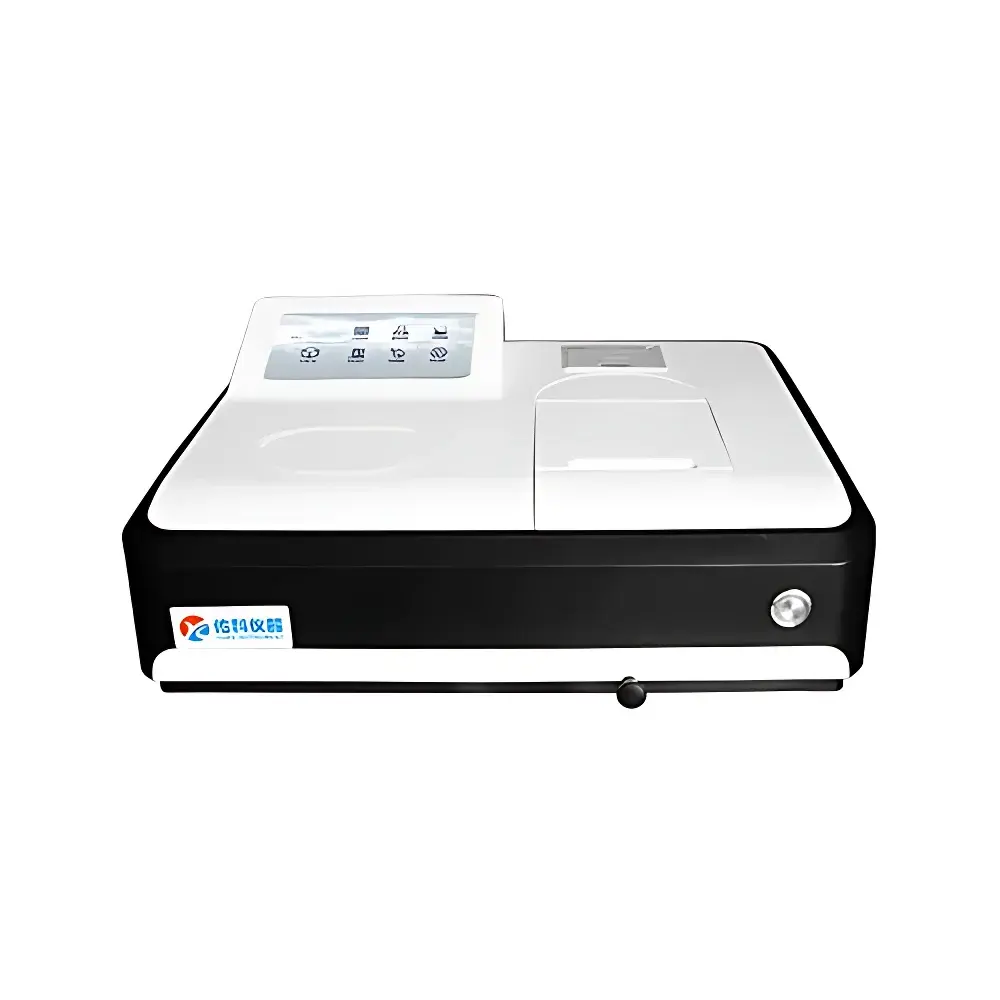
Yoke IT-1001COD-Gr Chemical Oxygen Demand Analyzer
| Brand | Yoke |
|---|---|
| Origin | Shanghai, China |
| Manufacturer Type | Direct Manufacturer |
| Instrument Type | Benchtop Laboratory Analyzer |
| Model | IT-1001COD-Gr |
| Measurement Principle | Rapid Digestion Spectrophotometry (HJ/T 399–2007) |
| Range | 10–10,000 mg/L COD |
| Accuracy | ≤ ±8% |
| Repeatability | ≤ ±5% |
| Digestion Time | 15–20 min |
| Batch Capacity | 20 samples per run |
| Display | 5.6-inch color capacitive touchscreen |
| Data Storage | ≥5,000 records (5 factory curves + 195 user-expandable calibration curves) |
| Light Source | Cold LED with narrow-band interference filters (rated lifetime: 100,000 h) |
| Processor | ARM9 core with 512 MB onboard memory |
| Connectivity | USB 2.0 host/device, RS-232 serial port |
| Printer | Integrated thermal printer |
| Calibration Flexibility | User-definable multi-point calibration curves with adjustable segment-specific K coefficients |
| Compatible Reagents | Lab-yy pre-formulated COD digestion reagents (certified to HJ/T 399–2007) |
Overview
The Yoke IT-1001COD-Gr is a benchtop laboratory chemical oxygen demand (COD) analyzer engineered for precision, regulatory compliance, and operational efficiency in environmental testing laboratories. It implements rapid digestion spectrophotometry—fully aligned with China’s national standard HJ/T 399–2007—for quantitative determination of COD in domestic wastewater, industrial effluents, surface water, and treated discharge streams. Unlike open-reflux or titrimetric methods, this instrument integrates controlled thermal digestion (150 °C, 15–20 min) followed by photometric measurement at optimized wavelengths (typically 610 nm for dichromate reduction), enabling high reproducibility without manual titration or volumetric glassware dependency. Its optical architecture employs cold LED illumination coupled with narrow-band interference filters, minimizing spectral drift and thermal noise—critical for long-term stability in routine QC workflows.
Key Features
- 5.6-inch capacitive color touchscreen with intuitive GUI navigation—designed for glove-compatible operation and minimal training overhead.
- Dual-function capability: Simultaneous support for COD, ammonia nitrogen, total phosphorus, total nitrogen, turbidity, color, suspended solids, and selected heavy metal ions (e.g., Cu²⁺, Zn²⁺, Pb²⁺) using standardized reagent kits.
- Robust data management: Onboard storage for ≥5,000 test records; 5 preloaded factory calibration curves and 195 expandable user-defined curves with segment-wise K-coefficient adjustment for non-linear ranges.
- Integrated thermal printer for immediate hardcopy output of real-time measurements, stored datasets, and calibration reports—eliminating external peripherals.
- ARM9-based embedded system with 512 MB flash memory ensures responsive operation during multi-parameter batch analysis and firmware updates.
- USB 2.0 host/device interface enables direct export of CSV-formatted data to USB drives; RS-232 port supports legacy LIMS integration or remote control via terminal emulation.
- Cold LED light source rated for 100,000 hours—no warm-up delay, zero mercury content, and immunity to ambient temperature fluctuations affecting absorbance baseline.
Sample Compatibility & Compliance
The IT-1001COD-Gr accepts standard 16-mm round glass or quartz digestion vials (compatible with Lab-yy pre-filled COD reagent tubes). It accommodates sample matrices including municipal sewage, electroplating rinse water, food processing effluent, and river water—with turbidity up to 500 NTU and chloride concentrations ≤2,000 mg/L (when using chloride compensation protocols per HJ/T 399–2007). All measurement protocols adhere strictly to HJ/T 399–2007, ensuring traceability to China’s Ministry of Ecology and Environment (MEE) certification requirements. While not CE-marked or FDA 510(k)-cleared, its hardware architecture and data handling logic support GLP-aligned documentation practices—including timestamped audit logs, operator ID tagging (via optional password protection), and uneditable raw absorbance values retained alongside final COD calculations.
Software & Data Management
Firmware includes embedded calibration management tools supporting multi-point linear and polynomial curve fitting, with automatic R² validation and outlier flagging. All calibration events—including date/time stamp, operator ID (if enabled), curve name, and K-factor—are logged internally. Data exports via USB preserve metadata: sample ID, digestion time/temperature, measured absorbance, calculated COD value, and uncertainty flags (e.g., “out-of-range”, “low signal-to-noise”). No proprietary software installation is required for basic operation; however, optional PC-based YokeLab Suite (Windows/macOS) enables advanced reporting (PDF/Excel), trend charting across batches, and electronic signature capture compliant with internal QA documentation standards.
Applications
This analyzer serves as a primary COD quantification tool in municipal wastewater treatment plants (WWTPs) for influent/effluent monitoring, in environmental monitoring stations conducting routine surface water surveys, and in industrial QA labs verifying pretreatment efficacy prior to discharge. Its 20-sample batch capacity and <20-minute turnaround make it suitable for daily compliance checks under China’s Discharge Permit System. Researchers also utilize its expandable curve library for method development involving alternative oxidants (e.g., Mn-based systems) or matrix-specific corrections (e.g., humic acid interference modeling). The modular optical design permits future firmware upgrades for additional parameters without hardware modification.
FAQ
Does the IT-1001COD-Gr comply with international standards such as ISO 6060 or ASTM D1252?
It is validated exclusively against HJ/T 399–2007. While its rapid digestion methodology shares conceptual alignment with ISO 6060:1989 (Clause 4.2), formal cross-standard equivalence has not been certified.
Can the instrument be used for chloride-rich samples like seawater or landfill leachate?
Yes—with appropriate chloride masking (e.g., HgSO₄ addition per HJ/T 399–2007 Annex B) and use of high-range reagents; accuracy degrades above 2,000 mg/L Cl⁻ without correction.
Is audit trail functionality available for GLP/GMP environments?
Basic timestamped logs are embedded; full 21 CFR Part 11-compliant electronic signatures and role-based access control require integration with third-party LIMS—not natively supported.
What maintenance is required beyond routine cleaning and reagent replacement?
Annual verification of photometric linearity (using NIST-traceable neutral density filters) and digestion block temperature uniformity (±1 °C across all 20 positions) is recommended.
Are consumables other than Lab-yy reagents compatible?
Third-party reagents may be used if they conform to HJ/T 399–2007 composition and packaging specifications—but calibration curve validation is mandatory before deployment.
Related Products







