
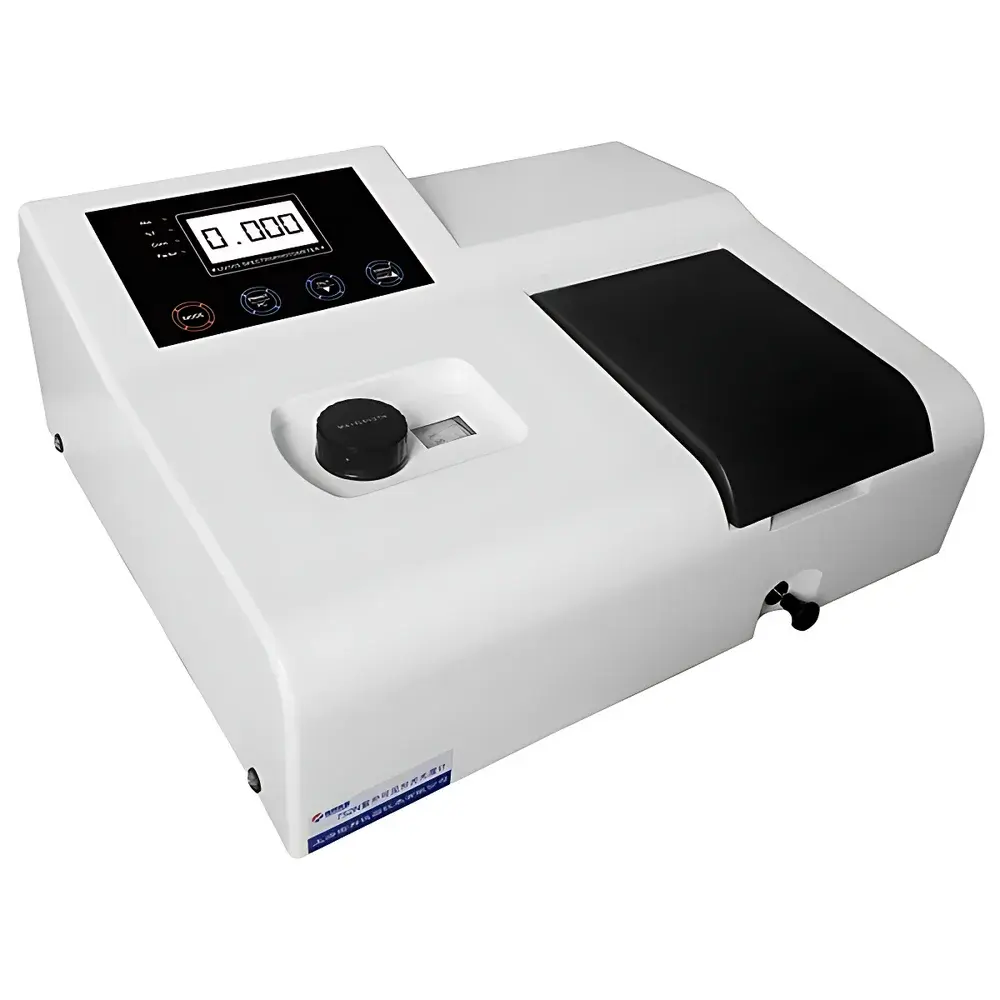
Yoke UV-Vis Spectrophotometer Model 722
| Brand | Yoke |
|---|---|
| Origin | Shanghai, China |
| Manufacturer Type | Direct Manufacturer |
| Instrument Architecture | Single-Beam |
| Detector | Photodiode Array |
| Wavelength Range | 320–1020 nm |
| Wavelength Selection | Manual |
| Spectral Bandwidth | 5 nm |
| Wavelength Accuracy | ±2 nm |
| Wavelength Repeatability | ≤1 nm |
| Photometric Accuracy (Transmittance) | ±0.5% T |
| Photometric Linearity | 0–200% T, –0.3 to 3 A, 0–9999 C |
| Stray Light | ≤0.3% T @ 360 nm |
| Baseline Stability | ±0.004 A/h @ 500 nm |
| Noise Level | ≤0.2% T |
| Light Source | Imported Tungsten Halogen Lamp |
| Sample Compartment | Accommodates up to 10 cm pathlength cuvettes |
| Interface Options | RS232 (optional) |
| Dimensions & Weight | Approx. 8 kg |
| Compliance | Designed for routine laboratory compliance with ISO/IEC 17025 supporting practices and GLP documentation workflows |
Overview
The Yoke UV-Vis Spectrophotometer Model 722 is a precision-engineered single-beam optical instrument designed for quantitative and qualitative analysis in the visible and near-UV spectral region. Based on a Czerny-Turner monochromator configuration with a 1200 lines/mm holographic grating, the system delivers consistent spectral resolution and photometric reliability across its operational range of 320–1020 nm. Its optical architecture incorporates an imported tungsten halogen lamp as the stable broadband source, optimized for intensity uniformity and long-term radiometric stability. The instrument operates on fundamental Beer-Lambert law principles, enabling absorbance (A), transmittance (T), and concentration (C) measurements with traceable calibration pathways. Intended for use in academic teaching labs, QC/QA environments, and industrial process support settings, the Model 722 provides a robust foundation for method development and routine analysis without requiring complex alignment or environmental controls.
Key Features
- Single-beam optical design with manual wavelength selection—optimized for simplicity, mechanical stability, and cost-effective operation in high-throughput educational and entry-level analytical labs.
- High-fidelity photodiode array detector ensures rapid signal acquisition and low-noise performance (≤0.2% T), supporting reproducible quantitation under ambient lighting conditions.
- Integrated automatic zeroing and 100% T calibration routines eliminate manual baseline drift compensation, reducing operator dependency and improving inter-user consistency.
- Spacious sample compartment engineered to accept standard 10 mm, 20 mm, 50 mm, and 100 mm pathlength cuvettes—facilitating flexibility in dilution strategy and low-concentration assay design.
- Microprocessor-based control system enables intuitive navigation between measurement modes (T/A/C), real-time data display, and internal memory retention of calibration parameters.
- Optional RS232 serial interface supports external data logging via compatible printers or legacy PC systems running terminal emulation software—enabling audit-ready hardcopy output and basic LIMS integration.
Sample Compatibility & Compliance
The Model 722 accommodates standard quartz, glass, and plastic cuvettes with pathlengths from 10 mm to 100 mm, making it suitable for aqueous, organic, and mildly corrosive solutions. It complies with core metrological requirements outlined in ISO 6059 (water quality analysis), ASTM E275 (spectrophotometer performance verification), and USP (UV-Vis spectrophotometric system suitability). While not inherently 21 CFR Part 11 compliant, its optional RS232 interface allows connection to validated third-party data acquisition platforms that support electronic signature and audit trail functionality—enabling deployment within GLP and GMP-aligned workflows when paired with appropriate SOPs and validation protocols.
Software & Data Management
The instrument operates autonomously without proprietary software; however, its RS232 port enables communication with industry-standard terminal programs (e.g., Tera Term, PuTTY) or custom LabVIEW/Python scripts for automated data capture. Output formatting follows ASCII-based fixed-field conventions, facilitating direct import into Excel, MATLAB, or statistical analysis packages. All internal calibration constants—including dark current offset, reference gain, and wavelength correction coefficients—are stored in non-volatile memory and persist through power cycles. Firmware updates are performed via hardware-level reprogramming only, ensuring system integrity and minimizing cybersecurity exposure vectors common in networked instruments.
Applications
- Routine concentration determination of dyes, pigments, transition metal complexes, and biological chromophores (e.g., hemoglobin, chlorophyll extracts).
- Water and wastewater analysis per APHA Standard Methods (e.g., nitrate, phosphate, silica) using established colorimetric protocols.
- Pharmaceutical excipient purity screening and dissolution testing support in non-GxP research settings.
- Food and beverage quality control—including color index assessment (e.g., AOAC methods for fruit juice clarity) and preservative quantification.
- Academic instruction in analytical chemistry, emphasizing fundamentals of spectroscopic theory, calibration curve construction, and error propagation analysis.
FAQ
What is the recommended calibration frequency for the Model 722?
For routine use, wavelength calibration should be verified annually using NIST-traceable holmium oxide or didymium filters; photometric accuracy should be checked daily with neutral density filters or certified reference standards.
Can the instrument measure absorbance below 320 nm?
No—the optical path and tungsten lamp emission profile limit reliable operation to ≥320 nm. For UV-range work (190–320 nm), a deuterium lamp-equipped double-beam system is required.
Is the RS232 interface included by default?
No—it is an optional accessory. Units shipped without the interface lack the physical DB9 connector and associated firmware drivers.
Does the Model 722 support kinetic or scanning modes?
No—it is a fixed-wavelength or manually stepped instrument. Continuous spectral scanning requires a motorized monochromator and synchronized detector readout, which are not implemented in this architecture.
What maintenance is required to sustain long-term photometric accuracy?
Regular cleaning of the cuvette holder and optical windows with lens-grade tissue and isopropanol; periodic inspection of the tungsten lamp for filament integrity; and annual verification of stray light performance using a 360 nm cutoff filter.



