
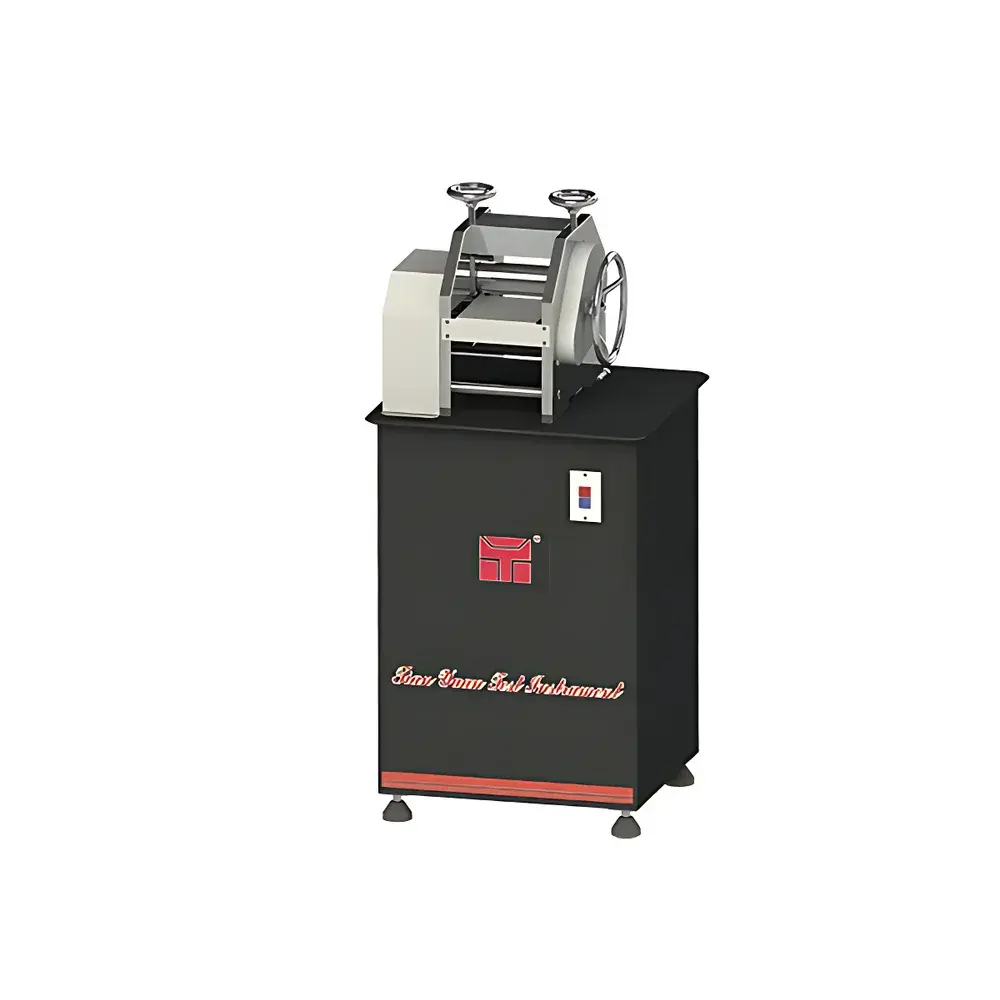
TY-4288 Rubber & Plastic Sample Slicing Machine
| Brand | TianYuan |
|---|---|
| Origin | Jiangsu, China |
| Manufacturer Type | Direct Manufacturer |
| Country of Origin | China |
| Model | TY-4288 |
| Pricing | Upon Request |
| Worktable Width | 100 mm |
| Maximum Slice Thickness | 12 mm |
| Blade Dimensions (L×W×H) | 80 × 25 × 1 mm |
| Maximum Feed Thickness | 12 mm |
| Overall Dimensions (L×W×H) | 700 × 300 × 400 mm |
| Motor Power | 0.55 kW |
| Net Weight | 86 kg |
Overview
The TY-4288 Rubber & Plastic Sample Slicing Machine is a precision mechanical sample preparation instrument engineered for consistent, reproducible thickness-controlled slicing of elastomeric and thermoplastic materials in quality control and R&D laboratories. It operates on a robust gear-driven dual-roll feeding principle combined with a fixed-angle, single-edge cutting blade—functioning as a calibrated planer-type slicer rather than a rotary or oscillating cutter. This architecture ensures minimal material deformation during feed and high dimensional repeatability across sequential slices, critical for tensile testing, hardness calibration, aging studies, and cross-sectional morphology analysis per ASTM D3767, ISO 2782, and GB/T 528 standards. Designed specifically for rubber compounding labs, polymer formulation centers, and cable insulation development facilities, the TY-4288 delivers deterministic slice thickness control within the 0.1–12 mm range without requiring thermal stabilization or vacuum clamping—making it suitable for both ambient-cured elastomers and semi-crystalline thermoplastics.
Key Features
- Gear-synchronized dual-feed roller system ensures uniform material traction and eliminates slippage during slicing of low-friction surfaces (e.g., silicone rubber, TPEs, and EPDM compounds)
- Manually adjustable micrometer-style handwheel with calibrated 1.5 mm/revolution increment for precise slice thickness setting; fine-tuning supported by dual-axis lateral thickness compensation (top-right and base-level adjustment screws)
- Stainless steel blade (80 × 25 × 1 mm) mounted on rigid C-frame housing to minimize deflection under load; blade replacement requires no recalibration
- IP54-rated motor enclosure with integrated ON/OFF push-button station and overload-protected 0.55 kW induction motor for continuous-duty operation
- Compact footprint (700 × 300 × 400 mm) optimized for benchtop integration in ISO/IEC 17025-accredited lab environments; 86 kg mass provides inherent vibration damping
- No hydraulic or pneumatic subsystems—fully mechanical actuation enhances long-term reliability and reduces maintenance dependency
Sample Compatibility & Compliance
The TY-4288 accommodates a broad spectrum of viscoelastic and ductile sheet materials, including raw and vulcanized natural rubber (NR), styrene-butadiene rubber (SBR), nitrile rubber (NBR), polyvinyl chloride (PVC), polyethylene (PE), polypropylene (PP), thermoplastic elastomers (TPEs), and leather substrates up to 12 mm nominal thickness. It is not intended for fibrous composites, filled ceramics, or highly abrasive compounds containing >30% silica or carbon black loading without prior blade wear assessment. The machine conforms to general electrical safety requirements per IEC 61000-6-2 (EMC immunity) and IEC 60204-1 (machine safety). While not certified to UL or CE for standalone sale in North America/EU, its mechanical design aligns with the functional safety expectations outlined in ISO 12100 for laboratory-scale sample preparation equipment used under supervised conditions.
Software & Data Management
The TY-4288 is a manually operated, non-digital instrument with no embedded firmware, touchscreen interface, or data logging capability. All operational parameters—including slice thickness settings, feed rate (determined by gear ratio and motor RPM), and blade engagement depth—are set and verified mechanically. For GLP/GMP traceability, users are advised to document thickness adjustments via lab notebook entries or LIMS-integrated SOP workflows referencing the handwheel position index and visual blade alignment checks. Calibration verification should be performed quarterly using certified gauge blocks (e.g., NIST-traceable 0.1–12 mm step gauges) and recorded in accordance with ISO/IEC 17025 Clause 7.7.
Applications
- Preparation of standardized test specimens for tensile strength (ASTM D412), elongation at break, and modulus evaluation
- Cutting uniform cross-sections for Shore A/D hardness calibration blocks and durometer verification plates
- Generating thin sections of cured rubber compounds for FTIR transmission analysis and SEM sample mounting
- Producing layered samples for peel adhesion testing (ASTM D903) and interfacial bond characterization
- Preparing cable jacket and insulation strips for dielectric strength and thermal aging protocols (IEC 60811 series)
- Creating reference slices for colorimetric consistency checks in pigment-dispersed elastomer batches
FAQ
What materials are incompatible with the TY-4288 slicing mechanism?
Highly abrasive composites (e.g., metal-filled silicones or ceramic-loaded rubbers), unfilled thermosets with rapid crosslink density gradients, and foamed elastomers exhibiting >40% compression set are not recommended due to inconsistent feed behavior and accelerated blade wear.
Is blade sharpening possible in-house, or must it be replaced?
The 1 mm-thick hardened steel blade is designed for field replacement only; resharpening is not advised as it alters the critical cutting edge geometry and compromises thickness repeatability.
Can the machine be integrated into an automated sample prep line?
No—the TY-4288 lacks electrical signaling outputs (e.g., limit switches, encoder feedback, or PLC-compatible I/O), making it unsuitable for direct integration into automated workflows without third-party retrofitting.
Does the 12 mm maximum feed thickness apply to pre-vulcanized rubber sheets?
Yes, but for sheets exceeding 8 mm thickness, a two-pass strategy (rough cut followed by finish cut) is recommended to maintain edge squareness and minimize curling.
What routine maintenance is required to ensure long-term dimensional accuracy?
Monthly inspection of gear train lubrication, biannual torque verification of feed roller mounting bolts, and quarterly verification of blade parallelism relative to the worktable surface using a dial indicator (±0.02 mm tolerance).






