
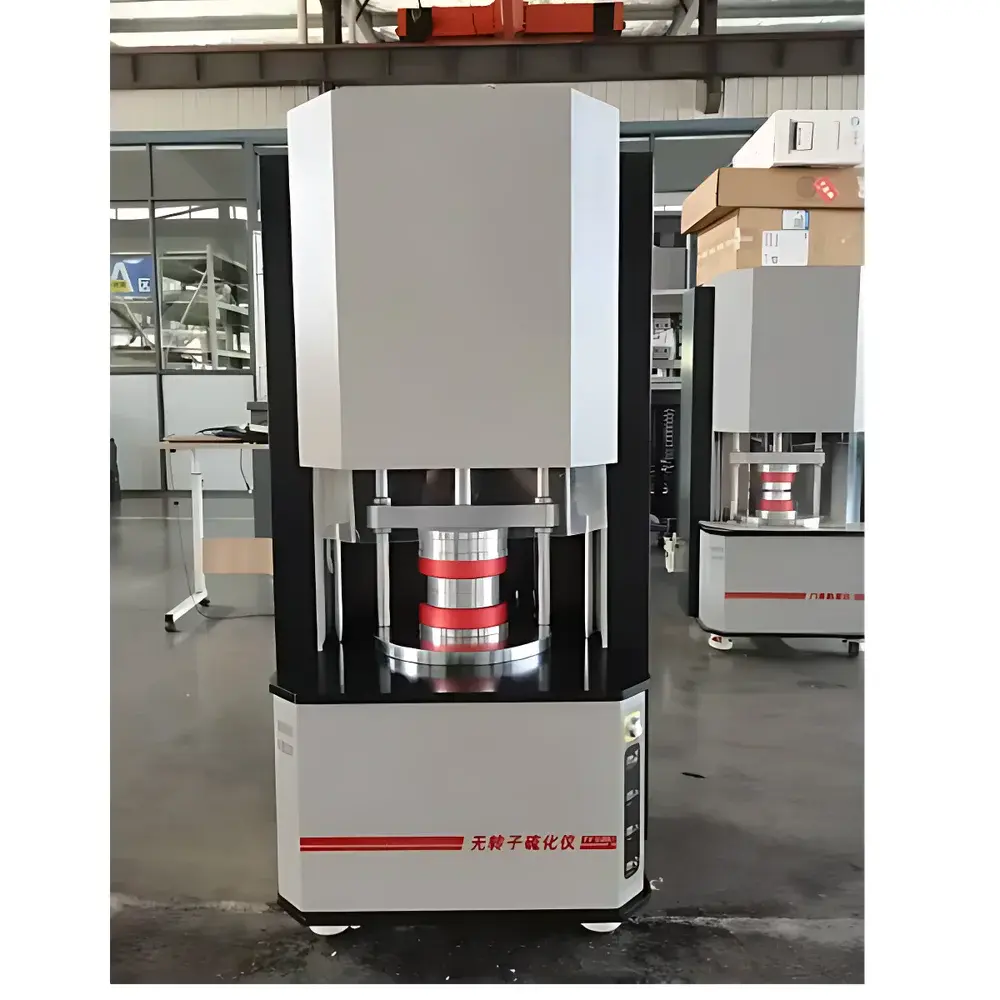
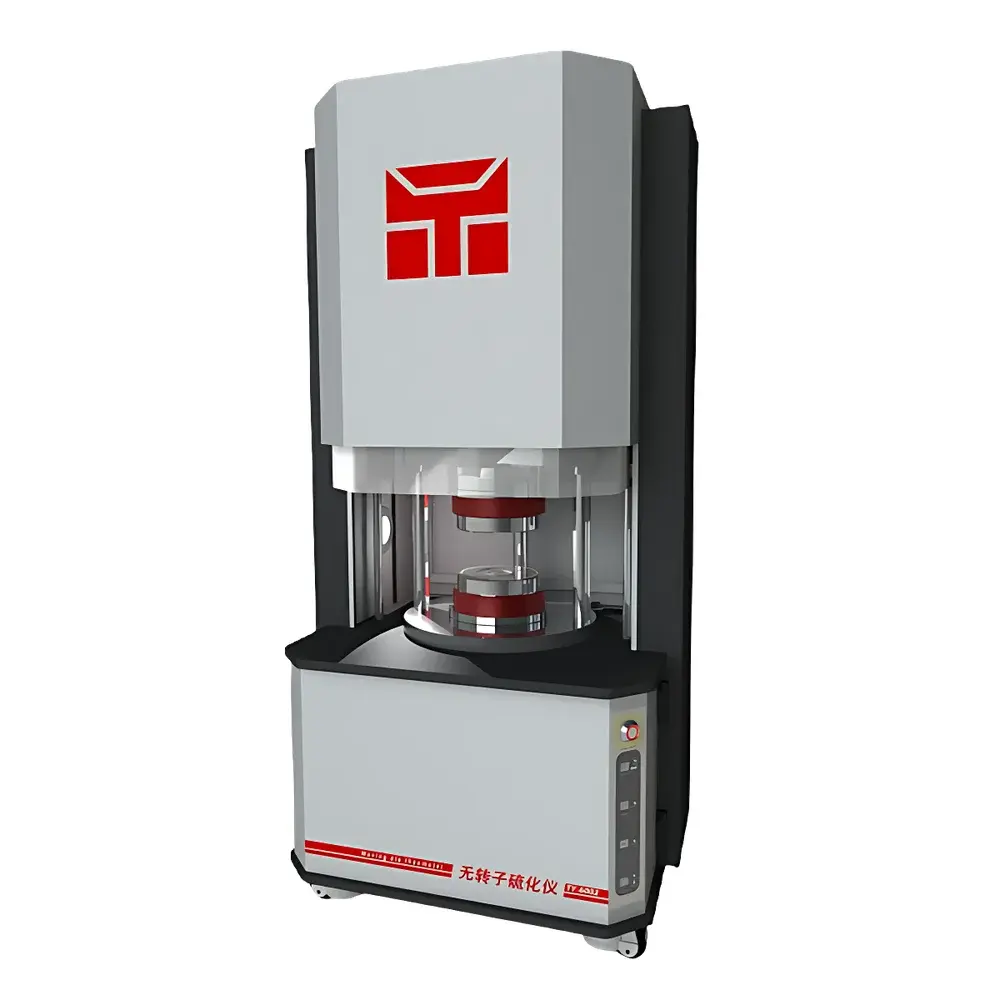
TianYuan TY-6002 Rotorless Vulcanizer
| Brand | TianYuan |
|---|---|
| Origin | Jiangsu, China |
| Manufacturer Type | Direct Manufacturer |
| Region of Origin | Domestic (China) |
| Model | TY-6002 |
| Price Range | USD 4,200 – 7,000 (FOB) |
| Temperature Range | Ambient to 200 °C |
| Temperature Accuracy | ≤ ±0.3 °C |
| Temperature Resolution | 0.01 °C |
| Torque Range | 0–20 N·m |
| Torque Resolution | 0.001 N·m |
| Oscillation Frequency | 1.7 Hz |
| Oscillation Amplitude | ±0.5° / ±1° (±3° available on request) |
| Heating Rate | Ambient to 150 °C in <20 min |
| Operating Environment | 0–35 °C, RH <80% |
| Curing Time Setting Range | 1–300 min |
| Air Supply Pressure | 0.4 MPa |
| Power Supply | AC 220 V ±10%, 50/60 Hz |
| Power Consumption | 800 W |
| Dimensions (W×D×H) | 660 × 580 × 1300 mm |
| Net Weight | 260 kg |
Overview
The TianYuan TY-6002 Rotorless Vulcanizer is a precision instrument engineered for real-time monitoring of rubber compound vulcanization kinetics under controlled thermal and dynamic shear conditions. Based on the principle of oscillating die rheometry—where a sealed, heated cavity subjects uncured rubber to sinusoidal torsional deformation at fixed frequency and amplitude—the instrument measures torque response as a function of time. Since torque is directly proportional to the shear modulus of the sample, and shear modulus correlates linearly with crosslink density during vulcanization, the resulting cure curve provides quantitative insight into scorch time (ts₁, ts₂), optimum cure time (t₉₀), cure rate index (CRI), and reversion behavior. Designed for compliance with international standards including ISO 6502, ASTM D5289, and GB/T 16584, the TY-6002 delivers reproducible, traceable data essential for rubber formulation development, quality control, and process validation in tire, automotive elastomer, and industrial rubber manufacturing.
Key Features
- High-resolution torque transduction system (0–20 N·m range, 0.001 N·m resolution) using calibrated strain-gauge sensor architecture for minimal hysteresis and long-term stability.
- Integrated servo-driven oscillation system powered by Panasonic AC servo motor with digital position feedback and amplitude fine-tuning capability (standard ±0.5° or ±1°; ±3° configurable upon request).
- Multi-zone PID temperature control with intelligent auto-tuning algorithm, enabled by high-stability Pt100 RTD sensors and multi-channel thermal expansion modules—ensuring ≤ ±0.3 °C accuracy across the full 20–200 °C operational range.
- Robust cavity assembly fabricated from Cr6WV tool steel—optimized for hardness (>60 HRC), thermal conductivity, and resistance to abrasive wear from carbon-black–filled compounds.
- Fail-safe mechanical interlock system: 5-mm acrylic safety shield synchronized with mold motion; automatic power cutoff upon shield disengagement; mandatory physical button press required for mold closure—fully compliant with IEC 61508 functional safety principles.
- LED illumination module activated only during mold opening—reducing ambient heat load and enhancing operator visibility during sample loading/unloading without affecting thermal equilibrium.
- USB 2.0 interface for deterministic, low-latency data acquisition; no network dependency ensures compatibility in regulated lab environments where Ethernet isolation is mandated.
Sample Compatibility & Compliance
The TY-6002 accommodates standard 40-mm-diameter, 5.5-mm-thick disc specimens prepared per ISO 6502 and ASTM D5289. It supports natural rubber (NR), styrene-butadiene rubber (SBR), ethylene propylene diene monomer (EPDM), nitrile rubber (NBR), silicone (VMQ), and halogenated elastomers—including high-filler systems (e.g., >60 phr carbon black or silica). All hardware and firmware conform to CE marking requirements (EMC Directive 2014/30/EU, Low Voltage Directive 2014/35/EU). Data integrity meets GLP and GMP expectations through timestamped audit trails, user-access logging, and non-modifiable raw data storage—aligned with FDA 21 CFR Part 11 electronic record guidelines when used with validated software configuration.
Software & Data Management
TY CureMeter v4.x software operates on Windows 10/11 (64-bit) and provides ISO-compliant curve analysis: automatic detection of scorch point (ts₂), t₉₀, minimum/maximum torque (ML/MH), and delta torque (MH−ML). Comparative overlay of up to eight historical curves is supported with deviation quantification (RMS error, time-shift alignment). Raw data exports to CSV, TXT, and XML formats; graphical reports include customizable legends, grid annotations, and dual-Y axis options (torque + rate-of-cure). Software supports multilingual UI (English, Simplified/Traditional Chinese, Russian) and includes built-in calibration verification routines traceable to NIST-traceable torque standards.
Applications
- Rubber compound screening: rapid assessment of accelerator package efficiency, sulfur vs. peroxide cure systems, and filler–polymer interaction effects.
- Production lot release testing: verification of batch-to-batch consistency against master curve baselines using statistical process control (SPC) charts.
- Vulcanization modeling: generation of kinetic parameters (e.g., Arrhenius activation energy) via isothermal runs at multiple temperatures (60–180 °C).
- Reversion analysis: quantification of post-optimum torque decline in EPDM and CR compounds under extended dwell times.
- Quality assurance in Tier-1 automotive suppliers: integration into APQP Stage 3 validation protocols for new rubber parts.
FAQ
What standards does the TY-6002 comply with?
It fully satisfies ISO 6502:2017, ASTM D5289-19, and GB/T 16584-1996 for rotorless vulcanometer testing.
Is the software validated for regulated environments?
Yes—when deployed with documented IQ/OQ protocols and configured with password-protected user roles, it supports 21 CFR Part 11 compliance for electronic signatures and audit trails.
Can the instrument operate continuously at 200 °C?
Yes—the thermal insulation, cavity material grade, and cooling fan design permit sustained operation at maximum setpoint with drift < ±0.2 °C over 120 minutes.
What maintenance is required for long-term accuracy?
Annual torque sensor recalibration using certified dead-weight standards and biannual cavity surface inspection for micro-pitting are recommended.
Does the system support automated sample handling?
Not natively—but third-party robotic gripper interfaces can be integrated via TTL-level I/O ports provided on the rear panel.





