
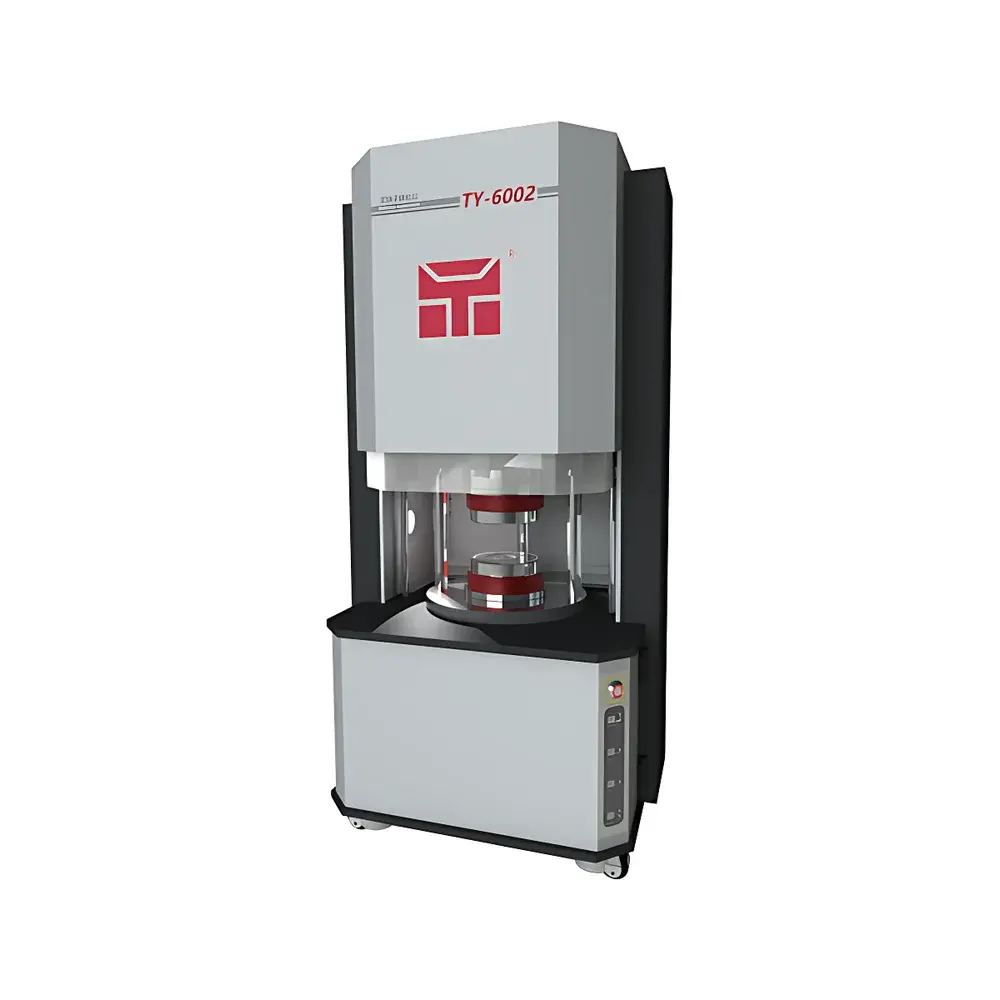
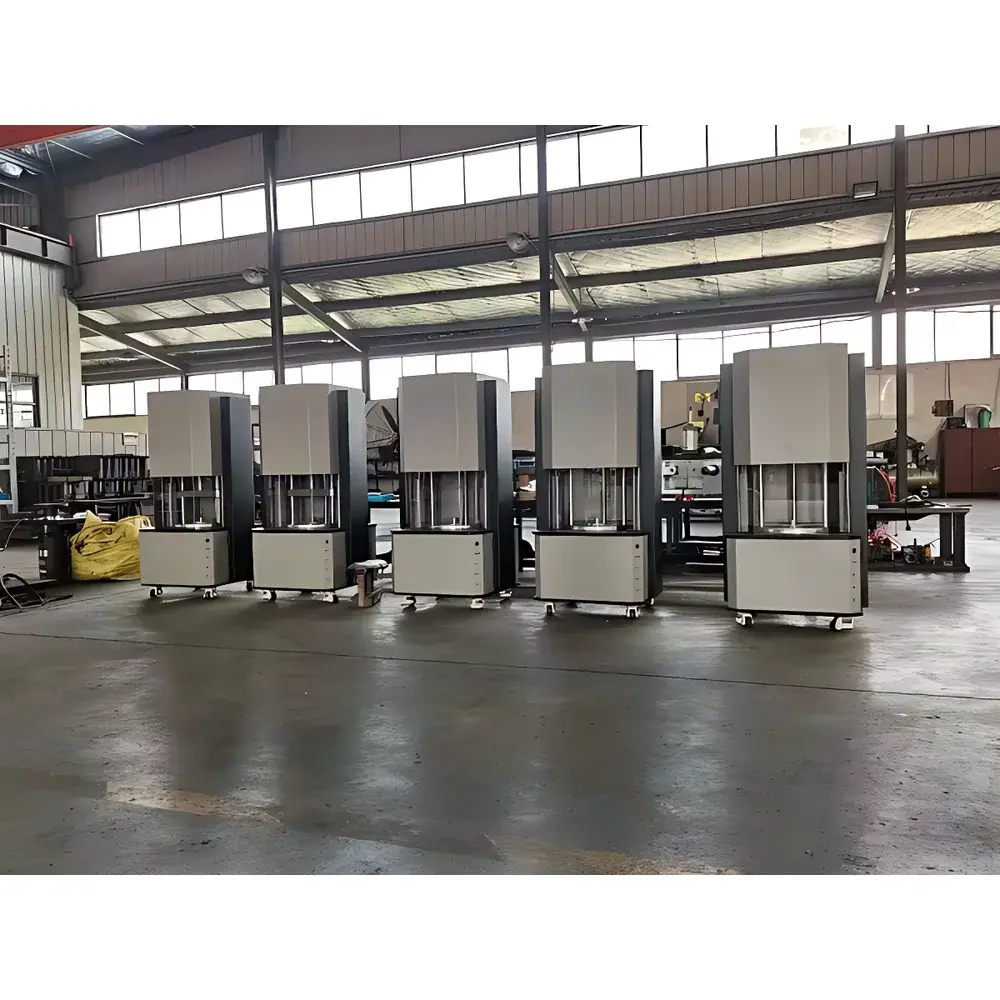
TianYuan TY-6002 Rotorless Vulcanizer
| Brand | TianYuan |
|---|---|
| Origin | Jiangsu, China |
| Manufacturer Type | Direct Manufacturer |
| Country of Origin | China |
| Model | TY-6002 |
| Torque Range | 0–20 N·m |
| Torque Resolution | 0.001 N·m |
| Temperature Range | RT to 200 °C |
| Temperature Control Accuracy | ≤ ±0.3 °C |
| Temperature Resolution | 0.01 °C |
| Heating Rate | RT to 150 °C in <20 min |
| Oscillation Frequency | 1.7 Hz |
| Oscillation Amplitude | ±0.5° or ±1° (±3° available on request) |
| Cavity Material | Cr6WV tool steel |
| Power Supply | AC 220 V ±10%, 50/60 Hz |
| Rated Power | 800 W |
| Dimensions (W×D×H) | 660 × 580 × 1300 mm |
| Net Weight | 260 kg |
| Ambient Operating Conditions | 0–35 °C, RH <80% |
| Compressed Air Requirement | 0.4 MPa |
| Data Interface | USB |
Overview
The TianYuan TY-6002 Rotorless Vulcanizer is a precision instrument engineered for real-time monitoring of rubber compound vulcanization kinetics under controlled thermal and mechanical conditions. Based on the principle of oscillating disk rheometry (ODR), it applies a small sinusoidal torsional strain to uncured rubber within a sealed, temperature-regulated cavity and measures the resulting torque response—directly proportional to the material’s shear modulus and, by extension, its crosslink density evolution. Unlike rotor-type vulcanizers, the rotorless design eliminates mechanical wear at the sample interface and ensures highly reproducible measurements across repeated tests. This makes the TY-6002 especially suitable for quality control laboratories, R&D departments, and rubber formulation centers requiring compliance with international vulcanization testing standards—including ASTM D5289, ISO 6502, and GB/T 16584.
Key Features
- High-resolution torque sensing system (0–20 N·m range, 0.001 N·m resolution) calibrated traceably to national metrological standards.
- Integrated servo-driven oscillation mechanism using Panasonic industrial-grade servo motor and amplitude-adjustable actuator, ensuring stable 1.7 Hz frequency and precise angular displacement (±0.5° or ±1° standard; ±3° configurable).
- Multi-point PID temperature control architecture with intelligent auto-tuning via multi-channel thermal expansion modules; achieves ≤ ±0.3 °C uniformity across the cavity surface over the full 25–200 °C operating range.
- Cavity fabricated from Cr6WV high-carbon, high-chromium tool steel—optimized for hardness (>60 HRC), thermal stability, and resistance to abrasion and chemical degradation during prolonged exposure to sulfur-based compounds.
- Full-safety interlock system: 5-mm acrylic transparent guard automatically synchronizes with mold position; power cutoff on emergency stop or loss of supply; physical enable button required for mold closure to prevent accidental activation.
- LED illumination integrated into the mold assembly—activated only during open-cavity operation to enhance visual inspection without thermal interference.
- USB-based digital data acquisition with zero-latency transmission to TY CureMeter software, supporting synchronized time-stamped logging of torque, temperature, and elapsed time at user-defined intervals (down to 100 ms).
Sample Compatibility & Compliance
The TY-6002 accommodates standard 38 mm diameter × 11.5 mm thick rubber specimens (per ASTM D5289 and ISO 6502). It supports natural rubber (NR), styrene-butadiene rubber (SBR), ethylene propylene diene monomer (EPDM), nitrile rubber (NBR), silicone (VMQ), and halogenated elastomers—including filled and oil-extended formulations. All test protocols align with GLP documentation requirements: audit trails, electronic signatures, and data integrity safeguards are embedded in firmware and software. The system supports 21 CFR Part 11-compliant operation when configured with user authentication, role-based access control, and immutable raw-data archiving.
Software & Data Management
TY CureMeter v4.x is a Windows-based application offering full lifecycle test management—from method definition and parameter presetting to real-time curve visualization, comparative overlay analysis, and automated report generation (PDF/CSV/XLSX). Key capabilities include: customizable test duration (1–300 min), dynamic baseline correction, multiple curve superposition with delta-T or delta-M comparisons, automatic identification of scorch time (ts1/ts2), optimum cure time (t90), minimum/maximum torque (ML/MH), and reversion index calculation. All raw datasets are stored in encrypted binary format with SHA-256 checksum validation. Software supports multilingual UI (English, Simplified/Traditional Chinese, Russian) and integrates seamlessly with LIMS via ODBC drivers.
Applications
The TY-6002 delivers quantitative vulcanization profiles essential for compound development, batch release testing, and process validation. Typical use cases include: optimization of accelerator systems and sulfur dosage; evaluation of filler dispersion efficiency (e.g., carbon black, silica); assessment of scorch safety in extrusion and calendering processes; aging studies under accelerated thermal conditions; correlation of rheometric data with final product performance (e.g., tensile strength, compression set); and troubleshooting of curing inconsistencies in tire treads, conveyor belts, seals, and automotive hoses. Its robust architecture ensures consistent performance in high-throughput QC environments operating >12 hrs/day.
FAQ
What standards does the TY-6002 comply with?
It meets ASTM D5289, ISO 6502, and GB/T 16584 for rotorless vulcanization testing, including torque calibration, temperature uniformity, and timing accuracy requirements.
Is the instrument suitable for regulatory submissions?
Yes—when deployed with validated TY CureMeter software, audit trail enabled, and proper user access controls, it satisfies FDA 21 CFR Part 11 and EU Annex 11 data integrity expectations.
Can I export raw torque vs. time data for third-party analysis?
Yes—CSV exports contain timestamped torque, temperature, and status flags (e.g., heating phase, steady-state, cooling), fully traceable to instrument serial number and operator ID.
What maintenance is required for long-term accuracy?
Annual torque sensor recalibration and cavity surface inspection are recommended; Cr6WV cavity requires no routine polishing but should be cleaned post-test with approved solvent wipes to prevent residue buildup.
Does the system support networked deployment in a lab environment?
While native Ethernet is not included, USB-connected units can be shared via Windows Remote Desktop or terminal server solutions; future firmware updates will add optional TCP/IP communication module support.





