
TianYuan TY-7009 Laboratory-Scale Co-Rotating Twin-Screw Extruder
| Brand | TianYuan |
|---|---|
| Origin | Jiangsu, China |
| Manufacturer Type | Direct Manufacturer |
| Country of Origin | China |
| Model | TY-7009 |
| Screw Diameter | 21.7 mm |
| L/D Ratio | 40:1 |
| Main Drive Motor | 4 kW (Siemens Beide AC Motor) |
| Max Screw Speed | 600 rpm |
| Heating Power | ~3 kW |
| Total Installed Power | ~10 kW |
| Throughput Capacity | 2–5 kg/h (material-dependent) |
| Feeding Capacity | 2–5 kg (batch) |
| Gearbox Reduction Ratio | 2.5:1 |
| Vacuum Pump | SK-0.15 water-ring type (0.75 kW) |
| Cooling System | Separated soft-water circulation (30 L tank, copper-coated tubing, 0.55 kW pump) |
| Control System | Siemens PLC-based with RKC dual-channel temperature controllers, solid-state relay heating control, and interlocked safety logic |
Overview
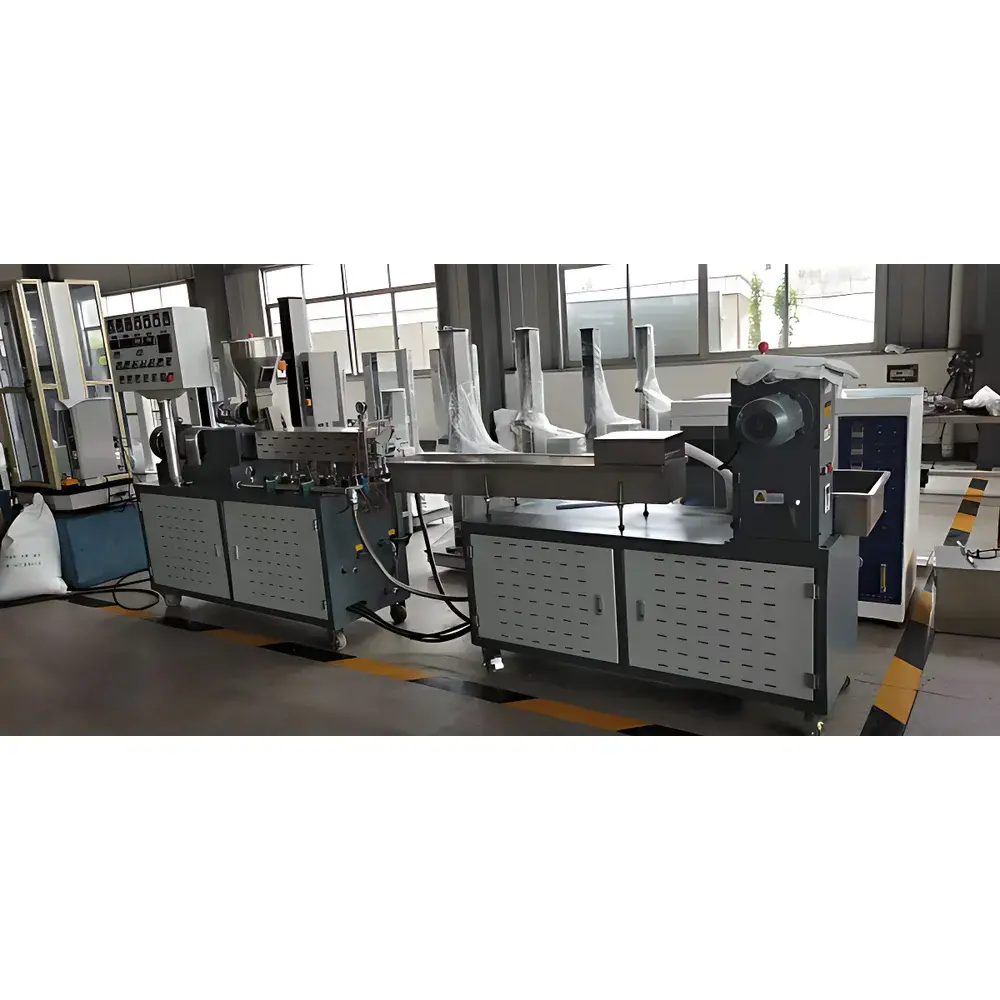
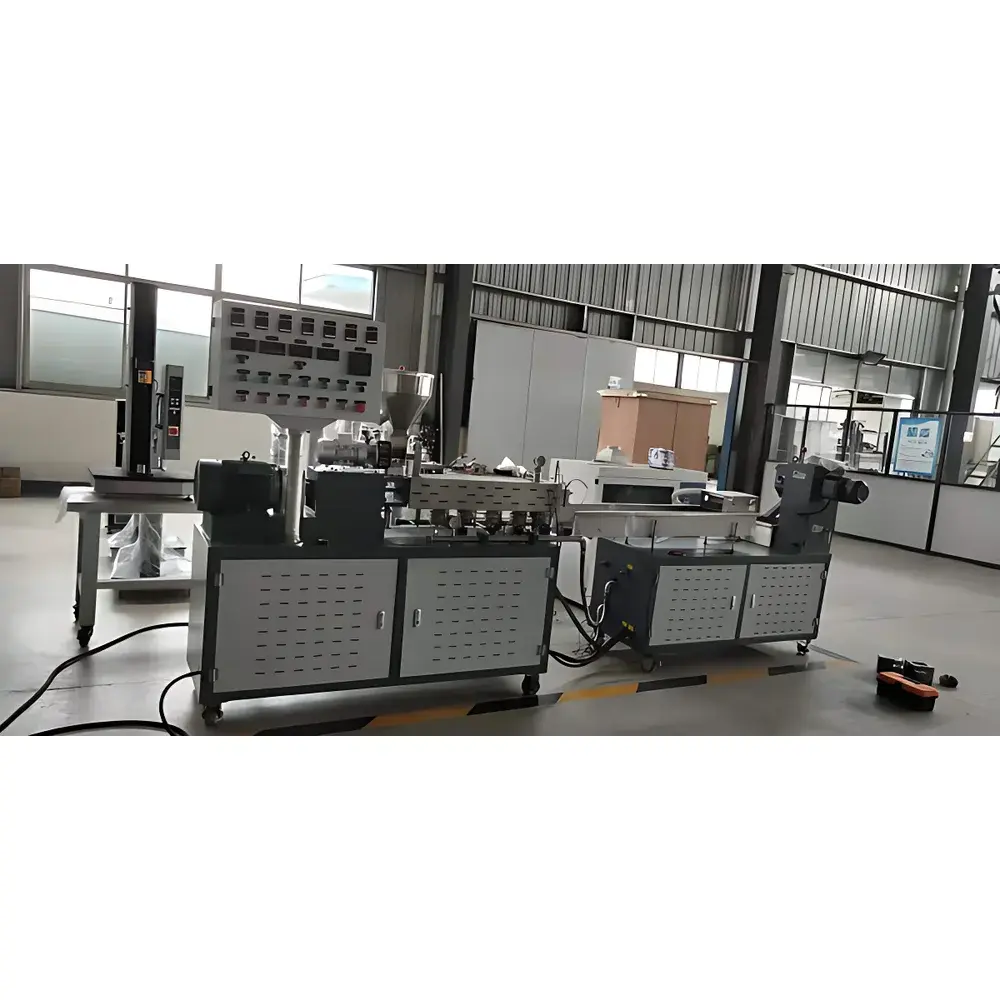
The TianYuan TY-7009 is a compact, laboratory-scale co-rotating twin-screw extruder engineered for precision polymer compounding, formulation development, and process validation in R&D environments. Based on the fundamental principles of positive displacement conveying, distributive and dispersive mixing, and controlled residence time distribution, the TY-7009 employs a modular, self-wiping screw design to enable reproducible melt processing of thermoplastics, elastomers, composites, and filled systems. Its 40:1 length-to-diameter (L/D) ratio ensures sufficient residence time for thorough melting, homogenization, devolatilization, and reactive extrusion—while maintaining minimal material consumption (2–5 kg per batch). The unit integrates a forced-feed single-screw feeder, vacuum venting, oil-lubricated gearbox, soft-water jacketed barrel, and fully interlocked electrical control architecture—making it suitable for GLP-compliant method development, pre-production trials, and academic polymer engineering instruction.
Key Features
- Modular twin-screw configuration: φ21.7 mm co-rotating screws with 40:1 L/D ratio; screw elements fabricated from high-speed tool steel W6Mo5Cr4V2, vacuum-hardened to HRC 62–64 and assembled on a 40CrNiMoA core shaft via involute spline coupling for high torque transmission and easy reconfiguration.
- Wear-resistant barrel system: Seven-zone barrel assembly with bimetallic liners (Fe-Cr-Ni-B + carbide composite, HRC 60–64) mounted in 45# steel housings; dedicated feed, vacuum vent (Zone 6), and die zones ensure optimal material handling and degassing performance.
- Integrated thermal management: Dual-mode heating (cast copper/aluminum heaters across seven zones) with RKC dual-channel PID controllers; independent soft-water cooling circuit (30 L external reservoir, 0.55 kW pump, chromium-plated copper tubing) enables precise zone-by-zone temperature profiling up to 260 °C.
- Robust drive and safety architecture: 4 kW Siemens Beide AC main motor coupled to a parallel triple-shaft gearbox (2.5:1 reduction, max 600 rpm output); full interlock logic including oil pressure–host start dependency, feed–extruder sequence enforcement, overpressure shutdown (<25 MPa sensor), and overload current cutoff.
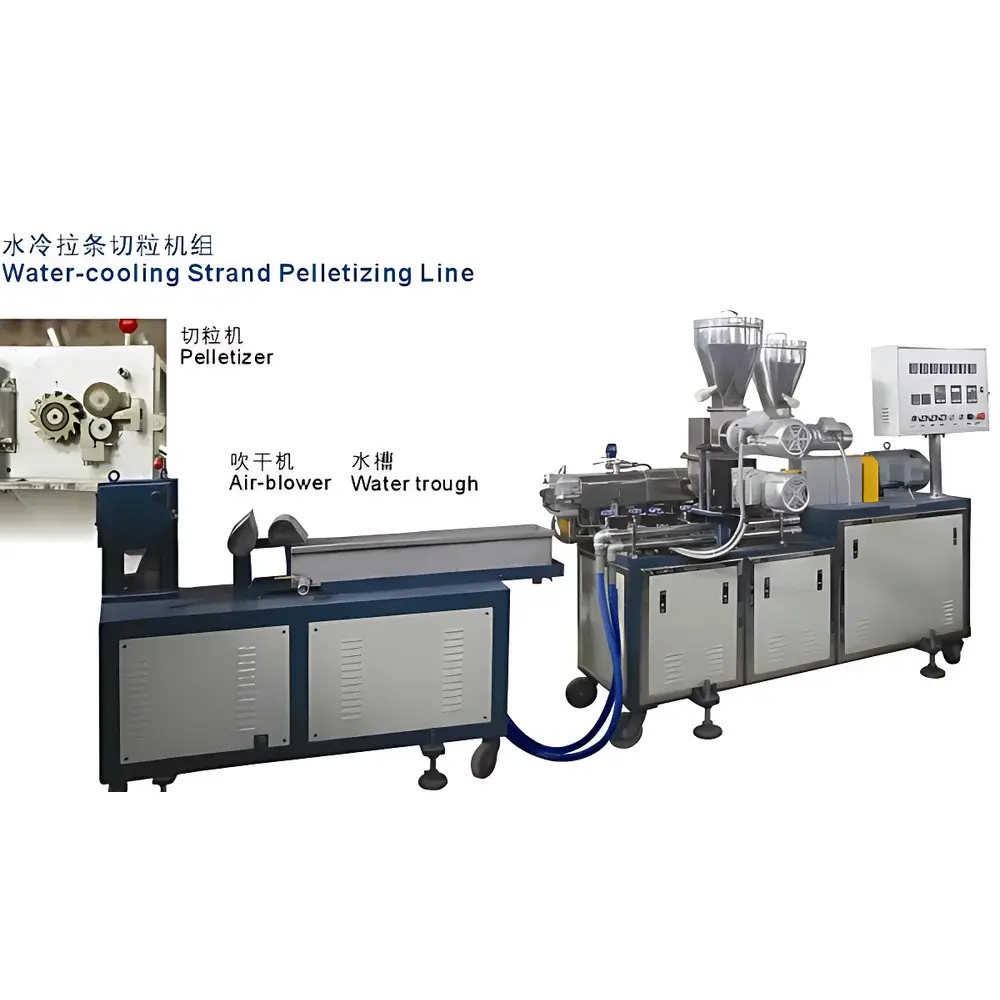
- Process monitoring & auxiliary integration: Melt temperature measured via dedicated thermocouple; melt pressure monitored with calibrated transducer; SK-0.15 water-ring vacuum system (0.75 kW) for moisture/monomer removal; water-cooled strand pelletizer with 2×φ3.5 mm die and 0.37 kW air dryer.
Sample Compatibility & Compliance
The TY-7009 supports a broad range of polymeric materials—including polyolefins (PP, PE), engineering thermoplastics (PA6, PC, PBT), thermoplastic elastomers (TPEs), biopolymers (PLA, PHA), and filled systems (glass fiber, mineral, nanocellulose, conductive carbon black). Its modular screw design allows rapid adaptation for low-shear blending or high-intensity dispersion via interchangeable kneading blocks, reverse elements, and mixing paddles. All electrical components comply with IEC 60204-1 industrial safety standards; control architecture supports audit-ready operation under GLP and pre-GMP R&D frameworks. While not certified for ISO 13485 or FDA 21 CFR Part 11 out-of-the-box, the system’s deterministic logic, event-logged temperature/pressure/speed data, and hardware-enforced interlocks provide foundational traceability for regulated lab workflows.
Software & Data Management
The TY-7009 operates via a panel-mounted Siemens-based control interface with real-time display of screw speed, zone temperatures (±1 °C accuracy), melt pressure, vacuum level, and motor load. Temperature setpoints, ramp rates, and hold times are programmable per zone; all operational parameters are logged at user-defined intervals (default: 10 s) to internal non-volatile memory. Data export is supported via USB port in CSV format for post-processing in MATLAB, Python, or statistical analysis platforms. Optional OPC UA gateway integration enables connection to centralized MES or LIMS systems for automated batch record generation—facilitating alignment with ASTM D3835 (standard test method for melt flow rate of thermoplastics) and ISO 1133 protocols.
Applications
- Polymer formulation screening: Rapid evaluation of compatibilizers, flame retardants, plasticizers, and nucleating agents in small-batch trials.
- Reactive extrusion studies: Controlled initiation of grafting, crosslinking, or transesterification reactions under inert or vacuum conditions.
- Recycled material valorization: Decontamination, stabilization, and property recovery of post-consumer PET, PP, or mixed plastic streams.
- Nanocomposite development: Dispersive mixing of nanoclays, graphene, or metal oxides into polymer matrices with quantifiable dispersion metrics via SEM/TEM correlation.
- Academic polymer processing labs: Hands-on training in screw geometry effects, residence time distribution modeling, and melt rheology–structure–property relationships.
FAQ
What is the minimum sample quantity required for a valid trial run?
Typical batch size ranges from 2–5 kg depending on material density and feeding efficiency; for preliminary screw configuration tests, 1.5 kg may be used with adjusted feed rate and dwell time calibration.
Can the TY-7009 accommodate nitrogen purge or inert gas blanketing?
Yes—the feed throat and vacuum vent zone can be adapted with gas inlet fittings and pressure-regulated mass flow controllers for controlled atmosphere processing.
Is the screw geometry customizable beyond standard configurations?
All screw elements are fully modular and interchangeable; custom geometries—including extended mixing sections, reverse pitch elements, or barrier flights—can be ordered separately using standard DIN 30910 mounting interfaces.
Does the system support continuous operation mode?
While primarily designed for batch and semi-continuous R&D use, stable throughput at 3–4 kg/h is achievable with optimized feeding and cooling; continuous runs exceeding 4 hours require scheduled lubricant inspection and barrel temperature recalibration.
What documentation is provided for regulatory submissions?
Standard delivery includes mechanical drawings, electrical schematics, factory calibration certificates for temperature and pressure sensors, and a traceable component parts list—sufficient for internal SOP development and audit preparation.



