
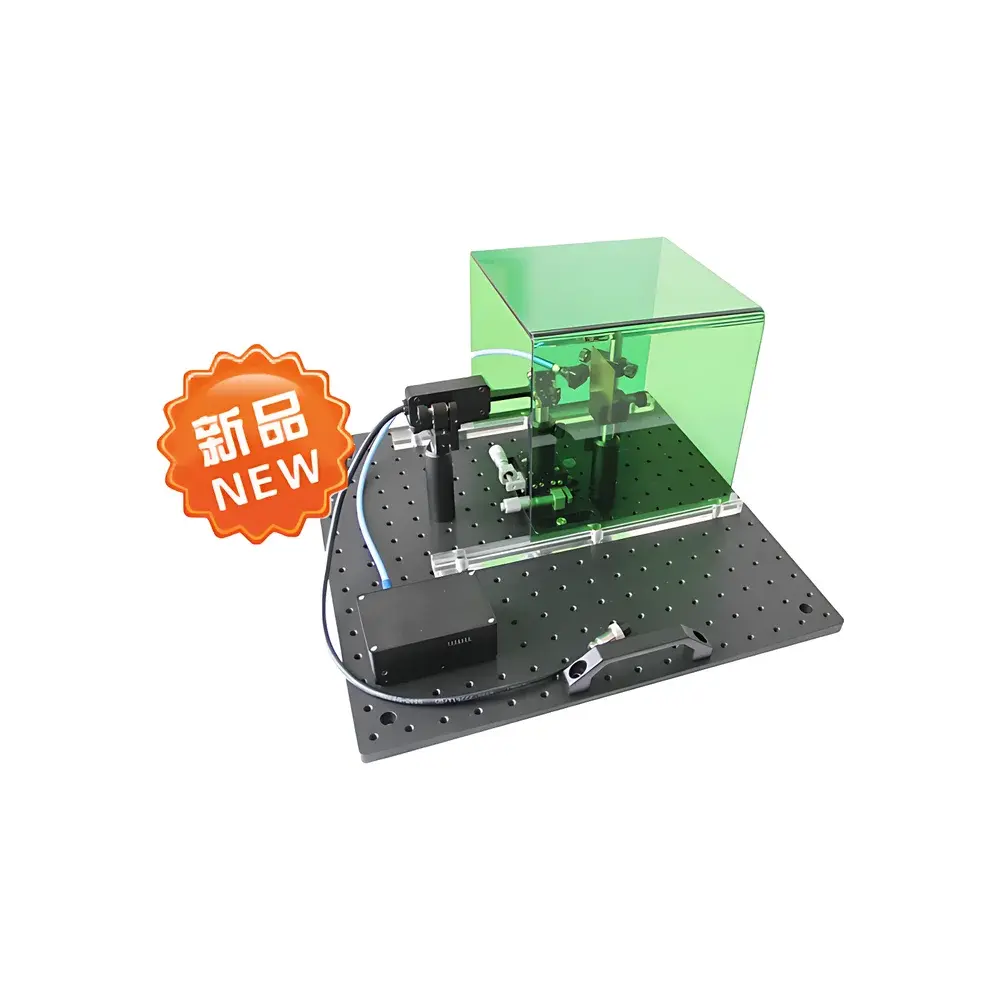
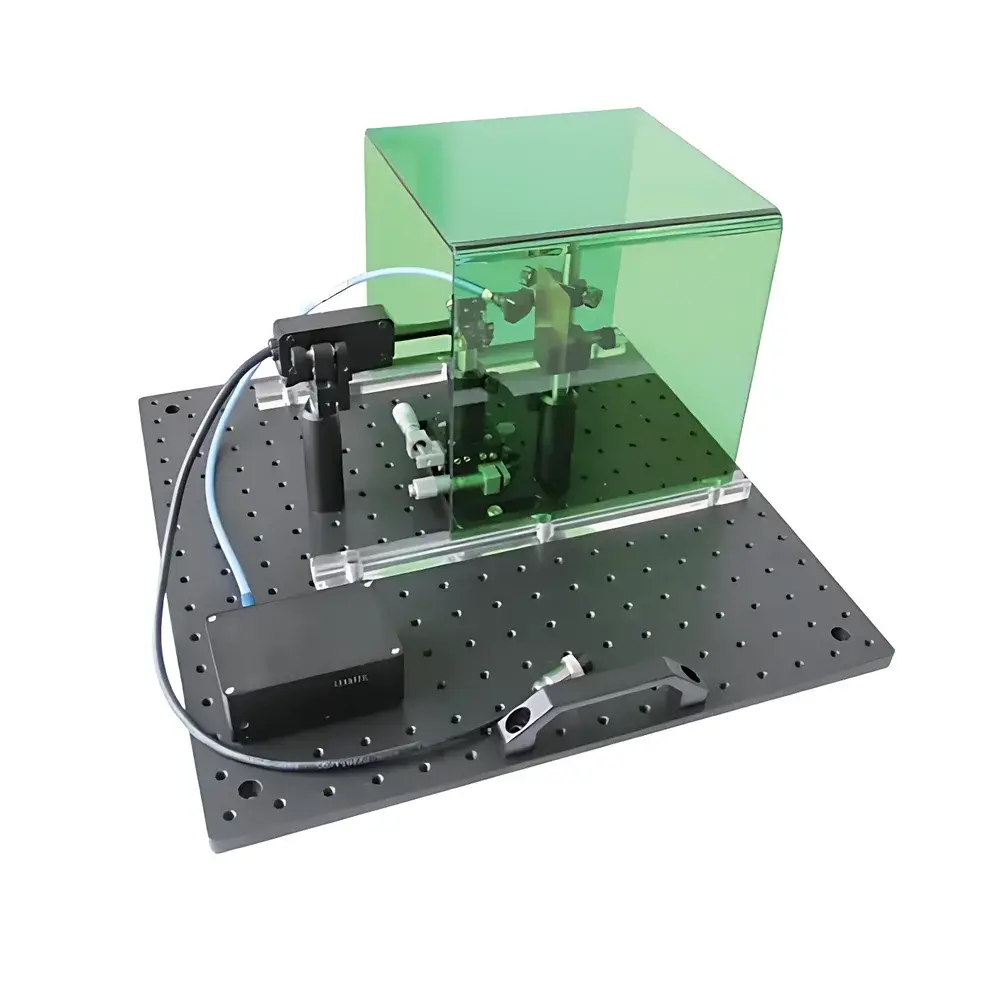
Topo LIBS1 Benchtop Laser-Induced Breakdown Spectroscopy System
| Brand | Topo (TP) |
|---|---|
| Origin | Tianjin, China |
| Manufacturer Type | Direct Manufacturer |
| Regional Classification | Domestic (China) |
| Model | LIBS1 |
| Instrument Type | Benchtop |
| Integration Level | Fully Integrated |
| Laser Pulse Energy | >500 µJ |
| Pricing | Available Upon Request |
Overview
The Topo LIBS1 is a benchtop, fully integrated Laser-Induced Breakdown Spectroscopy (LIBS) system engineered for fundamental research, method development, and quantitative elemental analysis in academic laboratories and industrial R&D settings. LIBS operates on the principle of laser ablation: a high-intensity, nanosecond-duration pulsed laser is focused onto a solid, liquid, or aerosol sample surface, generating a transient microplasma (>10,000 K). As the plasma cools, excited atoms and ions emit characteristic atomic and ionic line spectra in the UV–VIS–NIR range (typically 200–900 nm). These spectral signatures are collected via high-efficiency fiber-optic coupling and resolved by a calibrated spectrometer, enabling qualitative identification and semi-quantitative to quantitative determination of elemental composition—including major, minor, and trace constituents—without requiring extensive sample preparation.
Key Features
- Fully integrated benchtop architecture with pre-aligned optical path: includes Q-switched Nd:YAG laser (1064 nm, pulse width <10 ns), precision focusing optics, plasma collection optics, multimode fiber coupling (core diameter ≥400 µm), and a compact Czerny–Turner spectrometer with CCD or ICCD detection
- Laser pulse energy exceeding 500 µJ at the sample plane—sufficient to generate stable, reproducible plasmas across conductive and non-conductive materials including metals, alloys, soils, polymers, and ceramics
- Modular design supports user-configurable experimental parameters: adjustable laser fluence (via attenuators), variable delay time between laser pulse and spectral acquisition (0–10 µs), and customizable gate width for time-resolved plasma emission studies
- Self-cleaning ablation mechanism minimizes matrix effects and crater residue accumulation, enhancing measurement repeatability across sequential shots on the same location
- Non-contact, ambient-pressure operation eliminates need for vacuum chambers or inert gas purging—enabling rapid analysis of irregular, large, or temperature-sensitive samples
- Designed for compliance with ISO/IEC 17025 calibration traceability frameworks; optical components certified to ISO 10110 surface quality standards
Sample Compatibility & Compliance
The LIBS1 accommodates a broad spectrum of sample forms: flat or curved metallic alloys (e.g., stainless steel, aluminum, titanium grades), geological powders pressed into pellets, thin-film coatings, biological tissues (freeze-dried), and liquid droplets deposited on substrates. No conductive coating or vacuum compatibility is required. The system meets electromagnetic compatibility (EMC) requirements per IEC 61326-1 for laboratory use and incorporates Class 4 laser safety interlocks compliant with IEC 60825-1:2014. All firmware and data handling protocols support audit-ready documentation aligned with GLP and GMP principles; raw spectral files include embedded metadata (timestamp, laser energy, integration time, spectrometer calibration coefficients) for full traceability.
Software & Data Management
The system ships with Topo-SpectraControl v3.x—a Windows-based application developed in accordance with FDA 21 CFR Part 11 guidelines for electronic records and signatures. It provides real-time spectral preview, automated peak identification using NIST Atomic Spectra Database (ASD) libraries, multivariate calibration (PLS, PCA), and limit-of-detection (LOD) estimation per element. Data export options include ASCII (.txt), CSV, and HDF5 formats compatible with MATLAB, Python (SciPy, Astropy), and commercial chemometrics platforms. Software logs all user actions, instrument state changes, and calibration events with tamper-evident timestamps, satisfying requirements for regulatory submissions and internal QA/QC audits.
Applications
- Rapid alloy grade verification and sorting in metallurgical QC labs
- Depth-profiling of multi-layer coatings and corrosion products
- In situ elemental mapping of heterogeneous geological or archaeological specimens
- Trace metal analysis (e.g., Cr, Ni, Pb, Cd) in environmental soil and sediment samples at sub-ppm detection levels
- Fundamental plasma physics studies: electron temperature and density estimation via Boltzmann plot and Stark broadening analysis
- Method transfer and validation for ASTM E2926-22 (Standard Test Method for Determination of Elemental Composition by LIBS)
FAQ
What is the typical detection limit for transition metals in steel using the LIBS1?
Detection limits vary by element and matrix but typically range from 10–100 ppm for Fe, Cr, Ni, and Mn in homogenized steel standards under optimized gating conditions.
Can the LIBS1 be used for liquid analysis?
Yes—liquids may be analyzed as static droplets, flowing jets, or dried residues; signal stability is enhanced using double-pulse configurations or liquid jet stabilization modules (optional add-on).
Is spectral calibration traceable to NIST standards?
Yes—the onboard wavelength calibration uses Hg–Ne and Ar emission lines, with optional NIST-traceable holmium oxide or didymium filters available for periodic verification.
Does the system support remote operation or integration with automation platforms?
Yes—TCP/IP and RS-232 interfaces enable SCPI command control; API documentation supports integration with LabVIEW, Python, or PLC-based robotic sample handlers.
What maintenance is required for long-term operational stability?
Routine maintenance includes quarterly cleaning of collection optics with spectroscopic-grade solvents, annual recalibration of laser energy meter and spectrometer dispersion, and replacement of flashlamp every 10⁶ pulses (typical lifetime).




