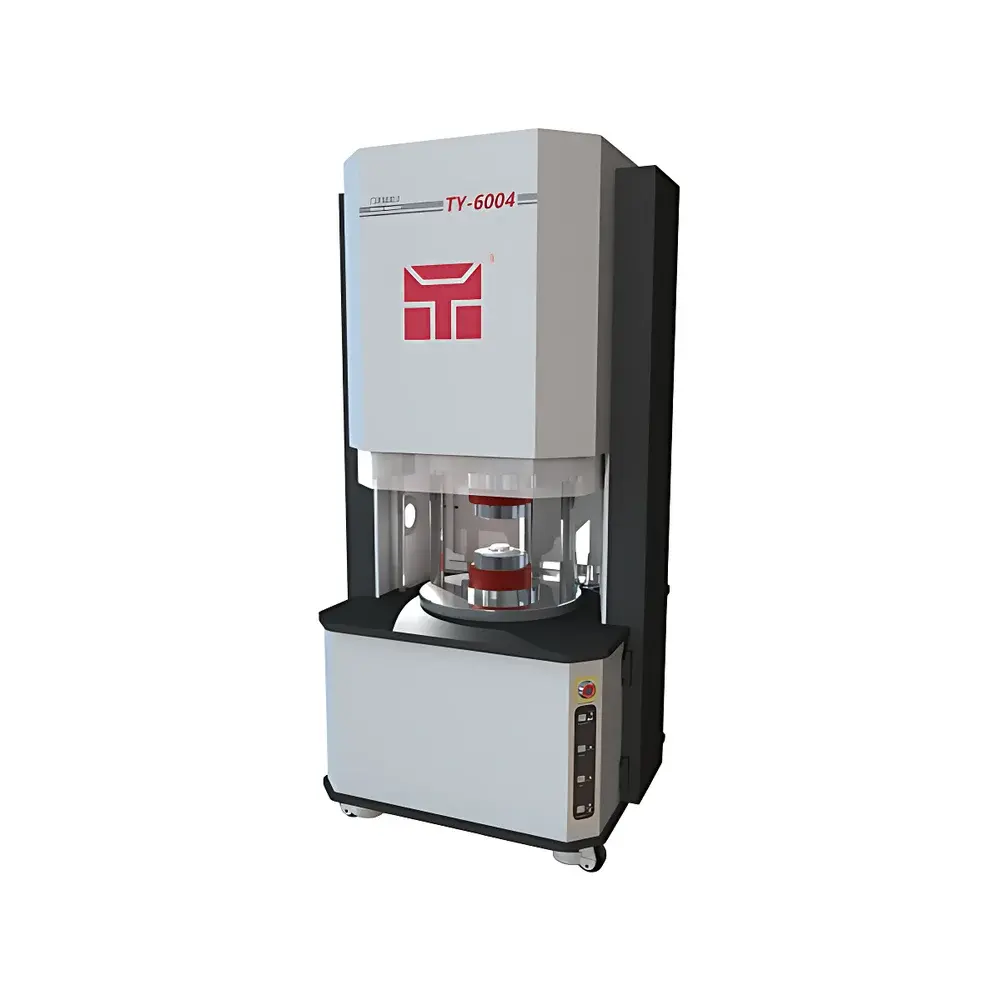
TY-6004 Mooney Viscometer (TianYuan)
| Brand | TianYuan |
|---|---|
| Origin | Jiangsu, China |
| Manufacturer Type | Direct Manufacturer |
| Product Category | Domestic |
| Model | TY-6004 |
| Price Range | USD 4,200 – 7,000 |
| Measuring Range | 0–200 Mooney Units (MU) |
| Accuracy | ±0.5 MU |
| Resolution | 0.1 MU |
| Temperature Range | Ambient to 200 °C |
| Temp. Stability | ±0.3 °C |
| Heating Rate | <20 min (RT to 150 °C) |
| Rotor Speed | 2.00 ± 0.02 rpm |
| Cavity Closure Force | 11.5 kN |
| Applied Pressure | 0.4 MPa |
| Power Supply | AC 220 V ±10%, 50/60 Hz |
| Power Consumption | 800 W |
| Dimensions (W×D×H) | 660 × 570 × 1300 mm |
| Net Weight | 260 kg |
| Rotor Material | Cr6WV Tool Steel |
| Data Interface | USB |
| Software Language Support | English, Simplified Chinese, Traditional Chinese, Russian |
Overview
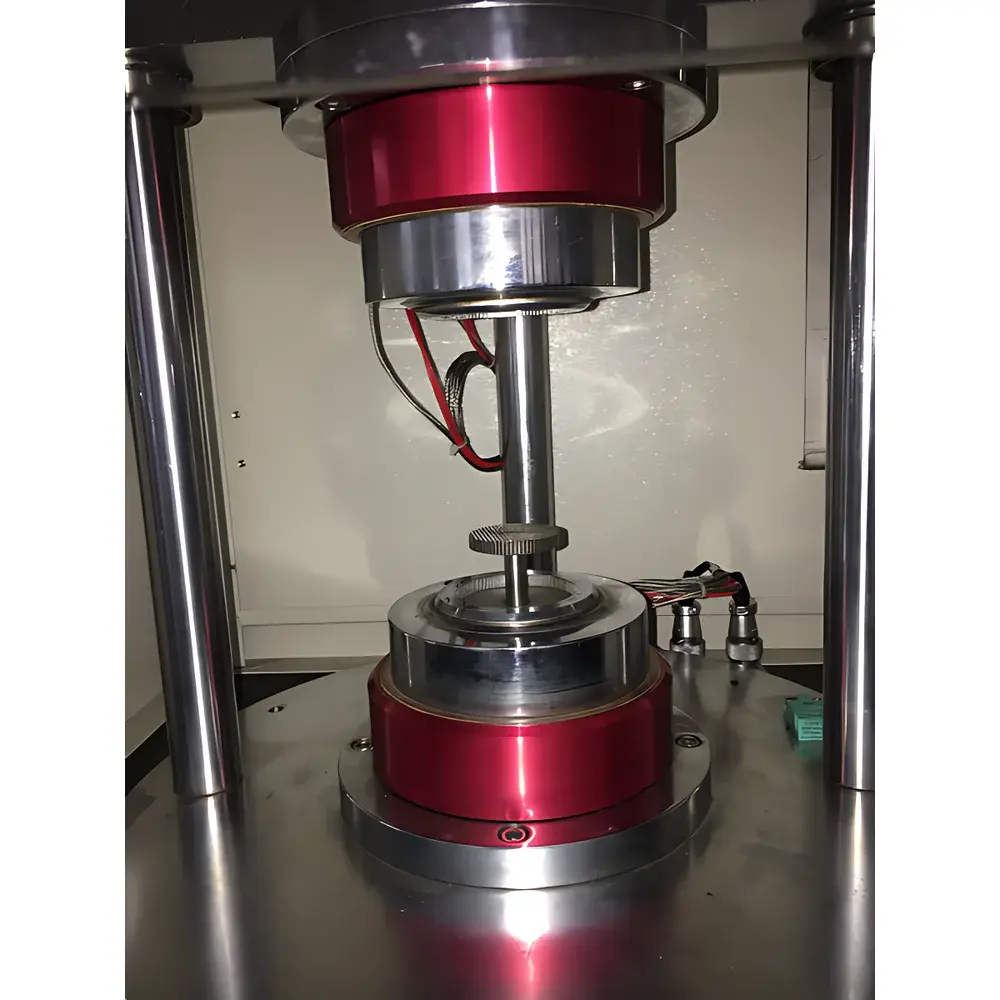
The TY-6004 Mooney Viscometer (TianYuan) is a precision-engineered instrument designed for the standardized determination of Mooney viscosity, scorch time (t5), and vulcanization index (Δt30) of uncured rubber compounds. It operates on the principle of rotational shear rheometry within a sealed, temperature-controlled cavity—complying with the fundamental mechanics defined in ISO 289 and ASTM D1646. The device subjects a pre-conditioned rubber sample to controlled shear deformation via a calibrated rotor rotating at 2.00 ± 0.02 rpm under a constant compressive load of 0.4 MPa. Torque resistance is measured continuously by a high-stability load cell, converted into Mooney units (MU) using the internationally accepted scaling factor (1 MU = 0.083 N·m). This method provides reproducible, traceable data essential for quality control in rubber compounding, incoming raw material verification, and process development across tire, automotive elastomer, and industrial rubber goods manufacturing.
Key Features
- High-accuracy torque sensing system with full-scale range of 0–200 MU and resolution of 0.1 MU, validated to ±0.5 MU accuracy per ISO 289 Annex B calibration protocols.
- Integrated servo-driven rotation system featuring Panasonic AC servo motor coupled with planetary gear reduction—ensuring stable, low-vibration 2 rpm operation with minimal speed drift over extended test cycles.
- Multi-channel intelligent PID temperature control architecture with real-time parameter auto-tuning; achieves thermal stability of ±0.3 °C across the operating range (ambient to 200 °C) and heats from ambient to 150 °C in under 20 minutes.
- Robust cavity assembly with Cr6WV alloy rotor—engineered for high hardness (>60 HRC), wear resistance, and dimensional stability after repeated thermal cycling.
- Fail-safe mechanical interlock system: 5 mm acrylic safety shield automatically synchronizes with mold position; powered closure requires deliberate physical button activation at the instrument panel—eliminating risk of inadvertent actuation.
- LED-assisted optical monitoring: Integrated LED illumination activates only during mold opening, enhancing operator visibility during sample loading/unloading while conserving energy.
- USB-based digital communication interface compliant with USB 2.0 standards, enabling direct connection to Windows-based host systems without proprietary drivers.
Sample Compatibility & Compliance
The TY-6004 supports all standard uncured elastomeric materials including natural rubber (NR), styrene-butadiene rubber (SBR), butadiene rubber (BR), ethylene propylene diene monomer (EPDM), nitrile rubber (NBR), and reclaimed rubber compounds. It conforms to multiple international test standards: GB/T 1232 (China), GB/T 1233 (China), HG/T 3242–2017 (China), ISO 289:2010, and ISO 667:1992. All measurements are fully compatible with laboratory quality management systems aligned with ISO/IEC 17025 requirements. The instrument’s hardware design and software architecture support audit-ready data integrity—including timestamped test records, operator ID logging, and immutable curve storage—facilitating GLP/GMP-aligned documentation workflows.
Software & Data Management
The TY Viscosity Test Software (v4.x) provides a bilingual (English/Chinese) GUI optimized for QC laboratories. It enables automated test sequence execution, real-time curve visualization, comparative overlay of up to eight historical curves, adjustable test duration (with configurable t5/t35 thresholds), and customizable report templates exportable as PDF or CSV. All raw torque/time and temperature/time datasets are stored in binary format with embedded metadata (test ID, operator, calibration date, environmental conditions). Software supports FDA 21 CFR Part 11–compliant user access controls when deployed on domain-authenticated Windows environments, including electronic signatures, role-based permissions, and audit trail generation for all critical actions.
Applications
- Routine QC testing of incoming raw rubber batches against specification limits for Mooney viscosity (ML1+4 @ 100 °C or 125 °C).
- Scorch safety assessment of compound formulations prior to extrusion or calendering operations.
- Accelerated aging studies evaluating polymer degradation kinetics under elevated temperature exposure.
- Formulation screening during R&D—quantifying effects of curatives, fillers, plasticizers, and processing aids on viscoelastic onset behavior.
- Inter-laboratory correlation studies supporting ASTM D1646 round-robin validation protocols.
FAQ
What standards does the TY-6004 comply with?
It meets ISO 289, ISO 667, GB/T 1232, GB/T 1233, and HG/T 3242–2017 for Mooney viscosity and scorch testing.
Is the instrument suitable for regulatory submissions?
Yes—when configured with appropriate access controls and audit logging enabled, its data output satisfies documentation requirements for ISO/IEC 17025 accreditation and GLP-compliant studies.
Can test parameters be modified during runtime?
Yes—the software allows dynamic extension or truncation of test duration, manual override of scorch threshold detection, and real-time adjustment of temperature setpoints within operational limits.
What maintenance is required for long-term accuracy?
Annual calibration using NIST-traceable reference standards is recommended; rotor surface inspection and cavity cleaning after each test series are mandatory per ISO 289 Section 7.2.
Does the system support networked deployment?
While native Ethernet is not integrated, the USB interface permits connection to centrally managed lab PCs; remote monitoring and centralized database integration are achievable via third-party OPC UA or LabVIEW middleware layers.