
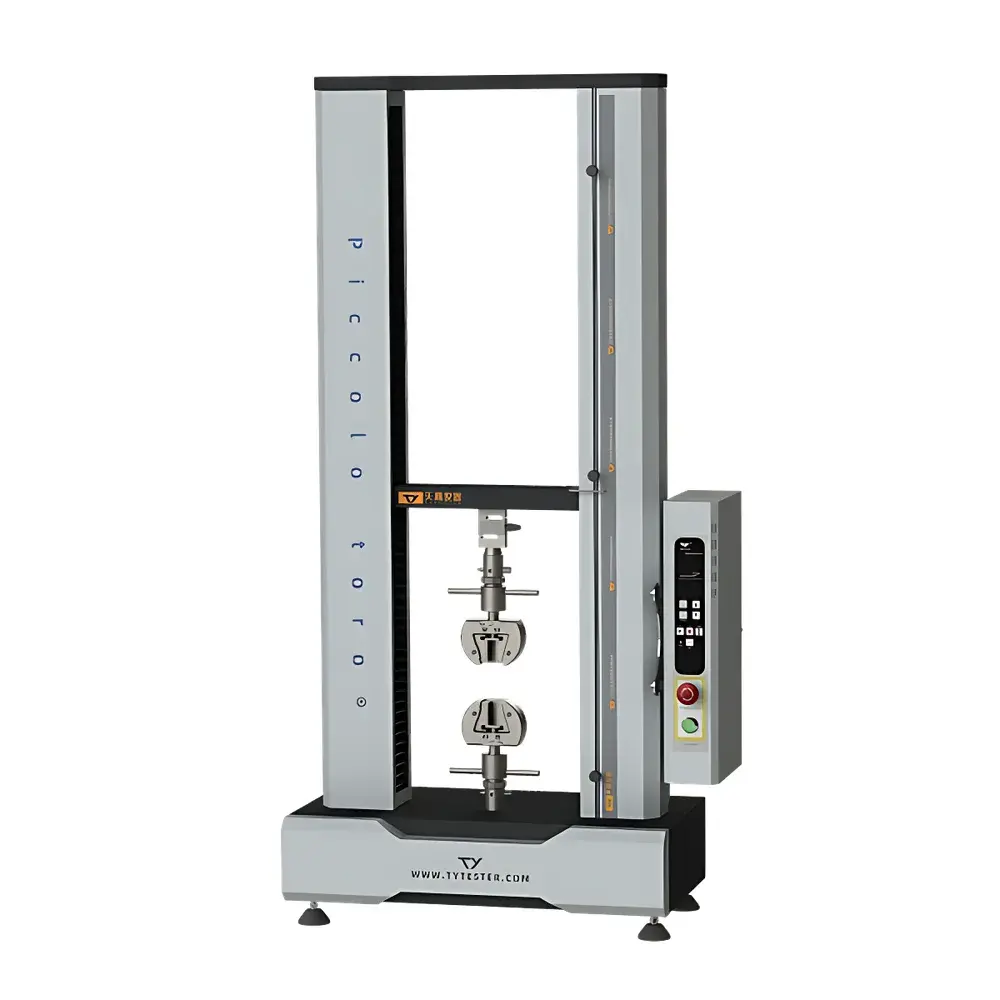
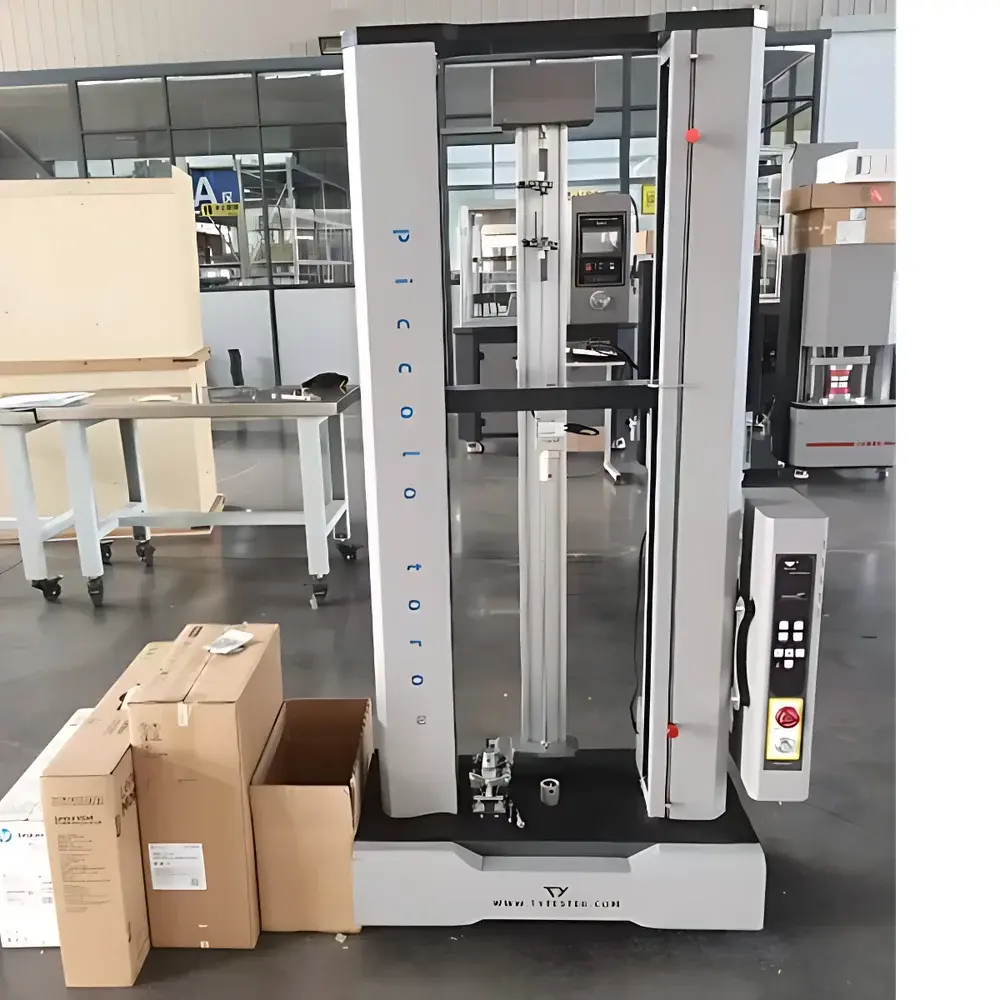
TianYuan TY-8000B 10 kN Electromechanical Universal Testing Machine
| Brand | TianYuan |
|---|---|
| Origin | Jiangsu, China |
| Manufacturer Type | Direct Manufacturer |
| Model | TY-8000B 10 kN |
| Max. Test Load | 10 kN |
| Force Range | 1–100% FS |
| Force Accuracy | ≤ ±0.5% |
| Crosshead Travel | 900 mm |
| Displacement Resolution | 0.01 mm |
| Test Speed | 10–260 mm/min |
| Speed Accuracy | ≤ ±0.8% |
| Load Resolution | 1/60000 |
| Effective Width | 400 mm |
| Power Supply | 220 V, 800 W |
| Weight | 480 kg |
| Dimensions (L×W×H) | 850 × 580 × 1900 mm |
Overview
The TianYuan TY-8000B 10 kN Electromechanical Universal Testing Machine is a precision-engineered static mechanical testing system designed for standardized tensile, compression, flexural, shear, tear, peel, and puncture testing of metallic and non-metallic materials. It operates on the principle of electromechanical force application via a high-rigidity frame, servo-controlled stepper motor, and preloaded recirculating ball screw transmission—ensuring stable load application, minimal thermal drift, and repeatable displacement control. The machine complies with fundamental metrological and structural requirements defined in ISO 7500-1 (Class 1 accuracy), ASTM E4 (verification of force-measuring systems), and GB/T 16491 (Chinese national standard for electronic universal testing machines). Its architecture supports both single-axis quasi-static loading and controlled strain-rate protocols, making it suitable for routine quality control, R&D validation, and regulatory-compliant material characterization in ISO/IEC 17025-accredited laboratories.
Key Features
- High-fidelity force measurement using calibrated load cells from Ningbo Kelili, traceable to national metrology institutes, with full-scale resolution of 1/60,000 and verified accuracy ≤ ±0.5% of reading across 1–100% FS.
- Dual-mode motion control: stepper servo motor coupled with Taiwan TBI precision ball screw and Taiwan Songgang gearbox ensures smooth, backlash-free crosshead movement and long-term mechanical stability.
- Digital signal processing (DSP) + microcontroller unit (MCU) real-time control architecture enables synchronized acquisition of load, displacement, and time at ≥1 kHz sampling rate, minimizing phase lag in dynamic response.
- Modular test space: 400 mm effective width and 900 mm unclamped travel accommodate standard ASTM and ISO specimen geometries—including flat tensile bars, cylindrical compression samples, and multi-layer composites.
- Integrated displacement sensing with 0.01 mm resolution and ≤ ±0.8% speed accuracy across 10–260 mm/min range, supporting both displacement-controlled and speed-controlled test modes per ISO 527-1 and ASTM D638.
- Comprehensive hardware synchronization: optical encoder feedback, overload protection circuits, emergency stop interlock, and dual-limit switch redundancy ensure operational safety and data integrity.
Sample Compatibility & Compliance
The TY-8000B accommodates specimens conforming to ISO 6892-1 (metallic tensile), ASTM D3039 (composite tensile), ISO 178 (flexural properties), ASTM D790 (flexural modulus), ISO 1133 (melt flow index support fixtures), and ASTM D882 (thin plastic films). Optional accessories include pneumatic wedge grips, compression platens, bending jigs, and extensometers meeting GB/T 12160 Class 1 specifications. All test procedures can be configured to enforce pass/fail criteria per ISO 10012 (measurement management systems) and support audit-ready documentation for GLP/GMP environments. Calibration certificates are issued with NIST-traceable references and uncertainty budgets compliant with ISO/IEC 17025 Clause 6.5.
Software & Data Management
The proprietary TianYuan TestMaster™ software runs on Windows-based Dell workstations included with the system. It provides real-time graphical display of up to six concurrent curves: Load vs. Displacement, Load vs. Time, Displacement vs. Time, Stress vs. Strain, Load vs. Extension (with two-point extensometer input), and custom user-defined derivatives. Data export is natively supported in CSV, XLSX, and PDF formats; all reports embed metadata including operator ID, calibration date, environmental conditions (optional sensor integration), and instrument serial number. Audit trail functionality logs every parameter change, test initiation, and result modification—fully satisfying FDA 21 CFR Part 11 requirements for electronic records and signatures when configured with user access controls and digital certificate authentication.
Applications
This system serves as a primary mechanical characterization platform in polymer compounding labs, metal forging QA departments, biomedical device manufacturing facilities, and academic materials science departments. Typical use cases include: determination of yield strength, ultimate tensile strength, elongation at break, Young’s modulus, Poisson’s ratio, compressive yield stress, flexural modulus, and tear resistance of thermoplastics, elastomers, fiber-reinforced composites, sheet metals, adhesives, and packaging films. It also supports accelerated aging studies where mechanical property degradation is tracked over time under controlled environmental conditions (when integrated with external climate chambers).
FAQ
What standards does the TY-8000B comply with for force calibration?
It meets ISO 7500-1 Class 1, ASTM E4, and GB/T 16491 verification requirements; factory calibration includes uncertainty analysis per ISO/IEC 17025.
Can the system perform closed-loop strain control using an extensometer?
Yes—when equipped with the optional two-point extensometer (GB/T 12160 Class 1 compliant), the DSP+MCU controller enables true strain-controlled ramp-and-hold tests.
Is test method scripting supported for automated sequence execution?
TestMaster™ supports programmable test sequences with conditional branching, multi-step loading profiles, and automatic pass/fail evaluation against user-defined limits.
What maintenance intervals are recommended for the ball screw and drive system?
Lubrication of the TBI ball screw is required every 500 operational hours; gearbox oil replacement is scheduled at 2,000-hour intervals per manufacturer guidelines.
Does the system support third-party LIMS or MES integration?
Yes—via TCP/IP-based API and configurable OPC UA server module, enabling bidirectional data exchange with laboratory information management systems and enterprise manufacturing execution systems.



