
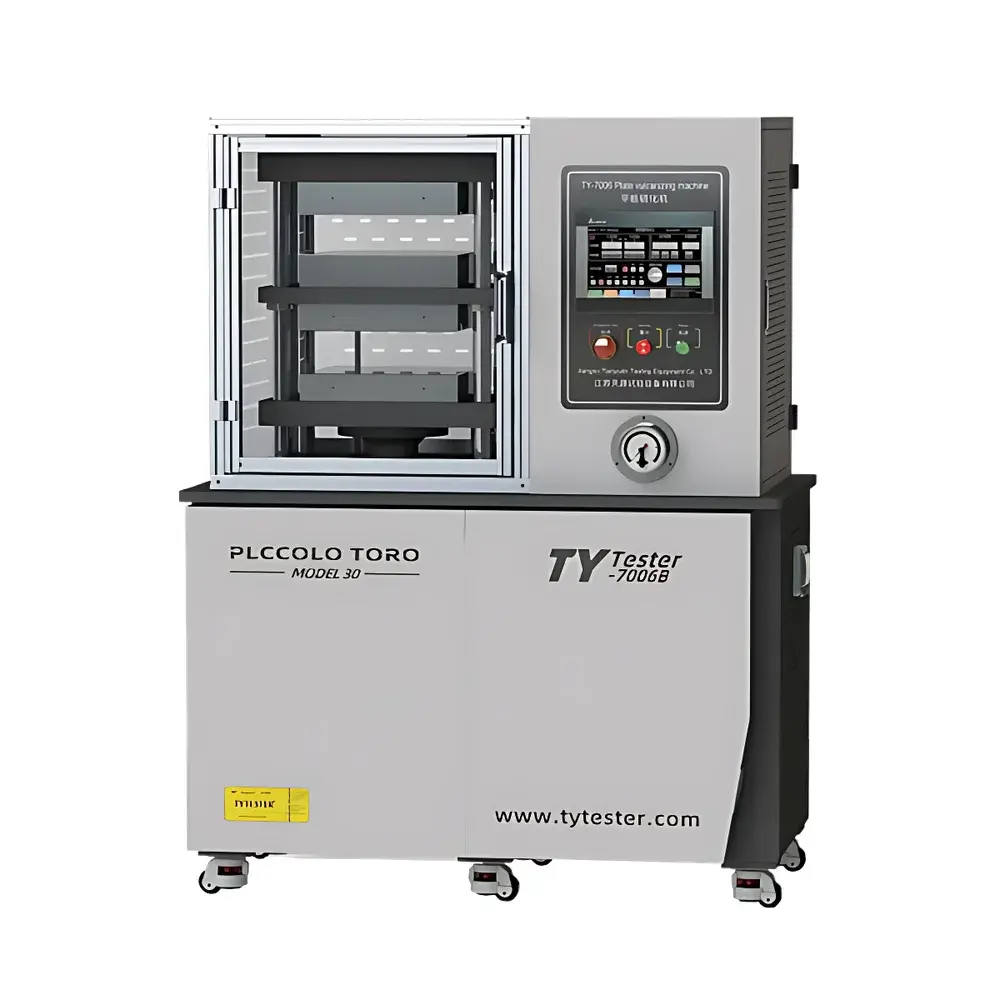
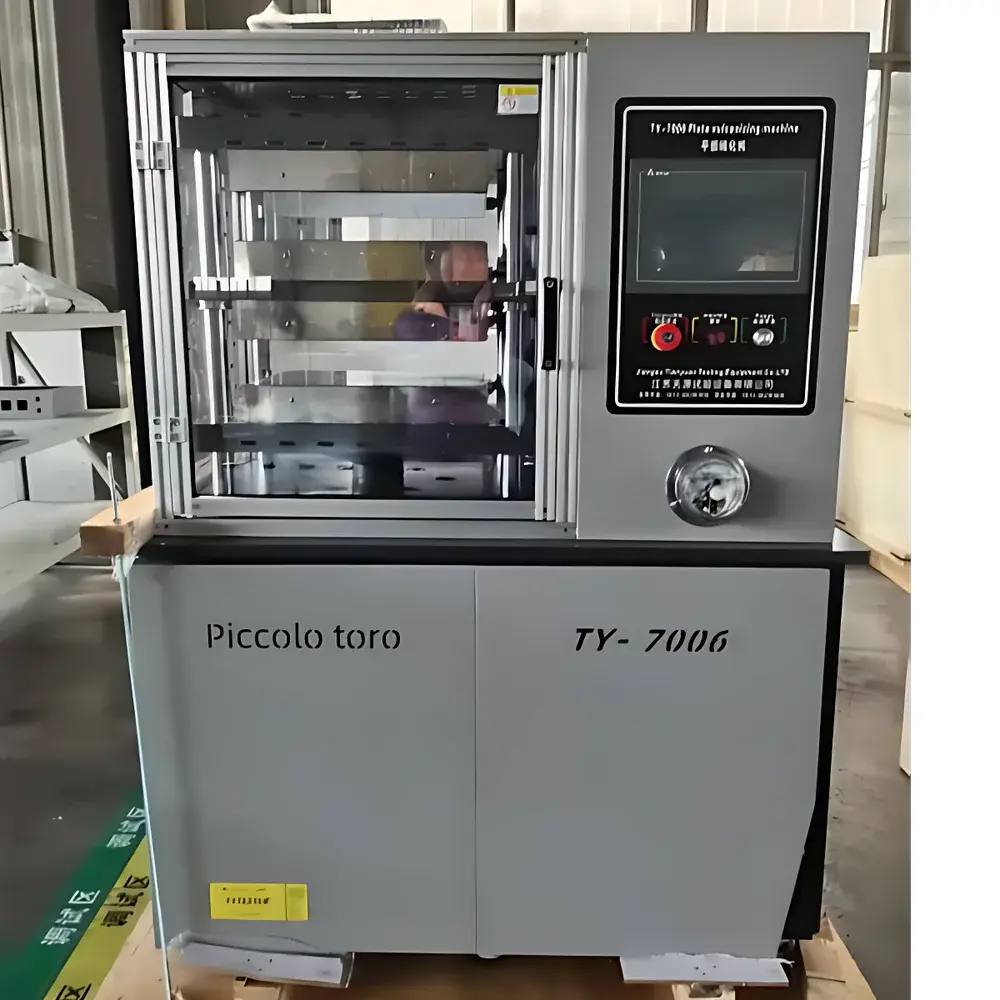
TianYuan TY-7006A 30T Dual-Platen Hydraulic Hot Press / Laboratory Vulcanizer
| Brand | TianYuan |
|---|---|
| Origin | Jiangsu, China |
| Manufacturer Type | Direct Manufacturer |
| Region Category | Domestic (China) |
| Model | TY-7006A 30T |
| Instrument Type | Semi-Automatic Hot Press |
| Function | Thermal & Cold Compression Molding |
| Max Stroke | 75 mm |
| Nominal Clamping Force | 25–50 T (configurable) |
| Actuation | Hydraulic |
| Pressure Control Range | 5–16.6 MPa |
| Pressure Accuracy | ±10% |
| Temperature Range | RT to 300 °C |
| Temp. Accuracy | ±2 °C |
| Platen Size | 300 × 300 mm |
| Platen Material | Alloy Steel with Hard Chrome Plating & Precision Ground Surface |
| Insulation Board | Imported High-Temp Insulation (500 °C Rated) |
| Piston Diameter | Φ150 mm |
| Max Piston Travel | 150 mm |
| Exhaust Cycles | 0–9 programmable |
| Hydraulic Fluid | L-HM 46 Anti-Wear Hydraulic Oil |
| Power Supply | AC 380 V ±10%, 18 A |
| Total Heating Power | 21 kW (Dual-Zone) |
| Dimensions (W×D×H) | 1180 × 585 × 1460 mm |
| Weight | ~738 kg |
Overview
The TianYuan TY-7006A 30T Dual-Platen Hydraulic Hot Press is a precision-engineered laboratory-scale thermal compression molding system designed for reproducible sample preparation in polymer science, elastomer formulation, composite material development, and quality control laboratories. Operating on the principle of controlled heat transfer and hydraulic force application, the system enables uniform thermal energy delivery and consistent pressure distribution across two independent platens—each equipped with dual heating zones and real-time temperature monitoring. Unlike single-platen configurations, the dual-space architecture allows simultaneous or staggered processing of two distinct samples under identical or independently programmed conditions (e.g., different dwell times or exhaust sequences), significantly improving throughput without compromising process fidelity. The press utilizes a closed-loop proportional hydraulic flow control system, ensuring stable clamping force maintenance throughout the entire curing cycle—even during thermal expansion of molds or specimen deformation. Its Y-configuration (star-connected) three-phase heating circuit eliminates phase imbalance, minimizing thermal gradient deviation across platen surfaces and extending heater service life.
Key Features
- Dual independent hot-press workspaces: Upper and lower chambers each feature 300 × 300 mm chrome-plated alloy steel platens with ±2 °C temperature uniformity across surface (per ASTM D3182)
- PLC-based HMI with color touchscreen interface supporting full recipe programming—including pressure ramping profiles, multi-stage temperature setpoints, timed exhaust cycles (0–9), and real-time graphical process logging
- Linear voltage regulation module ensures smooth, overshoot-free heating response; eliminates conventional on/off cycling that causes thermal shock and inconsistent crosslinking
- Hydraulic actuation with proportional flow valve and integrated pressure transducer feedback loop delivers repeatable clamping forces from 5 to 16.6 MPa (±10% accuracy)
- Integrated safety interlock system: transparent polycarbonate guard door automatically terminates all motion and heating functions upon opening, compliant with ISO 13857 mechanical safety clearance requirements
- High-efficiency insulation package using imported ceramic-fiber boards rated to 500 °C reduces standby heat loss by >40% versus standard mineral wool solutions
Sample Compatibility & Compliance
The TY-7006A accommodates a broad range of thermoplastic, thermoset, elastomeric, and powder-based feedstocks—including rubber compounds, polyolefin blends, PTFE dispersions, metal injection molding (MIM) feedstocks, and pharmaceutical excipient mixtures. Mold cavity depths up to 75 mm are supported within each workspace. All electrical components meet CE marking requirements per EN 61000-6-2/6-4 EMI immunity/emission standards. The control architecture supports audit-ready operation: event logs (including operator ID, parameter changes, and alarm triggers) are time-stamped and non-erasable, aligning with GLP and GMP documentation expectations (21 CFR Part 11–ready when paired with validated networked data export). Temperature calibration traceability follows ISO/IEC 17025 principles via optional NIST-traceable PT100 probe validation kits.
Software & Data Management
The embedded PLC firmware stores up to 100 user-defined process recipes with version timestamps. Real-time operational data—including platen surface temperature (dual-point per zone), applied pressure, elapsed cycle time, and exhaust event counters—is continuously logged to internal flash memory at 1 Hz resolution. Export options include USB mass storage (CSV format) and RS-485 Modbus RTU protocol for integration into LIMS or MES platforms. Optional Ethernet/IP gateway enables remote monitoring via secure web interface (HTTPS/TLS 1.2), supporting role-based access control (admin/operator/viewer) and automated daily log archiving to network shares.
Applications
- Rubber compound vulcanization for Mooney viscosity correlation and scorch time determination (ASTM D1646, ISO 289)
- Preparation of standardized test plaques for tensile, tear, hardness, and compression set evaluation (ASTM D412, D395, ISO 37, ISO 816)
- Hot-press lamination of multilayer polymer films and functional coatings prior to peel adhesion testing
- Thermal compression of battery electrode slurries onto current collectors for electrochemical performance benchmarking
- Consolidation of ceramic green bodies and metal powder compacts for sintering trials
- Controlled thermal aging studies requiring precise dwell-time/temperature matrices (e.g., ASTM D573, ISO 188)
FAQ
What is the maximum recommended mold thickness for this press?
Standard operation supports molds up to 75 mm thick per chamber. For thicker tooling, piston stroke must be verified against total open-height (150 mm) minus platen stack height.
Does the system support vacuum-assisted molding?
No built-in vacuum port is provided; however, third-party vacuum chambers can be integrated via custom mounting flanges on the upper platen (requires engineering review).
Is temperature calibration verification included with shipment?
A factory calibration certificate for the main PT100 sensors is supplied. Field recalibration using external reference thermometers is recommended annually per ISO/IEC 17025 guidelines.
Can the two platens operate at different temperatures simultaneously?
Yes—each platen zone has independent PID controllers and thermocouple inputs, enabling differential thermal profiles (e.g., 160 °C upper / 180 °C lower) for asymmetric curing applications.
What maintenance intervals are specified for the hydraulic system?
Hydraulic oil (L-HM 46) must be replaced every 2,000 operating hours or biannually, whichever occurs first. Filter elements require replacement every 1,000 hours. Full system pressure testing is advised every 5 years per manufacturer service bulletin TB-HP-2023-04.



