
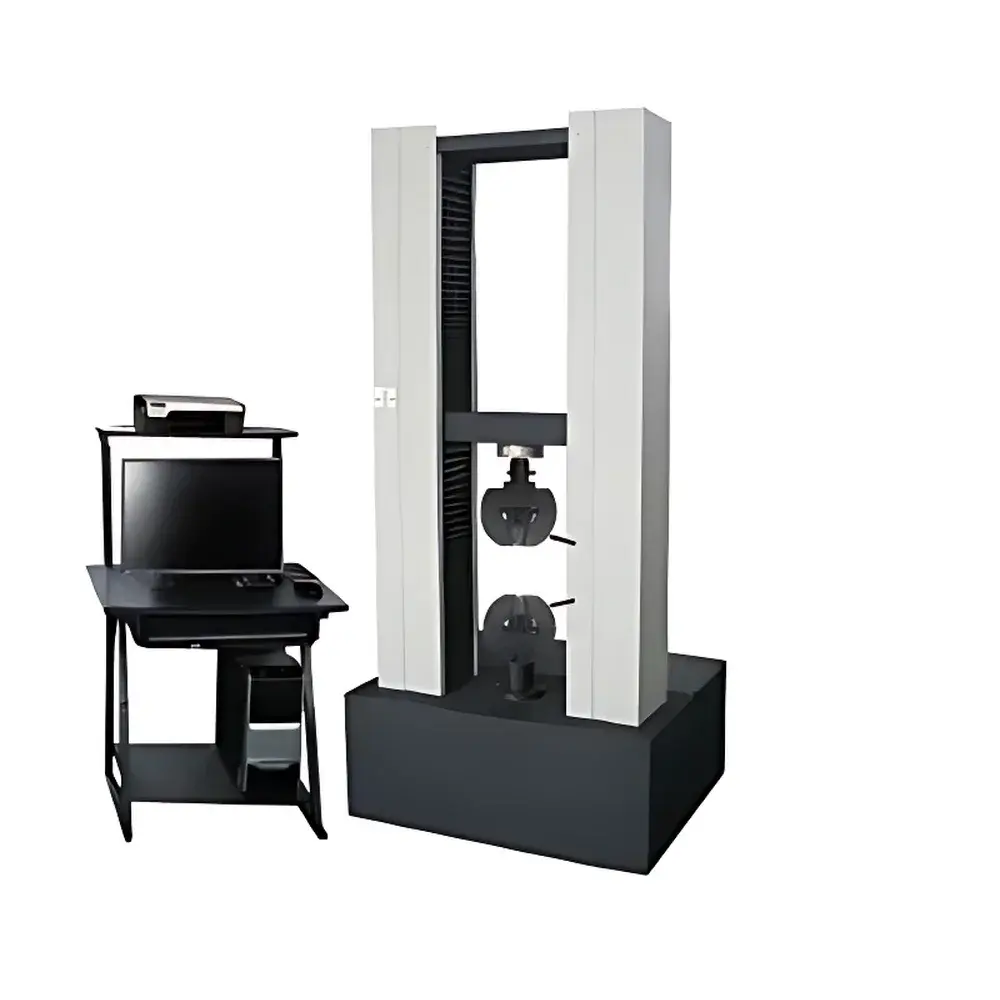
TianYuan TY-8000 300 kN Universal Tensile Testing Machine
| Brand | TianYuan |
|---|---|
| Origin | Jiangsu, China |
| Manufacturer Type | Direct Manufacturer |
| Model | TY-8000 |
| Load Capacity | 300 kN |
| Force Resolution | 1/300,000 |
| Force Accuracy | ≤0.3% |
| System Accuracy | ≤0.5% |
| Displacement Resolution | 1/100,000 |
| Displacement Accuracy | ≤1% |
| Extensometer Resolution (Metal) | 1/1000 |
| Extensometer Accuracy (Metal) | ≤0.5% |
| Large-Deformation Extensometer Accuracy | ±1 mm |
| Test Speed Range | 0.001–160 mm/min |
| Effective Stroke | 900 mm |
| Test Width | 480 mm |
| Power Supply | 380 V, 50 Hz |
| Power Consumption | ~5.5 kW |
| Dimensions (L×W×H) | 1090 × 840 × 2100 mm |
| Weight | ~1400 kg |
Overview
The TianYuan TY-8000 is a high-capacity, microprocessor-controlled universal tensile testing machine engineered for precision mechanical property evaluation of metallic and non-metallic materials under static loading conditions. Based on servo-controlled electromechanical actuation, it operates according to fundamental principles of uniaxial force–displacement transduction, enabling accurate determination of tensile strength, yield strength, elongation at break, Young’s modulus, flexural modulus, energy absorption (including net, return, and total energy), and other ASTM/ISO-defined mechanical descriptors. Designed for laboratory and industrial quality control environments, the system supports fully automated test sequences—including constant-rate loading, constant-rate displacement, constant-rate strain, and closed-loop cyclic protocols (load, displacement, or strain control) with low-frequency waveform generation (e.g., sinusoidal, triangular, trapezoidal). Its robust dual-column frame architecture ensures minimal deflection under maximum 300 kN load, maintaining geometric stability critical for compliance with ISO 7500-1 Class 1 calibration requirements.
Key Features
- High-force capacity platform rated to 300 kN with overload protection and real-time load cell diagnostics
- Seven-range automatic force amplification switching for optimal signal-to-noise ratio across full measurement span
- Integrated high-resolution encoder-based crosshead displacement sensing (1/100,000 resolution) and optional clip-on extensometers (metal: ≤0.5% accuracy; large deformation: ±1 mm)
- Programmable speed range from 0.001 to 160 mm/min, supporting both quasi-static and slow-dynamic testing per ISO 6892-1 and ASTM E8/E21
- Modular software architecture compatible with Windows OS, featuring real-time data acquisition at ≥1 kHz sampling rate
- Compliance-ready configuration with audit trail, electronic signature support, and configurable user access levels aligned with FDA 21 CFR Part 11 and GLP/GMP documentation practices
Sample Compatibility & Compliance
The TY-8000 accommodates standardized specimens per ISO 6892-1 (tensile), ISO 178 (flexure), ISO 527 (tensile plastics), ISO 34 (tear), ISO 37 (tensile rubber), and ASTM D638/D790/D412/D3574. Fixture adaptability includes wedge-action grips for metals, pneumatic clamps for polymers, bend supports for composites, and custom tooling interfaces for specialized geometries (e.g., wire, sheet, tube, and cast components). All mechanical calibrations conform to ISO 7500-1:2018 (static verification) and ISO 9513:2012 (extensometer verification). The system is preconfigured to execute over 200 test methods embedded in its software library—including GB/T 16491–1996, ASTM E4, ASTM E83, and ISO 5893—enabling direct alignment with internal QA/QC protocols and third-party certification audits.
Software & Data Management
The proprietary Windows-based testing software provides comprehensive control, visualization, and reporting functionality. It supports multi-curve overlay, differential analysis, derivative calculation (e.g., tangent modulus), and automatic parameter extraction (yield point via 0.2% offset method, ultimate tensile strength, fracture elongation). All raw data are stored in vendor-neutral CSV and XML formats, while test reports comply with ISO/IEC 17025 documentation standards—including operator ID, timestamp, environmental conditions (optional sensor integration), calibration status, and uncertainty statements. Audit logs record all user actions, parameter modifications, and result exports, satisfying traceability requirements for ISO 9001, IATF 16949, and aerospace AS9100 quality systems.
Applications
Typical use cases include mechanical validation of investment-cast turbine blades, sand-cast aluminum housings, ductile iron structural components, and magnesium die-cast parts—where dimensional variability and microstructural heterogeneity necessitate repeatable, high-fidelity stress–strain characterization. Additional applications span polymer composite laminates (ASTM D3039), elastomeric seals (ISO 37), geotextiles (ASTM D4595), and biomedical implant alloys (ISO 5832-1). The machine serves R&D labs developing new casting alloys, foundry QC departments verifying lot-to-lot consistency, and contract testing facilities performing accredited material certification per EN 10002-1 or MIL-STD-810.
FAQ
What standards does the TY-8000 natively support for cast metal testing?
It implements ASTM E8/E21, ISO 6892-1, GB/T 228.1, and EN 10002-1 for tensile evaluation of cast ferrous and non-ferrous alloys, including gray iron, ductile iron, and aluminum-silicon castings.
Can the system perform cyclic fatigue testing?
Yes—it supports low-cycle fatigue (LCF) protocols up to 5 Hz using displacement or load control, though high-cycle fatigue (HCF) requires optional hydraulic actuation modules not included in the base TY-8000 configuration.
Is third-party calibration certification available?
TianYuan provides factory calibration certificates traceable to NIM (China National Institute of Metrology); UKAS or DAkkS-accredited calibration services can be arranged through authorized regional partners.
How is data integrity ensured during long-duration tests?
The system employs non-volatile memory buffering, automatic power-fail recovery, and checksum-verified data streaming to prevent corruption during extended creep or relaxation experiments lasting >72 hours.
Does the software support integration with LIMS or MES platforms?
Yes—via OPC UA and RESTful API interfaces, enabling bidirectional communication with laboratory information management systems (LIMS) and manufacturing execution systems (MES) for automated result ingestion and workflow synchronization.



