
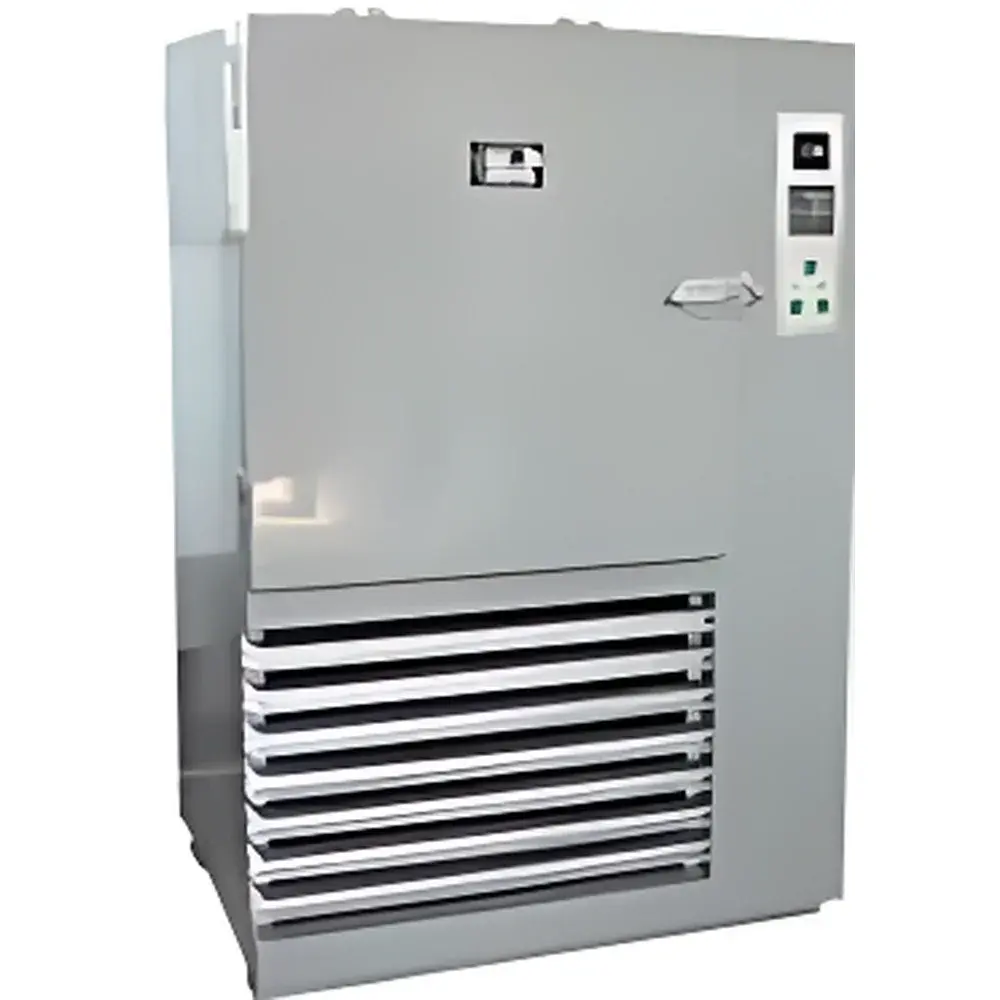
TianYuan TY-CS2 & TY-CS3 Natural Convection Thermal Aging Test Chambers
| Brand | TianYuan |
|---|---|
| Model | TY-CS2 / TY-CS3 |
| Origin | Jiangsu, China |
| Manufacturer Type | Direct Manufacturer |
| Country of Origin | China |
| Max Operating Temperature | 200 °C (TY-CS2) / 300 °C (TY-CS3) |
| Temperature Range | Up to 300 °C |
| Temperature Uniformity | ≤ ±1 °C |
| Temperature Fluctuation | ≤ ±1 °C |
| Temperature Deviation | ±2 °C |
| Heating Rate | ≤ 60 min (from ambient to max temperature) |
| Air Exchange Rate | 8–20 air changes per hour |
| Internal Chamber Dimensions (W×H×D) | 500 × 500 × 500 mm |
| Power Consumption | 1.5 kW (TY-CS2) / 4 kW (TY-CS3) |
Overview
The TianYuan TY-CS2 and TY-CS3 Natural Convection Thermal Aging Test Chambers are purpose-engineered environmental test systems designed to evaluate the long-term thermal stability and degradation behavior of polymeric insulating materials—particularly electrical wires, cables, elastomers, and thermoplastics—under controlled, non-forced airflow conditions. Unlike forced-air ovens, these chambers rely on natural convection to establish a stable, gradient-free thermal environment, closely simulating real-world aging conditions where convective heat transfer occurs without mechanical agitation. This methodology aligns with standardized aging protocols defined in IEC 60811-1-2, ASTM D573, ASTM D2436, and GB/T 2951.12, where material specimens are exposed to elevated temperatures for prescribed durations to assess changes in tensile strength, elongation at break, hardness, and insulation resistance. The chamber’s robust stainless-steel inner chamber (standard on TY-CS3; optional on TY-CS2), precision PID-controlled heating system, and calibrated airflow management ensure high reproducibility across sequential test cycles—critical for QC laboratories conducting comparative aging studies or supporting ISO/IEC 17025-compliant testing workflows.
Key Features
- Two model variants: TY-CS2 (max 200 °C) and TY-CS3 (max 300 °C), enabling selection based on material-specific thermal endurance requirements.
- Natural convection architecture eliminates fan-induced turbulence and localized hot/cold spots—preserving specimen integrity and ensuring uniform thermal stress distribution.
- Stainless-steel inner chamber (304 grade) standard on TY-CS3; corrosion-resistant and compliant with cleanroom-compatible maintenance practices.
- Precision temperature control via dual-sensor PID algorithm, achieving ≤ ±1 °C uniformity and ≤ ±1 °C fluctuation within the 500 × 500 × 500 mm working volume.
- Adjustable passive ventilation system supports configurable air exchange rates from 8 to 20 times per hour—meeting specification thresholds for oxygen replenishment and volatile byproduct removal during extended aging tests.
- Thermal ramp profile optimized for ≤ 60 minutes to reach maximum operating temperature (ambient to 300 °C), minimizing pre-test thermal inertia effects.
- Integrated over-temperature protection, door safety interlock, and grounded chassis design conforming to IEC 61000-6-2 (EMC immunity) and IEC 61010-1 (electrical safety).
Sample Compatibility & Compliance
The TY-CS series accommodates standard wire/cable specimens (e.g., insulated core samples per IEC 60811-501), dumbbell-shaped polymer tensile bars (ASTM D412), and molded plaques (ISO 37). Specimen racks are configurable to avoid contact-induced thermal shielding and ensure unobstructed air circulation around all surfaces. All models support traceable calibration using NIST-traceable RTDs and comply with regulatory documentation requirements for GLP and GMP environments—including audit-ready temperature mapping reports (per ISO 17025 Annex A.3) and validation protocols aligned with IQ/OQ/PQ frameworks. The absence of forced airflow eliminates particulate generation, making the chamber suitable for use in Class 8 (ISO 14644-1) clean areas when operated with filtered intake air.
Software & Data Management
While the base configuration features analog/digital front-panel operation with real-time temperature display and setpoint adjustment, optional RS485 Modbus RTU or Ethernet TCP/IP interfaces enable integration with centralized laboratory information management systems (LIMS) or SCADA platforms. Data logging (via external recorder or OEM-supplied software) supports time-stamped temperature history with ≥1-second resolution, automatic alarm event capture (e.g., deviation >±2 °C), and CSV export for statistical process control (SPC) analysis. Firmware supports user-defined test profiles, multi-step ramp/soak sequences, and electronic signature-enabled operator authentication—facilitating compliance with FDA 21 CFR Part 11 requirements when deployed in regulated pharmaceutical or medical device supply chain testing labs.
Applications
- Evaluation of insulation aging kinetics in PVC, XLPE, EPR, and silicone rubber cable compounds.
- Accelerated life testing of automotive wiring harnesses under SAE J1128 and UL 60335-1 thermal endurance criteria.
- Material qualification for aerospace-grade polymers per AMS 3675 and MIL-STD-202G Method 108.
- Pre-screening of flame-retardant additives’ thermal stability prior to full-scale fire testing (UL 94, IEC 60332).
- Supporting R&D efforts in polymer formulation development, including oxidative induction time (OIT) correlation studies.
FAQ
What standards does the TY-CS series comply with for wire and cable aging tests?
It supports IEC 60811-1-2, ASTM D573, ASTM D2436, GB/T 2951.12, and UL 1581 Section 1000—covering specimen conditioning, exposure duration, and post-aging mechanical property evaluation.
Is the internal chamber fully stainless steel on both models?
The TY-CS3 features a standard 304 stainless-steel inner chamber; the TY-CS2 offers it as an optional upgrade.
Can the air exchange rate be validated and documented?
Yes—using calibrated anemometry and tracer gas decay methods per ISO 14644-3, with validation reports generated per customer-specified IQ/OQ protocols.
Does the chamber support continuous unattended operation for 7+ days?
Yes—equipped with redundant thermal cutoffs, power-fail recovery mode, and non-volatile memory for setpoint retention after interruption.
What is the recommended calibration frequency for routine QC use?
Biannual calibration is recommended per ISO/IEC 17025; annual full temperature mapping is advised for GxP-regulated applications.



