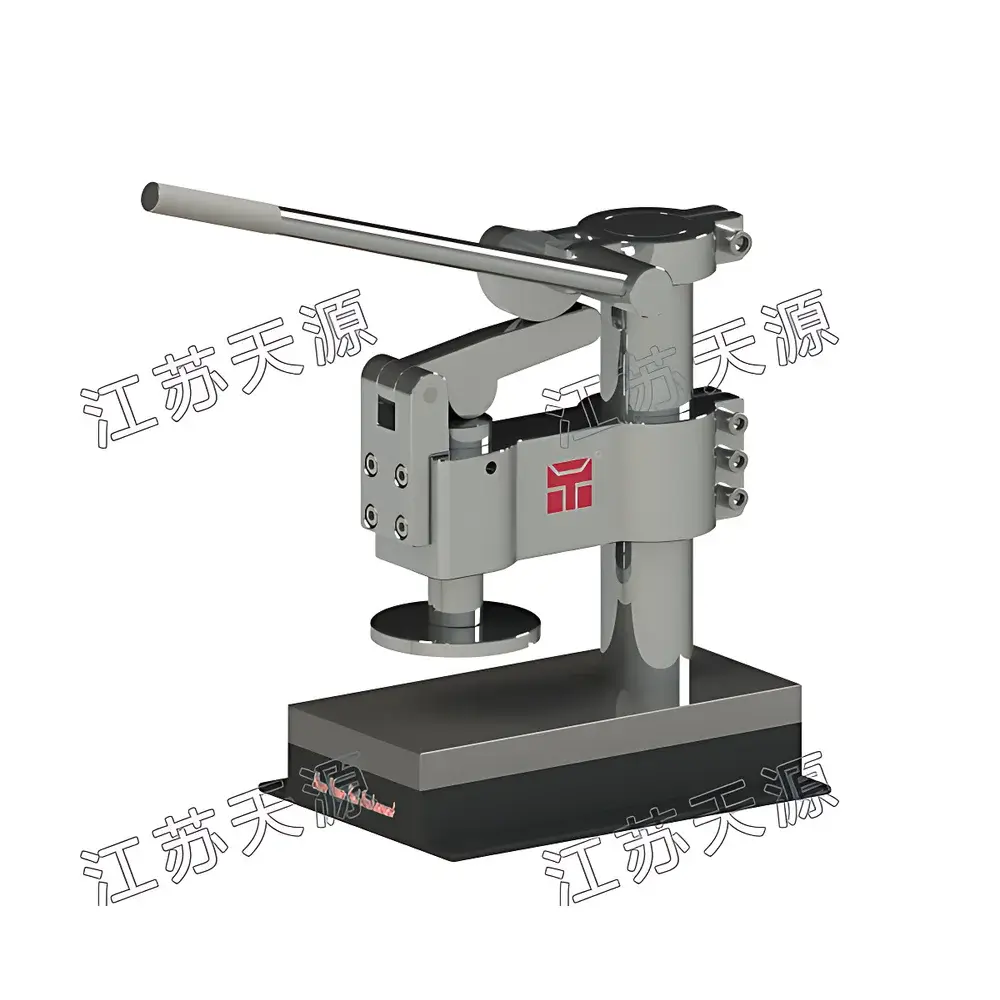
TianYuan TY-4025 Lever-Actuated Die Cutting Machine
| Brand | TianYuan |
|---|---|
| Origin | Jiangsu, China |
| Manufacturer Type | Direct Manufacturer |
| Country of Origin | China |
| Model | TY-4025 (Lever-Actuated) |
| Stroke | ~18 mm |
| Lever Arm Length | 390 mm |
| Worktable Dimensions | 150 × 200 mm |
| Overall Dimensions | 210 × 370 × 360 mm |
| Net Weight | 70 kg |
| Standard Nylon Pad Size | 82 × 155 mm |
| Die Cutter Compatibility | ASTM D3767, ISO 37, ISO 527, GB/T 528, GB/T 1040 compliant standard dies (custom dies available upon request) |
Overview
The TianYuan TY-4025 Lever-Actuated Die Cutting Machine is a precision-engineered sample preparation instrument designed specifically for the rubber and plastics testing laboratories. It operates on fundamental mechanical leverage principles—utilizing a manually actuated lever arm to transmit controlled force through a rigid frame to a die-cutting head—enabling consistent, repeatable specimen preparation without hydraulic or pneumatic assistance. This architecture ensures high positional repeatability and minimal operator-induced variability, making it suitable for standardized tensile, tear, hardness, and elongation testing per ASTM, ISO, and GB/T protocols. Unlike motorized or foot-pedal systems, the TY-4025’s purely mechanical design eliminates dependency on external power sources, reduces maintenance complexity, and enhances long-term calibration stability. Its fixed-stroke mechanism (~18 mm) guarantees uniform penetration depth across successive cuts, critical for minimizing edge deformation in elastomeric and thermoplastic sheets.
Key Features
- Lever-actuated force amplification system with 390 mm arm length—optimized for ergonomic operation while delivering sufficient cutting pressure for materials up to 6 mm thickness (e.g., vulcanized rubber compounds, PVC sheeting, TPU films, and leather substrates)
- Rigid cast-iron base and reinforced steel frame—engineered to resist torsional deflection during high-load cutting cycles, ensuring dimensional stability over >100,000 operational cycles
- Adjustable worktable (150 × 200 mm) with precision-machined T-slots—facilitates secure clamping of material blanks and rapid repositioning for multi-specimen batch processing
- Integrated nylon support pad (82 × 155 mm, included) — provides resilient backing that preserves die edge integrity and minimizes specimen burring during shearing
- Compact footprint (210 × 370 × 360 mm) and 70 kg net weight—designed for benchtop integration in QC labs with space constraints, while maintaining sufficient mass to suppress vibration-induced misalignment
Sample Compatibility & Compliance
The TY-4025 accommodates flat, flexible, and semi-rigid sheet materials within thickness ranges of 0.5–6.0 mm, including natural rubber (NR), styrene-butadiene rubber (SBR), nitrile rubber (NBR), polyethylene (PE), polypropylene (PP), polycarbonate (PC), and synthetic leathers. It supports all standard die geometries required by international test methods: dumbbell shapes per ASTM D412 and ISO 37; ring specimens per ASTM D1415; crescent tear dies per ASTM D624; and compression set punches per ASTM D395. All cut specimens meet dimensional tolerances specified in ISO/IEC 17025-accredited laboratories when used with traceable calibration dies. The machine itself conforms to CE machinery directive 2006/42/EC for mechanical safety and is compatible with GLP-compliant documentation workflows when paired with laboratory information management systems (LIMS).
Software & Data Management
As a fully manual, non-electronic instrument, the TY-4025 does not incorporate embedded firmware or digital interfaces. However, its deterministic mechanical behavior enables seamless integration into regulated environments: operators may log usage parameters (date, operator ID, material lot, die ID, specimen count) in paper-based or electronic batch records aligned with FDA 21 CFR Part 11 requirements. Optional barcode-labeled die holders and serialized nylon pads support audit-ready traceability. Calibration verification—performed quarterly using certified gauge blocks and dial indicators—is documented per ISO/IEC 17025 Section 6.4 and retained for minimum 5-year archival per GMP Annex 11 guidelines.
Applications
- Preparation of tensile test specimens for modulus, elongation at break, and stress-strain curve derivation (ASTM D412, ISO 37, GB/T 528)
- Cutting of tear resistance samples—including trouser, angle, and crescent configurations (ASTM D624, ISO 34-1)
- Generation of compression set discs and O-ring cross-sections (ASTM D395, ISO 815)
- Production of hardness test substrates requiring flat, parallel surfaces (ASTM D2240, ISO 7619)
- Prototyping and small-batch fabrication of gaskets, seals, and functional polymer components where CNC tooling is cost-prohibitive
FAQ
Is the TY-4025 compatible with non-standard die geometries?
Yes—custom die holders and mounting adapters are available for proprietary or research-specific specimen shapes, subject to mechanical clearance and stroke constraints.
What maintenance schedule is recommended?
Monthly visual inspection of lever pivot pins and worktable fasteners; biannual lubrication of fulcrum bearings with ISO VG 68 mineral oil; annual verification of stroke consistency using certified depth gauges.
Can this machine be used in ISO 17025-certified laboratories?
Yes—provided die calibration certificates, operator training records, and equipment verification logs are maintained per Clause 6.4 of ISO/IEC 17025:2017.
Does the TY-4025 require electrical power or compressed air?
No—it is a purely mechanical device requiring no utility connections, making it suitable for cleanrooms, explosion-proof zones, and mobile lab deployments.
How is die alignment verified prior to use?
Using a Class 0.5 optical alignment jig (optional accessory), users confirm concentricity between die cavity centerline and worktable reference grid within ±0.15 mm tolerance.