
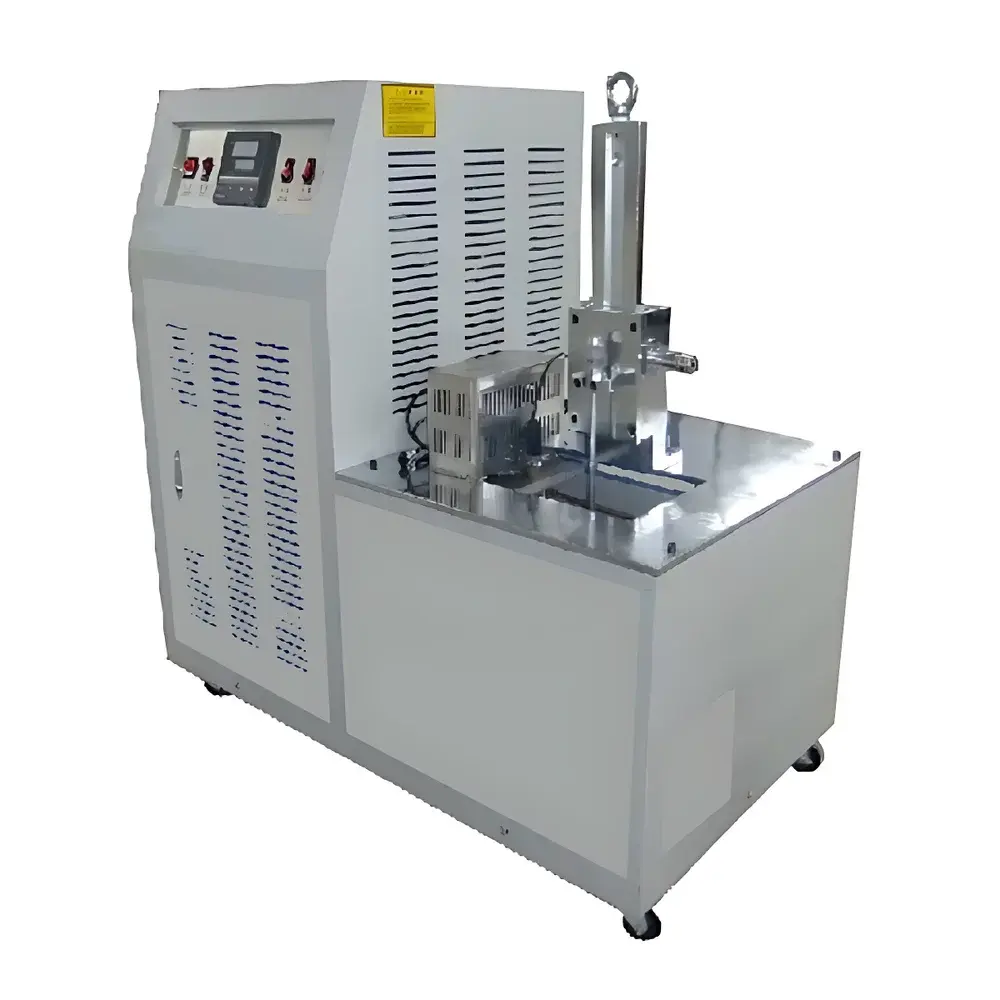
TianYuan TY-5003 Multi-Specimen Low-Temperature Brittleness Tester
| Brand | TianYuan |
|---|---|
| Origin | Jiangsu, China |
| Manufacturer Type | Direct Manufacturer |
| Product Category | Domestic Instrument |
| Model | TY-5003 (Multi-Specimen Method) |
| Pricing | Available Upon Request |
| Temperature Control Range | −70 °C |
| Temperature Stability During Test | ±0.5 °C within 3 min |
| Cooling Medium | Ethanol or Other Antifreeze Liquid |
| Specimen Capacity per Test | 5 |
| Impact Velocity | 2.0 ± 0.2 m/s |
| Minimum Impact Energy per Specimen | 3.0 J |
| Chamber Dimensions (W×H×D) | 720 × 1380 × 700 mm |
| Internal Bath Volume Dimensions | 200 × 140 × 100 mm (L×H×W) |
| Power Supply | 220–240 V~, 50 Hz, 2 kW |
| Cooling System | Cascade Compression Refrigeration |
| Compliance | GB/T 15256–2014, ISO 812:2006, ASTM D2137–94 |
Overview
The TianYuan TY-5003 Multi-Specimen Low-Temperature Brittleness Tester is an engineered solution for determining the brittle temperature of vulcanized rubber and elastomeric materials under standardized cryogenic impact conditions. It operates on the principle of multi-specimen impact testing in a thermally stabilized bath, where specimens are cooled to progressively lower temperatures and subjected to a controlled vertical impact at a defined velocity (2.0 ± 0.2 m/s) using a gravity-driven hammer mechanism. The brittle temperature is defined as the highest temperature at which at least one of five parallel specimens exhibits visible fracture or cracking after a single impact event—per the criteria specified in GB/T 15256–2014, ISO 812:2006, and ASTM D2137–94. This method enables comparative evaluation of low-temperature performance across formulations, grades, or processing batches, supporting material selection, quality assurance, and regulatory conformance in polymer R&D, QC laboratories, and production environments.
Key Features
- Integrated cascade compression refrigeration system delivering stable operation down to −70 °C with ≤ ±0.5 °C thermal fluctuation over 3-minute test intervals
- Dual-standard compliant mechanical design: precision-machined specimen holders, calibrated impact geometry (A- and B-type configurations), and traceable impact energy ≥3.0 J per specimen
- Five-specimen simultaneous clamping fixture with rigid cantilever mounting to prevent deformation during cooling and impact
- Thermally balanced cold bath with forced circulation via 15 W stirring motor, ensuring uniform coolant temperature distribution across all specimen positions
- Programmable timing control for standardized 3.0 ± 0.5 min immersion duration, synchronized with impact initiation
- Modular cold bath chamber (200 × 140 × 100 mm internal volume) compatible with ethanol or industrial antifreeze media, with level-sensing fill guidance (75 ± 10 mm depth above clamp base)
- Robust structural architecture: stainless steel housing, reinforced insulation, and front-access service panel for compressor heat dissipation
Sample Compatibility & Compliance
The TY-5003 accepts standard rectangular specimens per GB/T 15256–2014: 31.75 ± 6.35 mm length, 6.35 ± 0.51 mm width, and 1.91 ± 0.13 mm thickness. Surface finish must be smooth, free of contaminants or mechanical damage. Finished parts may be surface-ground prior to cutting. The instrument supports both A-type and B-type specimen geometries, with fully documented impact head radii (1.6 ± 0.1 mm), jaw curvature (4.0 ± 0.1 mm for A-type), and critical alignment tolerances (e.g., 3.6 ± 0.1 mm centerline clearance for A-type). All mechanical and thermal parameters are validated against ISO/IEC 17025-aligned calibration protocols. The system meets essential requirements for GLP-compliant testing environments and supports audit-ready documentation when paired with external lab notebooks or LIMS integration.
Software & Data Management
The TY-5003 operates via hardware-based digital temperature controller and independent electromechanical timer—designed for deterministic repeatability without software dependencies. While no embedded data logging or PC interface is included, its analog/digital hybrid architecture ensures immunity to firmware failure, electromagnetic interference, or OS-level vulnerabilities. Users record test outcomes manually using standardized reporting templates aligned with ISO 17025 Annex A.3 and FDA 21 CFR Part 11 principles (e.g., dated handwritten entries, witness signatures, specimen ID traceability). Optional third-party USB thermocouple loggers (e.g., Omega OM-CP-HITEMP140) may be deployed externally to capture time-stamped bath temperature profiles for validation reports or regulatory submissions.
Applications
- Comparative low-temperature performance screening of EPDM, NBR, SBR, silicone, and TPU compounds
- Batch-to-batch consistency verification in rubber compounding and extrusion processes
- Formulation optimization studies targeting improved cold-flex resistance in automotive seals, cables, and medical tubing
- Pre-qualification testing for aerospace elastomers requiring compliance with MIL-DTL-25390 or AMS3320
- Supporting ASTM D1415 (rubber hardness) and ASTM D412 (tensile properties) test series by establishing operational temperature boundaries
- Academic research on polymer crystallinity transitions, plasticizer migration effects, and cryo-induced phase separation
FAQ
What standards does the TY-5003 explicitly support?
It is fully compliant with GB/T 15256–2014 (Chinese national standard), ISO 812:2006 (international standard), and ASTM D2137–94 (U.S. standard) for multi-specimen brittle temperature determination.
Is the instrument suitable for non-rubber elastomers such as TPEs or thermoplastic polyurethanes?
Yes—provided specimens meet dimensional and surface requirements, and the material exhibits a measurable ductile-to-brittle transition within the −70 °C to +30 °C range.
Can test data be exported digitally?
The base unit does not include USB, Ethernet, or Bluetooth connectivity. However, external calibrated data loggers can be used to record bath temperature vs. time for inclusion in electronic lab notebooks or PDF validation dossiers.
What maintenance is required for long-term reliability?
Annual inspection of refrigerant charge, condenser coil cleaning, stirrer motor lubrication, and mechanical verification of impact head alignment and drop height are recommended. Compressor service should follow manufacturer-recommended intervals based on cumulative runtime hours.
Does the system require special electrical infrastructure?
It operates on standard single-phase 220–240 V~, 50 Hz supply with 2 kW peak draw. A dedicated 16 A circuit with earth leakage protection is advised. No three-phase or uninterruptible power supply is necessary.





