
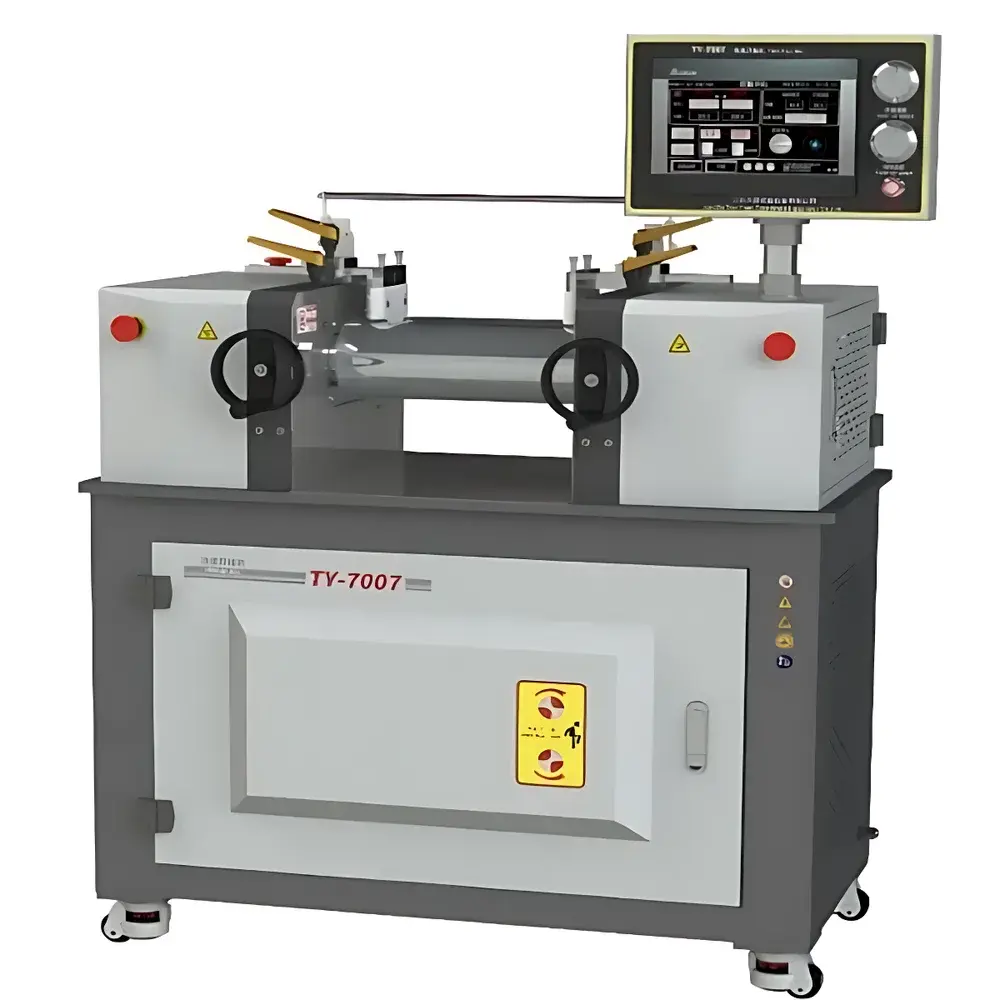
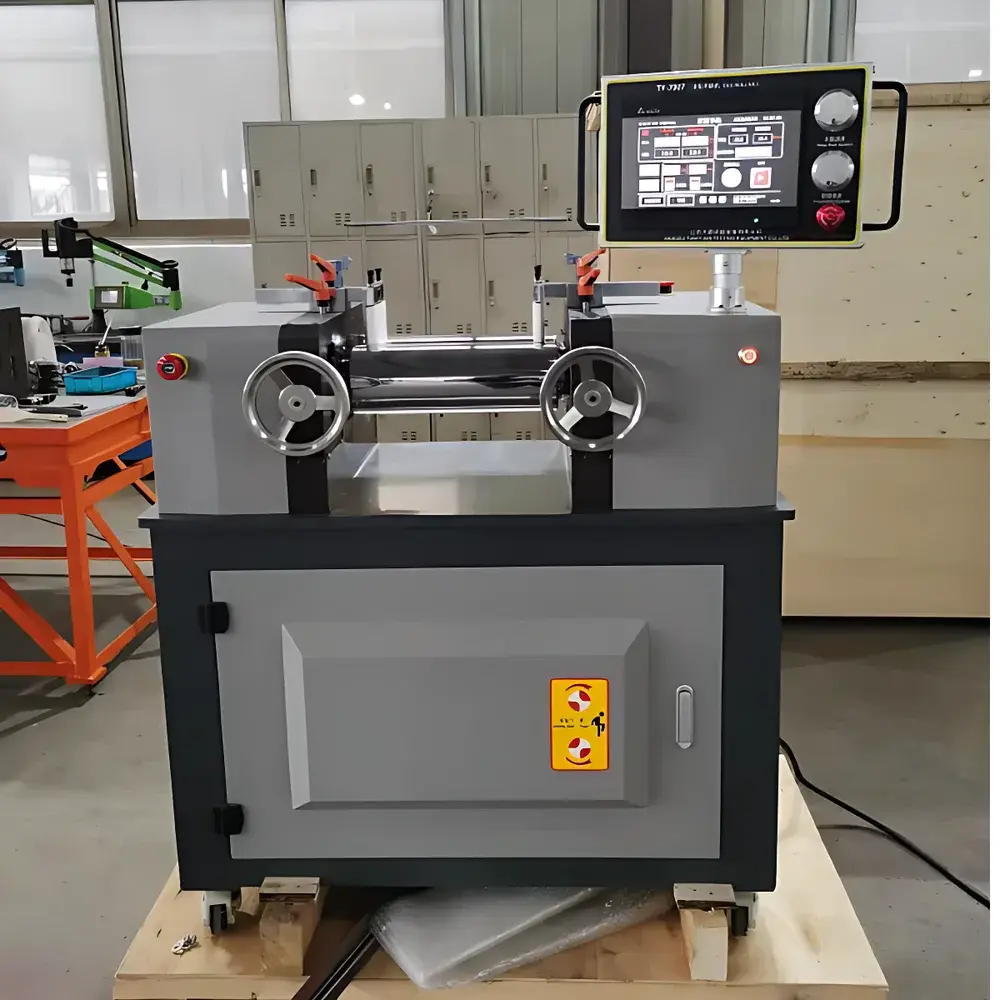
TianYuan TY-7007A Open Two-Roll Mill for Rubber & Plastic Compounding
| Brand | TianYuan |
|---|---|
| Origin | Jiangsu, China |
| Manufacturer Type | Direct Manufacturer |
| Region Classification | Domestic (China) |
| Model | TY-7007A |
| Price Range | USD 9,800 – 13,900 |
| Temperature Range | Ambient to 300 °C |
| Control System | PLC-based color touchscreen HMI |
| Heating Method | Electric heating |
| Temperature Accuracy | ±3 °C |
| Roll Dimensions | Ø120 mm × 350 mm (L) |
| Roll Gap Adjustment | 0–10 mm (motorized, micrometer-graduated) |
| Roll Material | Hard-chrome-plated alloy steel |
| Surface Hardness | HRC 58–62 |
| Surface Finish | Mirror-polished chrome |
| Roll Speed | 0–60 rpm (dual servo-driven, independently adjustable) |
| Speed Ratio Control | Continuously variable (1:1 to 1:3.5) |
| Total Power Consumption | 4 kW |
| Safety Systems | Mechanical pull-bar emergency stop, foot-activated reverse function, dual-hand safety interlock |
| Overall Dimensions (W×D×H) | 1030 × 520 × 1410 mm |
| Electrical Supply | AC 380 V, 3-phase, 5-wire |
Overview
The TianYuan TY-7007A Open Two-Roll Mill is an engineered compounding and dispersion platform designed for laboratory-scale formulation development and quality control in rubber, thermoplastic elastomer (TPE), and filled polymer systems. Operating on the principle of shear-dominated mixing between two counter-rotating, temperature-controlled rolls, the mill subjects viscous materials to controlled mechanical work, thermal history, and residence time—enabling homogeneous dispersion of fillers (e.g., carbon black, silica, CaCO₃), pigments, plasticizers, and curatives. Its dual-servo drive architecture allows independent speed control of each roll, facilitating precise adjustment of the speed ratio (n₁/n₂), a critical parameter governing shear rate distribution, material build-up, and dispersion efficiency. The mill’s robust cast-iron frame, precision-ground chrome-plated rolls, and integrated thermal management system ensure dimensional stability and process repeatability across extended operation cycles.
Key Features
- Dual independent servo motor drives enabling continuous, stepless adjustment of roll speeds (0–60 rpm) and speed ratios (1:1 to 1:3.5), supporting both forward and reverse nip configurations.
- Electrically heated, mirror-finished chrome rolls (Ø120 × 350 mm) with surface hardness HRC 58–62 and uniform thermal profile across the entire working length.
- PLC-based control system with 7-inch color touchscreen HMI for real-time monitoring and logging of roll temperature, surface speed, gap setting, and operational status.
- Precision-micrometer roll gap adjustment (0–10 mm range) with digital position feedback and mechanical lock for repeatable batch-to-batch setup.
- Integrated safety architecture compliant with ISO 13857 and IEC 60204-1, including dual-hand palm buttons, knee-activated reverse function, pull-bar emergency stop, and automatic roll separation upon power loss.
- Thermal control accuracy of ±3 °C over the full operating range (ambient to 300 °C), achieved via PID-regulated zone heating and embedded Pt100 RTD sensors at multiple axial positions.
Sample Compatibility & Compliance
The TY-7007A accommodates a broad spectrum of viscoelastic materials—including natural and synthetic rubbers (NR, SBR, EPDM, NBR), thermoplastics (PP, PE, PVC, TPU), masterbatches, and reactive compounds. Its open-roll geometry supports manual sheeting, flaking, and banding operations essential for pre-forming before vulcanization or extrusion. The machine meets CE machinery directive requirements (2006/42/EC) and conforms to general electrical safety standards (IEC 60204-1). While not certified to UL or CSA out-of-the-box, its design permits third-party certification for North American deployment. For regulated environments (e.g., ISO 17025-accredited labs or GMP-compliant R&D facilities), optional audit-ready data logging (with timestamped parameter records) and electronic signature support can be enabled per FDA 21 CFR Part 11 guidelines.
Software & Data Management
The onboard PLC controller stores up to 99 user-defined process recipes, each containing target temperatures, speed profiles, gap settings, and dwell times. All operational events—including start/stop timestamps, temperature deviations >±5 °C, emergency stops, and parameter modifications—are automatically logged with UTC timestamps and retained for ≥30 days. Export is supported via USB interface in CSV format for traceability and statistical process analysis (SPC). Optional Ethernet/IP or Modbus TCP communication enables integration into centralized MES or LIMS platforms for automated batch reporting and equipment utilization analytics.
Applications
- Rubber compound development: filler dispersion optimization, scorch safety evaluation, and viscosity profiling via Mooney-like sheeting tests.
- TPE and thermoset pre-compounding: dry blending verification, pigment homogenization, and thermal stabilization trials prior to extrusion or injection molding.
- Quality assurance: incoming raw material consistency checks (e.g., polymer melt flow index correlation), batch release testing, and failure root-cause analysis.
- Academic research: rheological behavior mapping under defined shear/thermal histories, crosslinking kinetics studies, and nanocomposite dispersion validation using TEM/SEM sample preparation.
- Process scale-up support: generating reproducible lab-scale batches for downstream extruder or calender feedstock qualification.
FAQ
What is the maximum recommended batch weight for consistent dispersion?
For optimal shear transfer and temperature uniformity, the standard recommendation is 300–500 g per pass; heavier loads (>700 g) may require extended mastication time and increase risk of localized overheating.
Can the TY-7007A be used for hot milling of sulfur-cured compounds?
Yes—provided the set temperature remains below the scorch point of the compound and dwell time is strictly controlled. The mill’s rapid cooling capability (forced-air assisted) supports safe handling of semi-vulcanized stocks.
Is remote monitoring or cloud-based data backup available?
Standard configuration includes local USB export; optional IoT gateway modules enable secure MQTT-based telemetry to private cloud instances or Microsoft Azure IoT Hub for predictive maintenance alerts.
Does the machine support ASTM D3182 or ISO 289-1 test protocols?
While not pre-configured as a dedicated test instrument, its mechanical and thermal specifications align with the operational envelope required by ASTM D3182 (rubber mixing procedures) and ISO 289-1 (Mooney viscometer calibration reference methods), making it suitable for method-developed QC workflows.
What maintenance intervals are recommended for the chrome rolls and drive system?
Roll surface inspection and light polishing every 200 operational hours; servo motor grease replacement every 5,000 hours; annual calibration of RTD sensors and torque verification of roll bearings per manufacturer service bulletin TY-SV-2023-07.






