
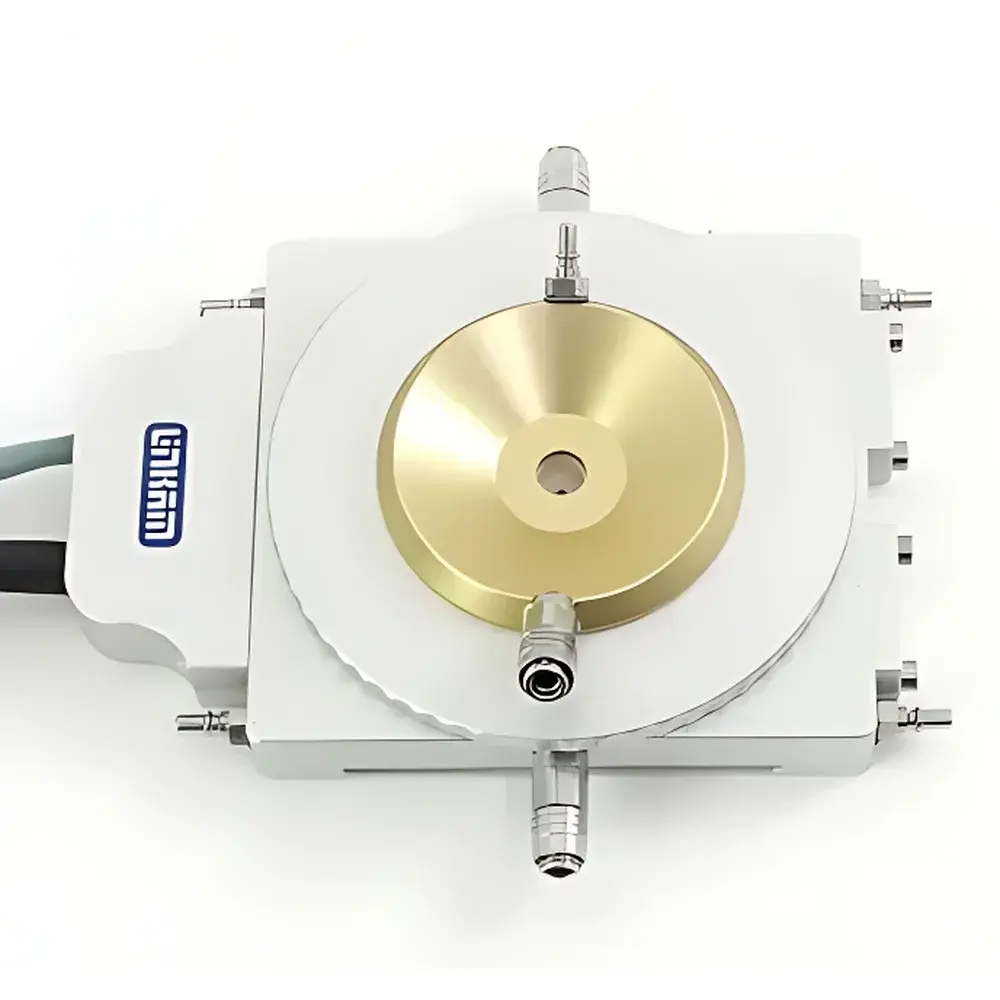
Linkam TS1500 High-Temperature Heating Stage
| Brand | Linkam |
|---|---|
| Origin | United Kingdom |
| Model | TS1500 |
| Temperature Range | Ambient to 1500 °C |
| Temperature Accuracy & Stability | ±1 °C over full range |
| Optical Aperture Diameter | 1.7 mm |
| Sample Chamber Dimensions | φ7 × 6 mm or φ7 × 3 mm |
| Maximum Heating Rate | 200 °C/min |
| Minimum Objective/Condenser Working Distance | 6.0 mm / 14.8 mm |
| Vacuum Compatibility | Down to 10⁻³ mbar |
Overview
The Linkam TS1500 is a precision-engineered high-temperature heating stage designed for in situ optical microscopy and spectroscopic analysis under controlled thermal conditions up to 1500 °C. Built upon Linkam’s established Couette-flow–inspired thermal architecture, the TS1500 employs a platinum-wound ceramic crucible as its core heating element—providing uniform radial and axial heat distribution while maintaining structural integrity at extreme temperatures. The sample chamber is defined by a φ7 mm internal bore, accommodating either 6 mm or 3 mm deep configurations to suit diverse specimen geometries and optical path requirements. A calibrated thermocouple is embedded flush with the inner surface of the ceramic cup, directly adjacent to a 7 mm-diameter sapphire disc that serves both as thermal interface and optical substrate. Sapphire’s exceptional thermal conductivity (>35 W/m·K at 1000 °C), broad transmission range (0.15–5.5 µm), and mechanical stability ensure minimal thermal lag and high-fidelity temperature measurement—critical for kinetic studies involving phase transitions, sintering, or crystal growth.
Key Features
- Temperature range from ambient to 1500 °C with ±1 °C accuracy and long-term stability across the entire span—validated per ISO/IEC 17025 traceable calibration protocols.
- Optimized optical design featuring a 1.7 mm central aperture compatible with transmitted-light microscopy, FTIR, Raman, and synchrotron beamline applications.
- Rapid thermal response enabled by a low-thermal-mass ceramic heater and DC-powered solid-state controller—achieving heating rates up to 200 °C/min without overshoot or thermal drift.
- Hermetically sealed sample chamber supports inert gas purging (N₂, Ar) or vacuum operation down to 10⁻³ mbar; optional feedthroughs allow simultaneous electrical biasing for resistivity, dielectric, or electrochemical characterization.
- Integrated water-cooled housing and radiation-shielded cap prevent thermal transfer to microscope objectives and condensers—maintaining working distances of ≥6.0 mm (objective) and ≥14.8 mm (condenser) even at peak temperature.
- Dual-zone independent temperature control enables precise gradient management between sample zone and chamber periphery—essential for studying interfacial phenomena such as grain boundary migration or liquid-phase epitaxy.
Sample Compatibility & Compliance
The TS1500 accommodates a wide range of solid-state samples including ceramics, metallic alloys, geological thin sections, polymer composites, and battery electrode materials. Its sapphire-based platform ensures compatibility with corrosive or reactive atmospheres when used with appropriate gas-handling accessories. The system conforms to key international standards governing thermal instrumentation: ASTM E1142 (standard guide for high-temperature microscopy), ISO 11357-3 (DSC calibration using reference materials), and IEC 61000-6-3 (EMC compliance for laboratory environments). When operated with Linkam’s TMS94 temperature controller and associated software, the TS1500 supports audit-ready data logging compliant with FDA 21 CFR Part 11 requirements—including electronic signatures, time-stamped event logs, and immutable parameter history.
Software & Data Management
Control and monitoring are executed via Linkam’s proprietary Linksys software, a Windows-based application supporting real-time temperature profiling, multi-step ramp/soak sequences, and synchronized acquisition triggers for external detectors (e.g., CCD cameras, spectrometers). All thermal events—including power output, thermocouple voltage, cooling water flow status, and vacuum pressure—are logged at user-selectable intervals (down to 100 ms resolution) and exported in CSV or HDF5 format for post-processing in MATLAB, Python (NumPy/Pandas), or OriginLab. The software architecture includes built-in GLP/GMP validation tools, enabling laboratories to perform IQ/OQ/PQ documentation packages aligned with ISO 13485 and ISO 9001 quality management systems.
Applications
- In situ observation of ceramic sintering kinetics and pore evolution during densification.
- Phase transformation mapping in metallurgical alloys (e.g., austenite → martensite, γ → α transitions).
- Thermal stability assessment of perovskite solar cell layers under inert atmosphere.
- Real-time crystallization behavior of pharmaceutical polymorphs above glass transition temperatures.
- High-temperature dielectric spectroscopy of ferroelectric thin films using integrated electrode variants.
- Geological mineralogical studies involving dehydration reactions and melt formation in silicate systems.
FAQ
What objective working distance is required to use the TS1500 with standard upright microscopes?
A minimum working distance of 6.0 mm is required for the objective lens; this is maintained across the full temperature range due to active water cooling of the stage body.
Can the TS1500 be used under vacuum and with electrical biasing simultaneously?
Yes—the stage supports combined vacuum-electrode configurations with vacuum-rated feedthroughs rated for ≤10⁻³ mbar and DC/AC potentials up to ±200 V.
Is calibration documentation provided with the instrument?
Each TS1500 ships with a factory-issued calibration certificate traceable to NPL (UK) standards, covering thermocouple linearity, temperature uniformity across the sample area, and heating rate verification.
How is temperature uniformity ensured within the sample chamber?
Uniformity is achieved through symmetric platinum coil winding, ceramic thermal mass optimization, and dynamic feedback from the embedded thermocouple—verified to ±1.5 °C across the central 3 mm diameter at 1500 °C.
Does the system support automated integration with third-party imaging platforms?
Yes—Linksys provides a documented COM API and LabVIEW/VB.NET drivers for seamless synchronization with commercial microscope control suites and custom acquisition software.




