
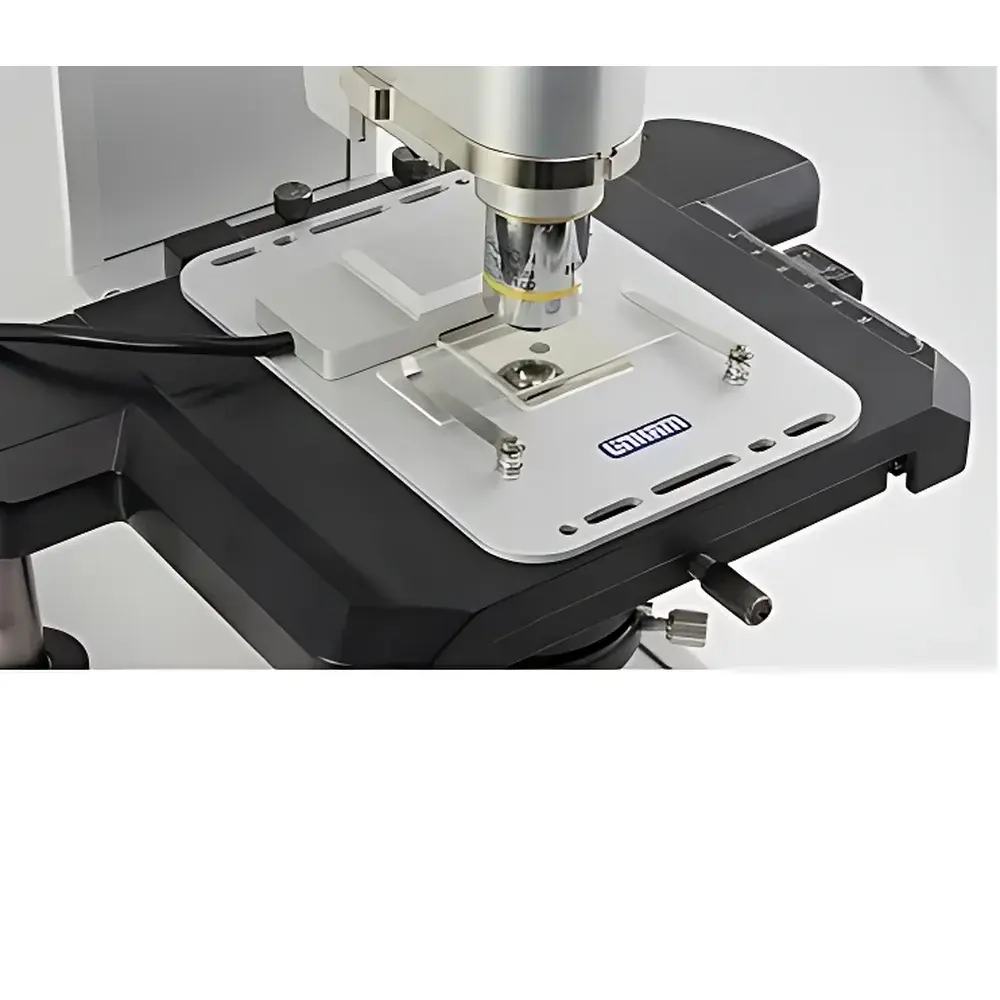
Linkam PE120 Peltier Thermal Stage
| Brand | Linkam |
|---|---|
| Origin | United Kingdom |
| Model | PE120 |
| Temperature Range | −25 °C to +120 °C |
| Heating/Cooling Rate | 0.1–20 °C/min |
| Stage Aperture Diameter | 5 mm |
| Sample Area | 35 × 32 mm |
| Temperature Stability & Accuracy | ±0.1 °C |
| Sensor | Pt100 Platinum Resistance Thermometer |
| Control Interface | LCD Touchscreen |
| Minimum Objective Working Distance | 0.1 mm |
| Minimum Condenser Working Distance | 5 mm |
| Stage Dimensions (PE120XY) | 160 × 110 mm |
| Cooling Method | External Recirculating Chiller (ECP Series) |
| Compatibility | Olympus BX, Nikon Ni-E/Ni-U, Zeiss Axio Imager/Axioskop with Optional Mount Adapters |
Overview
The Linkam PE120 Peltier Thermal Stage is a precision-engineered optical platform designed for in situ temperature-controlled microscopy and spectroscopy applications. Built upon solid-state Peltier thermoelectric technology, the system delivers bidirectional thermal control—capable of both heating and cooling—without mechanical refrigerants or cryogenic gases. Its core architecture integrates three modular subsystems: the PE120 stage body, the PE-series digital temperature controller, and an external ECP recirculating chiller unit. This configuration enables stable, reproducible thermal regulation across a wide operational range (−25 °C to +120 °C), with ramp rates programmable from 0.1 to 20 °C/min. The stage is optimized for integration with upright and inverted optical microscopes, Raman spectrometers, FTIR systems, and X-ray diffraction setups where real-time observation under controlled thermal conditions is essential. Its compact aperture (5 mm clear optical path) and minimal objective working distance (0.1 mm) support high-magnification, oil-immersion, and long-working-distance objective configurations without compromising optical throughput or mechanical stability.
Key Features
- Peltier-based thermoelectric actuation ensures silent, vibration-free operation—critical for high-resolution imaging and interferometric measurements.
- High-precision Pt100 resistance thermometer embedded directly in the stage surface provides real-time feedback with ±0.1 °C accuracy and long-term thermal stability over extended experiments.
- Intuitive LCD touchscreen interface on the PE controller enables standalone operation, including multi-segment ramp/soak profiles, manual setpoint adjustment, and real-time temperature logging.
- Optimized mechanical design accommodates standard microscope mounting interfaces; dedicated adapter kits are available for Olympus BX, Nikon Ni-E/Ni-U, and Zeiss Axio Imager/Axioskop platforms.
- Modular cooling architecture supports integration with ECP-series recirculating chillers, ensuring consistent heat dissipation during sustained low-temperature operation or rapid thermal cycling.
- Low-profile construction maintains compatibility with high-NA objectives—including CFI Plan Apochromat 60× oil and EC Plan Apochromat 63× oil lenses—via purpose-built variants (e.g., PE-CFI60, PE-EC63).
Sample Compatibility & Compliance
The PE120 stage supports a broad spectrum of sample formats—including thin films, single crystals, polymer blends, biological tissues, and hydrated gels—within its 35 × 32 mm sample area. Its open-top design permits direct access for micro-manipulation, electrode placement, or gas/vapor environment control when used with optional environmental chambers. The system conforms to ISO/IEC 17025 calibration traceability requirements when operated with certified Pt100 sensors and validated temperature profiles. While not inherently classified as medical or diagnostic equipment, its thermal performance and documentation support GLP-compliant materials characterization workflows in academic, industrial, and regulatory research environments (e.g., polymer phase transition analysis per ASTM D3418, crystallization kinetics per ISO 11357).
Software & Data Management
The PE controller includes USB and RS232 connectivity for integration with third-party acquisition software (e.g., NIS-Elements, ZEN, LabVIEW, Python-based instrument control frameworks). Temperature profiles can be exported in CSV format for post-acquisition correlation with image stacks, spectral time series, or diffraction pattern sequences. Audit-trail functionality—including timestamped setpoints, actual temperatures, and error logs—is retained onboard for up to 72 hours, facilitating compliance with internal quality procedures. For laboratories operating under FDA 21 CFR Part 11 requirements, optional software validation packages and electronic signature modules are available through Linkam’s certified support channel.
Applications
- Polymorph screening and solid-state phase transitions in pharmaceutical development.
- In situ observation of liquid crystal alignment, polymer melt crystallization, and glass transition behavior.
- Thermally induced conformational changes in proteins and lipid bilayers using fluorescence or polarized light microscopy.
- Correlative Raman-thermal mapping of battery electrode degradation mechanisms.
- Calibration and validation of thermal expansion coefficients in MEMS/NEMS devices via digital image correlation (DIC).
- Controlled dehydration/rehydration studies of plant tissues and hydrogels under variable humidity-temperature regimes (when paired with optional humidity modules).
FAQ
What microscope models are natively compatible with the PE120 stage?
The PE120 is supplied in application-specific variants: PE-BX120 for Olympus BX series, PE-NK120 for Nikon manual stages, PE-ZE120 for Zeiss Axioskop/Axio Imager, and specialized versions (e.g., PE-CFI60, PE-EC63) engineered for oil-immersion objectives with tight working distance constraints.
Is the PE120 suitable for vacuum or inert-gas environments?
The base PE120 stage is rated for ambient atmospheric use only. For vacuum or controlled-atmosphere applications, Linkam offers sealed variants (e.g., TS1500, THMS600) with feedthrough-compatible electrical and fluid connections.
Can temperature data be synchronized with camera acquisition timestamps?
Yes—via TTL trigger output and serial command protocol, the PE controller allows frame-accurate temporal alignment between thermal events and image capture in supported software environments.
What chiller specifications are required for optimal low-temperature performance?
An ECP chiller with ≥200 W cooling capacity at −25 °C and flow rate ≥1.5 L/min is recommended to maintain specified ramp rates and stability below 0 °C.
Does the system support automated scripting for multi-step thermal protocols?
The PE controller firmware supports up to 16 user-defined ramp/soak segments; full programmatic control—including dynamic parameter updates during run-time—is enabled via ASCII command set over USB/RS232.



