
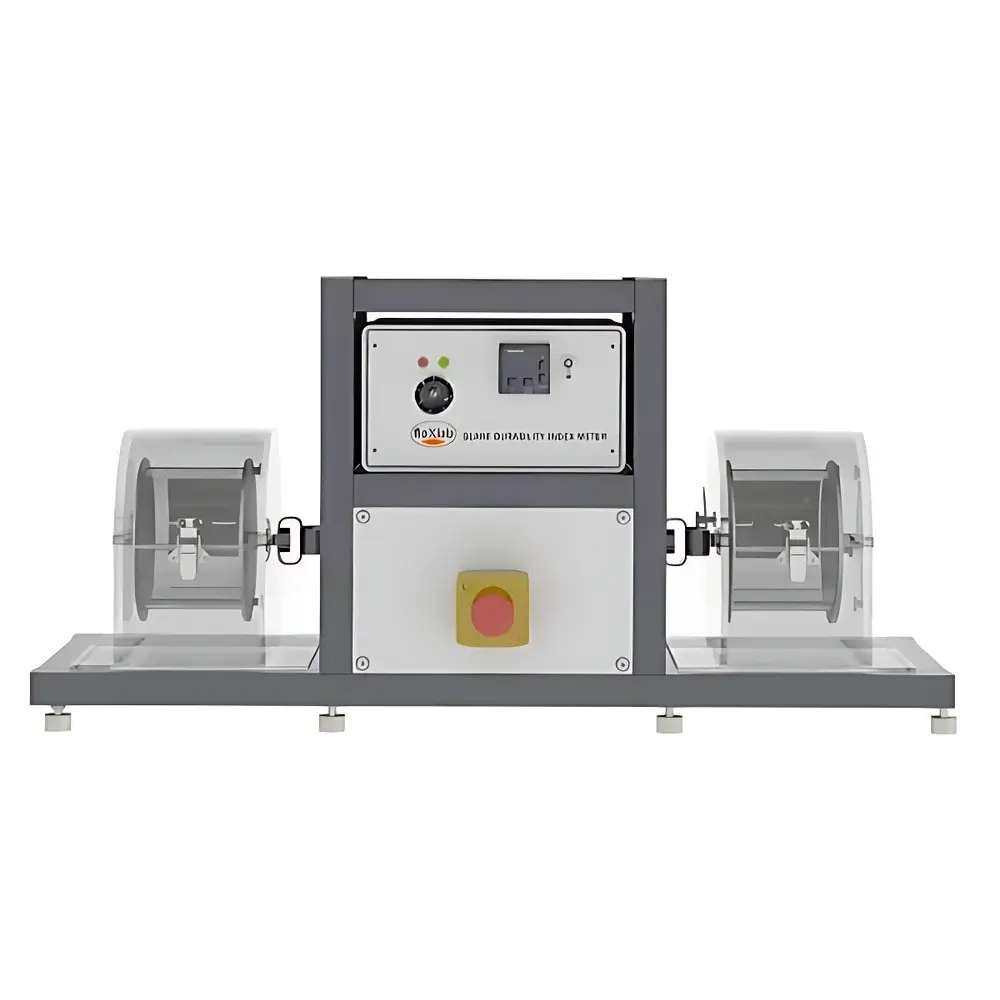
Brookfield SDIM100 Rock Disintegration Resistance Tester
| Brand | FLOXLAB |
|---|---|
| Origin | France |
| Model | SDIM100 |
| Standard Compliance | ASTM D4644, ISRM Suggested Method |
| Rotational Speed | 20 rpm |
| Dimensions (W×H×L) | 300 × 500 × 500 mm |
| Weight | 30 kg |
| Power Supply | 220 V, 50/60 Hz |
Overview
The Brookfield SDIM100 Rock Disintegration Resistance Tester is a precision-engineered instrument designed to quantify the resistance of weakly cemented or highly porous rock materials to physical disintegration under repeated wet-dry cycling. Based on the standardized drum rotation principle, the device subjects cylindrical or irregular rock specimens to controlled immersion and rotational agitation in water, simulating natural weathering processes such as capillary ingress, freeze-thaw preconditioning, and cyclic hydration-dehydration stress. The test output—expressed as residual mass percentage after a defined number of revolutions—is directly correlated with rock durability, clay mineral content, and degree of cementation. This measurement forms a critical input for geotechnical classification, slope stability assessment, and long-term performance prediction of engineered fills, road subbases, and quarry waste materials.
Key Features
- Compliant drum geometry and rotational kinematics per ASTM D4644 and ISRM Suggested Method for Rock Disintegration Testing, ensuring inter-laboratory reproducibility.
- Fixed-speed 20 rpm motor drive with ±0.5 rpm speed stability, eliminating variability from inconsistent angular velocity during the 10-minute standard test cycle (1200 revolutions).
- Stainless-steel sample drum with precisely machined perforations (2 mm diameter) to facilitate uniform water exchange while retaining fragmented particles above the sieve threshold.
- Integrated splash guard and removable water reservoir with level indicator, enabling consistent immersion depth (±2 mm tolerance) across sequential tests.
- Compact benchtop footprint (300 × 500 × 500 mm) and low mass (30 kg) for straightforward integration into geotechnical labs, field testing units, or mobile core logging facilities.
- Universal power input (220 V, 50/60 Hz) with internal voltage regulation, supporting stable operation in diverse regional electrical environments without external transformers.
Sample Compatibility & Compliance
The SDIM100 accommodates rock specimens conforming to ASTM D4644 dimensional requirements: nominal diameter of 40–50 mm and length-to-diameter ratio between 1.0 and 2.0. Specimens must be air-dried to constant mass prior to testing and weighed to ±0.01 g accuracy using a Class I analytical balance. The instrument supports both intact core segments and hand-broken clasts from sedimentary, volcaniclastic, and highly weathered metamorphic formations—including mudstones, siltstones, tuffs, lateritic duricrusts, and saprolites. All test procedures, data recording, and reporting align with ISO/IEC 17025:2017 general requirements for competence of testing laboratories. Results are traceable to NIST-traceable mass standards and documented in accordance with GLP principles for regulatory submissions related to landfill liner evaluation or mine waste characterization.
Software & Data Management
The SDIM100 operates as a standalone mechanical tester with no embedded microprocessor or digital interface. However, its protocol-driven workflow is fully compatible with laboratory information management systems (LIMS) and electronic lab notebooks (ELN). Test parameters—including specimen ID, pre-test dry mass, post-test retained mass, calculated disintegration index (%), and operator signature—are manually recorded in standardized templates compliant with FDA 21 CFR Part 11 when used in regulated environmental or mining compliance contexts. Optional barcode-scannable log sheets and PDF report generators (via third-party LIMS modules) support audit-ready documentation for ISO 9001-certified QA/QC programs.
Applications
- Geotechnical site characterization for highway embankments and railway ballast where disintegration susceptibility affects long-term bearing capacity.
- Evaluation of excavated material suitability for reuse in earthworks, particularly in regions with high seasonal humidity variation.
- Quality control of manufactured aggregate products intended for hydraulic structures subject to cyclic saturation.
- Research into clay–water interaction mechanisms in low-strength rocks, including swelling pressure development and pore network evolution.
- Supporting ASTM D5777–21 (Standard Guide for Geotechnical Drilling) by providing durability metrics for core recovery interpretation.
FAQ
What rock types are most appropriate for SDIM100 testing?
The instrument is optimized for weakly bonded, fine-grained, or clay-rich rocks exhibiting visible disintegration within 10 minutes of rotation—such as shale, mudstone, weathered sandstone, and volcanic tuff. Highly competent granites or quartzites typically yield >95% residual mass and fall outside the effective discrimination range.
Is calibration required before each test?
No routine calibration is specified in ASTM D4644; however, periodic verification of drum rotational speed (using a certified tachometer) and balance accuracy is recommended at intervals aligned with laboratory quality assurance schedules (e.g., daily pre-use check, weekly full verification).
Can the SDIM100 be used for soil-like materials?
It is not intended for cohesive soils meeting ASTM D2487 classification; soil disintegration behavior is assessed via different protocols (e.g., slaking tests per ASTM D4221). The SDIM100 targets rock fragments ≥20 mm in minimum dimension.
Does the device meet CE or UKCA marking requirements?
As an electromechanical benchtop tester operating below 50 V SELV thresholds and lacking programmable logic controllers, the SDIM100 falls outside the scope of the EU Machinery Directive 2006/42/EC. Its design conforms to IEC 61000-6-3 (EMC emission limits) and IEC 61000-6-2 (immunity), and it carries the FLOXLAB manufacturer’s Declaration of Conformity for general electrical safety under EN 61010-1.



