
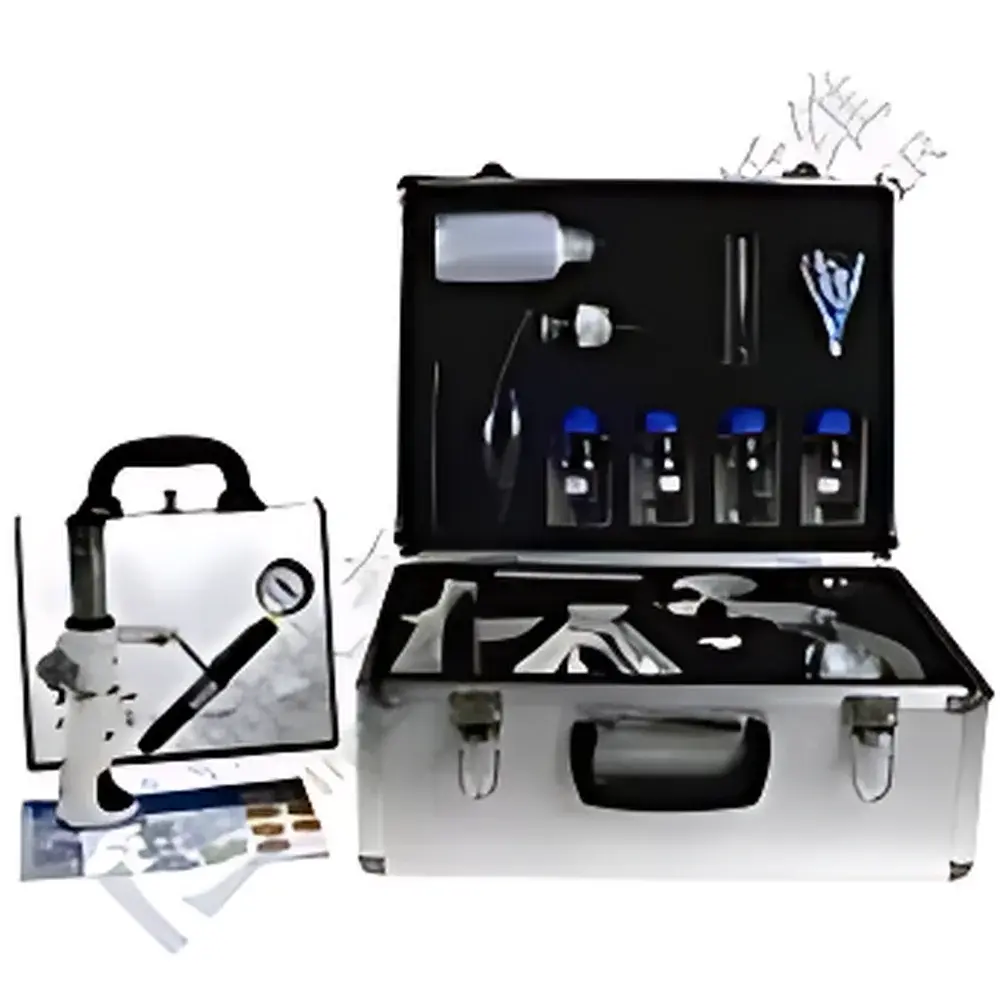
TimePower TP691 Portable Oil Particle Contaminometer
| Brand | TimePower |
|---|---|
| Origin | Beijing, China |
| Manufacturer Type | OEM Manufacturer |
| Country of Origin | China |
| Model | TP691 |
| Pricing | Available Upon Request |
| Compliance Standards | DL/T 432–2007, GB/T 20082–2006, ISO 4407:2017 |
| Detection Principle | Membrane Filtration + Microscopic Comparison |
| Particle Size Threshold | ≥5 µm |
| Rating Scale | NAS 1638 Classes 0–12 |
| Magnification | 100× (Transmitted Light Illumination) |
| Vacuum Filtration System | Integrated Manual Vacuum Pump (Mityvac® Compatible) |
| Filter Membrane | SMWP02500, 5.0 µm Pore Size, Polycarbonate, Smooth Surface |
| Dimensions | 420 × 330 × 220 mm |
| Weight | 6.64 kg |
| Application Scope | Phosphate Ester Turbine Oil, Mineral Turbine Oil, Transformer Oil, Hydraulic Fluids, and Other Industrial Lubricants with High Viscosity or Emulsified Conditions |
Overview
The TimePower TP691 Portable Oil Particle Contaminometer is a field-deployable, membrane-based particle counting system engineered for rapid, standardized assessment of particulate contamination in industrial lubricants and insulating oils. It operates on the principle of vacuum-assisted membrane filtration followed by optical microscopic evaluation—fully aligned with the gravimetric and comparative methodologies specified in ISO 4407:2017, DL/T 432–2007, and GB/T 20082–2006. Unlike laser-based inline counters, the TP691 employs a deterministic, human-verified visual classification protocol: oil samples are drawn through a 5.0 µm-rated polycarbonate membrane under controlled vacuum, depositing particles in a spatially dispersed monolayer; the retained residue is then examined under 100× transmitted-light magnification against a certified 12-level NAS 1638 reference template. This approach ensures traceability, operator independence, and regulatory acceptability—particularly critical for power generation assets where emulsified or high-viscosity oils (e.g., aged phosphate ester fluids in EH control systems) preclude reliable optical sensing via automated sensors.
Key Features
- Field-ready portable architecture: Compact footprint (420 × 330 × 220 mm), lightweight design (6.64 kg), and integrated manual vacuum pump enable on-site testing without external power or compressed air.
- Dedicated filtration subsystem: Includes Mityvac-compatible manual vacuum pump, 30 mL borosilicate glass filter flask with integrated tubing, dual 1.2 mm filtration caps, and SMWP02500 smooth-surface 5.0 µm polycarbonate membranes—optimized for viscous and water-contaminated oils.
- Standardized optical evaluation: 100× transmitted-light microscope with adjustable LED illumination ensures consistent contrast and depth-of-field for reliable particle morphology recognition and size grouping per NAS 1638 binning criteria.
- Traceable calibration framework: Supplied 12-grade NAS reference template conforms to ISO 4407 Annex A and is validated for use in GLP-compliant laboratories and power plant QA/QC workflows.
- Robust mechanical construction: All core components—including sample handling tools (stainless steel tweezers), solvent-resistant plastic wash bottles (250 mL), and inert blue-cap HDPE sampling vials—are selected for chemical compatibility with hydrocarbon, ester, and synthetic base oils.
Sample Compatibility & Compliance
The TP691 is explicitly validated for use with phosphate ester anti-wear hydraulic fluids (e.g., Fyrquel®, Skydrol®), mineral-based turbine oils (ISO VG 32–68), inhibited transformer oils (IEC 60296), and other auxiliary lubricants exhibiting viscosities up to 200 cSt at 40 °C or moderate water-in-oil emulsions (<300 ppm). Its filtration-first methodology eliminates refractive index interference and bubble artifacts common in light-scattering instruments. Regulatory alignment includes full technical conformance with ISO 4407:2017 (Method A – Microscopic Determination), DL/T 432–2007 (Chinese Power Industry Standard for Oil Cleanliness Assessment), and GB/T 20082–2006 (National Standard for Hydraulic Fluid Contamination Classification). The system supports audit-ready documentation per ISO/IEC 17025 and is routinely deployed in environments subject to NERC PRC-005, IEEE C57.106, and IEC 60422 compliance requirements.
Software & Data Management
The TP691 is a hardware-only, non-digital instrument—intentionally designed to eliminate firmware dependencies, cybersecurity vulnerabilities, or software validation overhead. All measurement records are manually documented using standardized lab notebooks or LIMS-integrated paper forms referencing the included NAS grading template. This analog workflow satisfies FDA 21 CFR Part 11 “non-electronic record” provisions and simplifies qualification under GxP, ISO 9001, and EN 15378 audit protocols. Optional digital integration may be achieved via third-party microscope-mounted USB cameras (not supplied) coupled with validated image analysis software—provided such additions undergo full IQ/OQ/PQ and change control per organizational SOPs.
Applications
- Condition monitoring of electro-hydraulic control (EHC) systems in thermal and nuclear power plants.
- Routine cleanliness verification of transformer oil prior to commissioning or after maintenance interventions.
- Root-cause analysis of servo-valve failures linked to silt-lock or abrasive wear.
- Acceptance testing of new oil batches against OEM cleanliness specifications (e.g., GEK 32568, Siemens TLV 9000).
- Research and development of filtration media performance under real-world fluid degradation scenarios.
- Third-party certification for oil reclamation services operating under ASTM D6792 or ISO 4406:2017 reporting frameworks.
FAQ
Is the TP691 compliant with ISO 4406:2017?
No—the TP691 implements ISO 4407:2017 (microscopic comparison method), not ISO 4406:2017 (automated particle counter reporting). However, NAS-class results can be cross-referenced to ISO 4406 codes using published conversion tables per ISO TR 11171 Annex B.
Can it analyze water-contaminated or milky oil samples?
Yes—its vacuum-driven membrane filtration process tolerates free water and stable emulsions that would disrupt laser-based counters. Pre-filtration coalescence is not required.
What is the minimum detectable particle size?
The system resolves and classifies particles ≥5 µm under 100× magnification using the supplied standard template. Sub-5 µm particles are not quantified per defined test method.
Does it require electrical power or compressed air?
No—all components operate mechanically: manual vacuum pump, passive optical path, and ambient-light-independent LED illumination powered by replaceable AA batteries.
Is training or certification required to operate the TP691?
Operators must complete internal competency assessment per ISO/IEC 17025 Clause 6.2.5; no vendor-specific certification is mandated, though TimePower offers optional on-site procedural workshops.





