
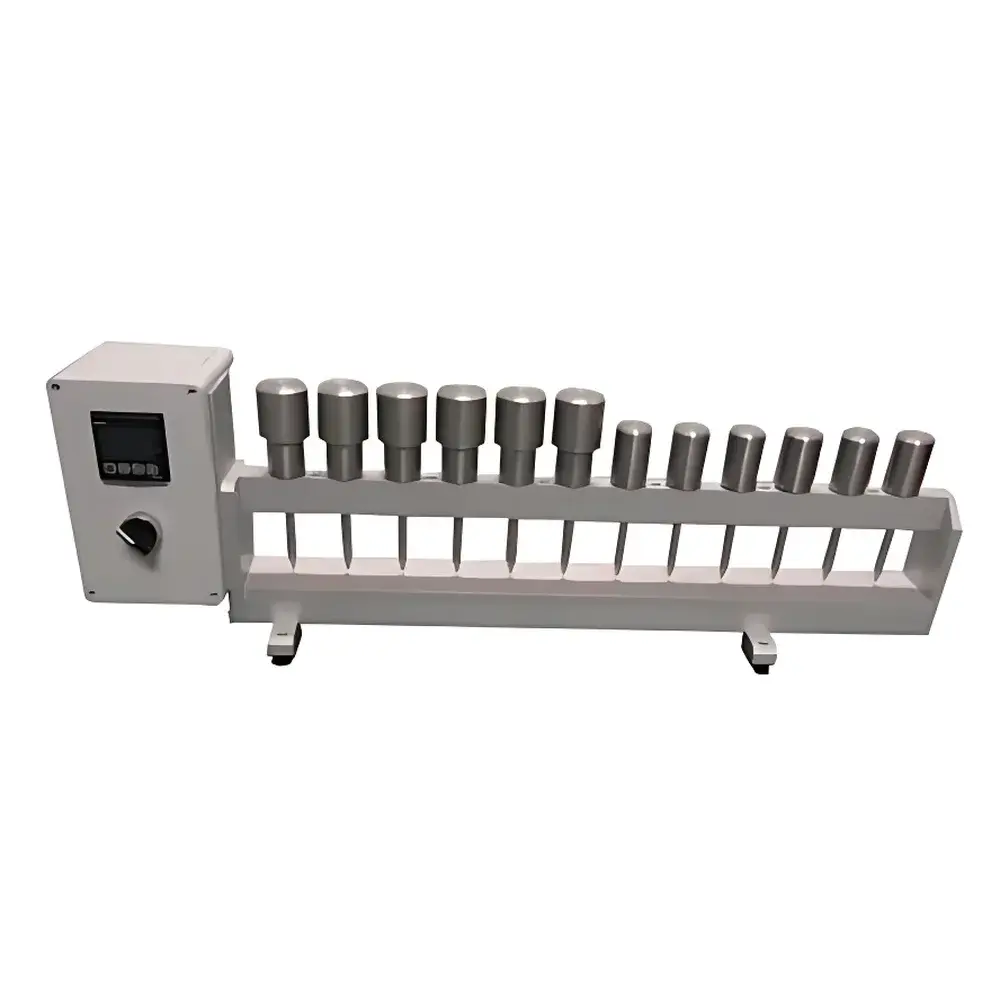
Brookfield BJ-12 Bonding Press for Uniform Resin Thickness Control
| Brand | FLOXLAB |
|---|---|
| Origin | France |
| Model | BJ-12 |
| Temperature Range | 20–130 °C |
| Weight | 10 kg |
| Dimensions | 217 × 124 × 708 mm |
| Power Supply | 220 V, 50/60 Hz |
Overview
The Brookfield BJ-12 Bonding Press is a precision-engineered thermal compression device designed specifically for the controlled lamination of thin polymer films, optical adhesives, and encapsulation resins between glass substrates—particularly microscope slides and cover slips. It operates on the principle of thermally regulated uniaxial pressure application, enabling reproducible formation of uniform resin layers critical for optical clarity, refractive index consistency, and mechanical stability in petrographic, geochemical, and petroleum core sample preparation workflows. Unlike generic hot presses, the BJ-12 integrates calibrated thermal zoning and programmable dwell time control to minimize thermal gradient-induced voids or delamination at the slide-resin interface—a key requirement when preparing transparent, bubble-free mounts for reflected-light microscopy or micro-FTIR analysis of bituminous fractions, kerogen morphology, or asphaltene distribution in crude oil samples.
Key Features
- Thermally stable heating platen with ±0.5 °C accuracy across the 20–130 °C operating range, ensuring consistent resin viscosity management during cure cycles.
- Vertical load application via calibrated mechanical lever system—no hydraulic or pneumatic components—to guarantee repeatable force transmission without drift or hysteresis.
- Compact footprint (217 × 124 × 708 mm) optimized for integration into analytical lab benches alongside petrographic microscopes, FTIR spectrometers, and automated stage scanners.
- Passive thermal insulation and low-thermal-mass aluminum platens enable rapid cooldown between cycles, supporting high-throughput sample batch processing.
- CE-marked electrical architecture compliant with IEC 61010-1 for laboratory equipment safety, including overtemperature cutoff and grounded chassis design.
Sample Compatibility & Compliance
The BJ-12 accommodates standard 25 × 75 mm and 26 × 76 mm microscope slides, as well as custom-cut quartz or fused silica substrates up to 3 mm thickness. It is routinely deployed in upstream and midstream petroleum laboratories adhering to ASTM D7097 (Standard Practice for Preparing Rock Thin Sections), ISO 14688-1 (Geotechnical Investigation and Testing – Identification and Classification of Soil), and internal API RP 44 protocols for reservoir rock characterization. The press supports GLP-compliant documentation when paired with external temperature loggers traceable to NIST standards; its manual operation mode avoids electronic audit trail requirements but remains fully compatible with 21 CFR Part 11–enabled data acquisition systems via optional analog output modules.
Software & Data Management
The BJ-12 operates as a standalone analog instrument with no embedded firmware or digital interface. All process parameters—including setpoint temperature, dwell duration, and cooling confirmation—are manually recorded in laboratory notebooks or integrated into LIMS via standardized SOP templates. For labs requiring digital traceability, third-party USB thermocouple loggers (e.g., Omega OM-DAQPRO-5300) may be mounted adjacent to the platen surface to capture real-time thermal profiles synchronized with operator timestamps. Calibration certificates for temperature sensors are issued annually per ISO/IEC 17025-accredited metrology providers.
Applications
- Preparation of petrographic thin sections from shale, sandstone, and carbonate cores for porosity/permeability correlation studies.
- Lamination of epoxy-impregnated cuttings prior to SEM-EDS elemental mapping of mineral assemblages and pore-network topology.
- Encapsulation of heavy oil fractions under inert atmosphere (when used inside gloveboxes) to prevent oxidative degradation during spectral analysis.
- Controlled curing of UV-curable acrylate resins used in microfluidic chip bonding for enhanced oil recovery (EOR) fluid dynamics simulation.
- Standardized mounting of wax-embedded drill cuttings for polarized light microscopy-based clay typing per ASTM D5102.
FAQ
What is the maximum recommended resin layer thickness achievable with the BJ-12?
The press does not impose a fixed upper limit; however, optimal uniformity is maintained for nominal cured thicknesses between 15 µm and 120 µm, depending on resin rheology and thermal history.
Can the BJ-12 be used under nitrogen purge conditions?
Yes—its open-frame mechanical design permits full integration into Class I, Division 2 glovebox environments when equipped with compatible feedthroughs for power and optional thermal sensors.
Is calibration documentation provided with shipment?
Each unit ships with a factory temperature verification report (±0.5 °C at 25 °C, 70 °C, and 100 °C), traceable to French national metrology institute (LNE) standards.
Does FLOXLAB offer service contracts for the BJ-12 outside the EU?
Global technical support and certified calibration services are available through authorized Brookfield service partners in North America, APAC, and EMEA regions—subject to local import regulations and voltage compliance verification.






