
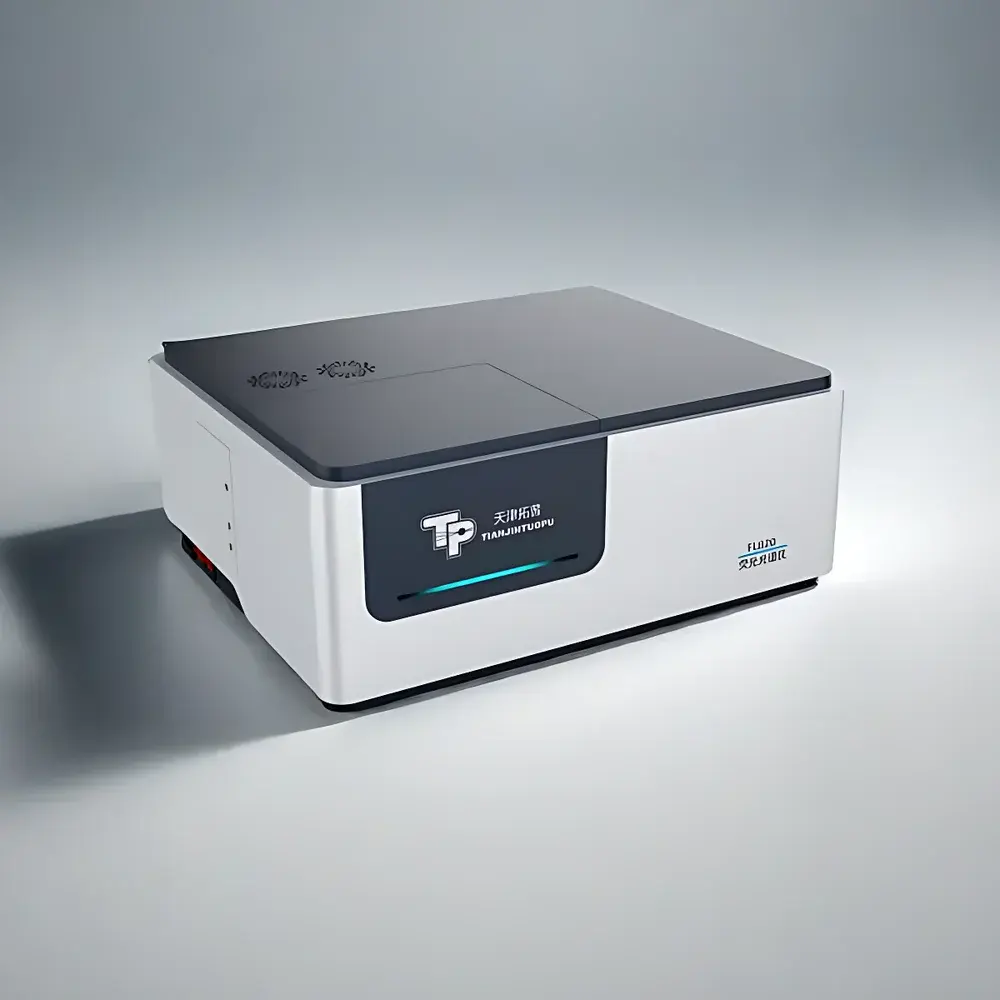
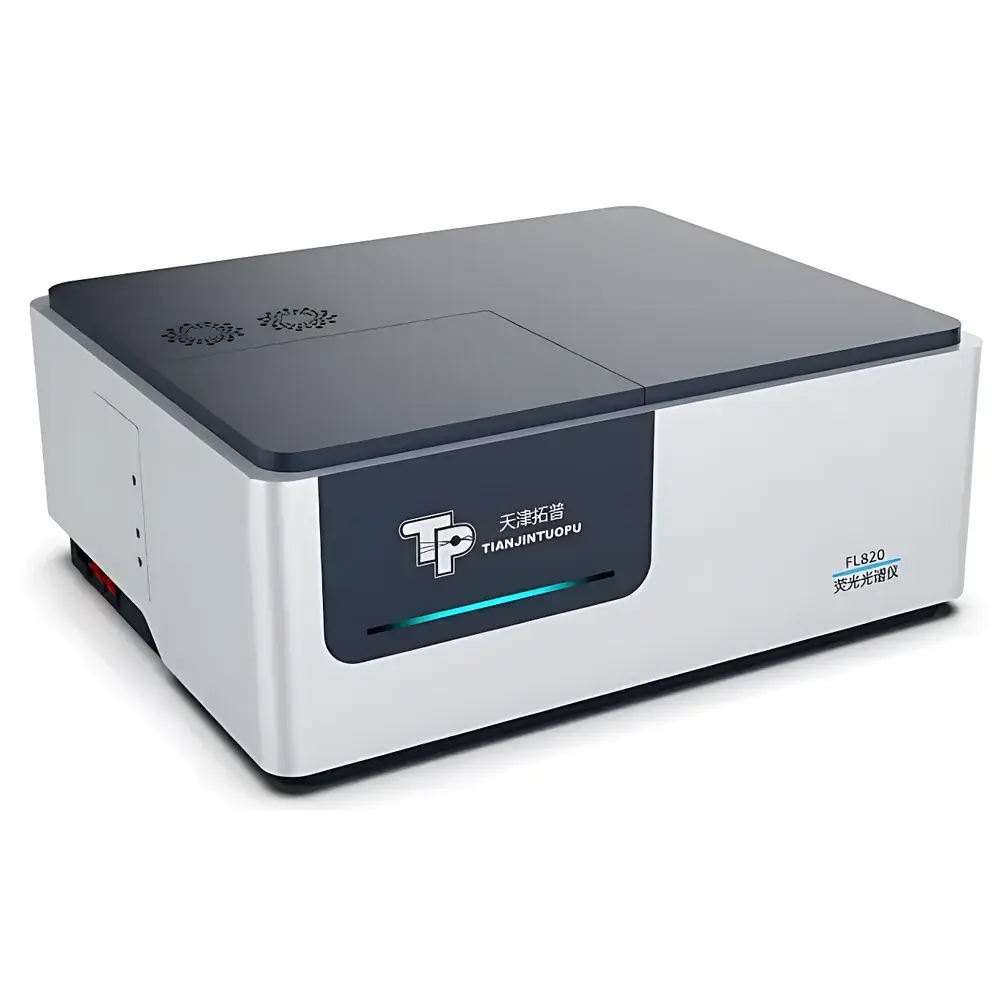
Topo FL820 Molecular Fluorescence Spectrometer
| Brand | Topo |
|---|---|
| Origin | Tianjin, China |
| Manufacturer Type | Original Equipment Manufacturer (OEM) |
| Instrument Type | Steady-State Fluorescence Spectrometer |
| Wavelength Range | Typically 200–900 nm (Xenon Lamp Source) |
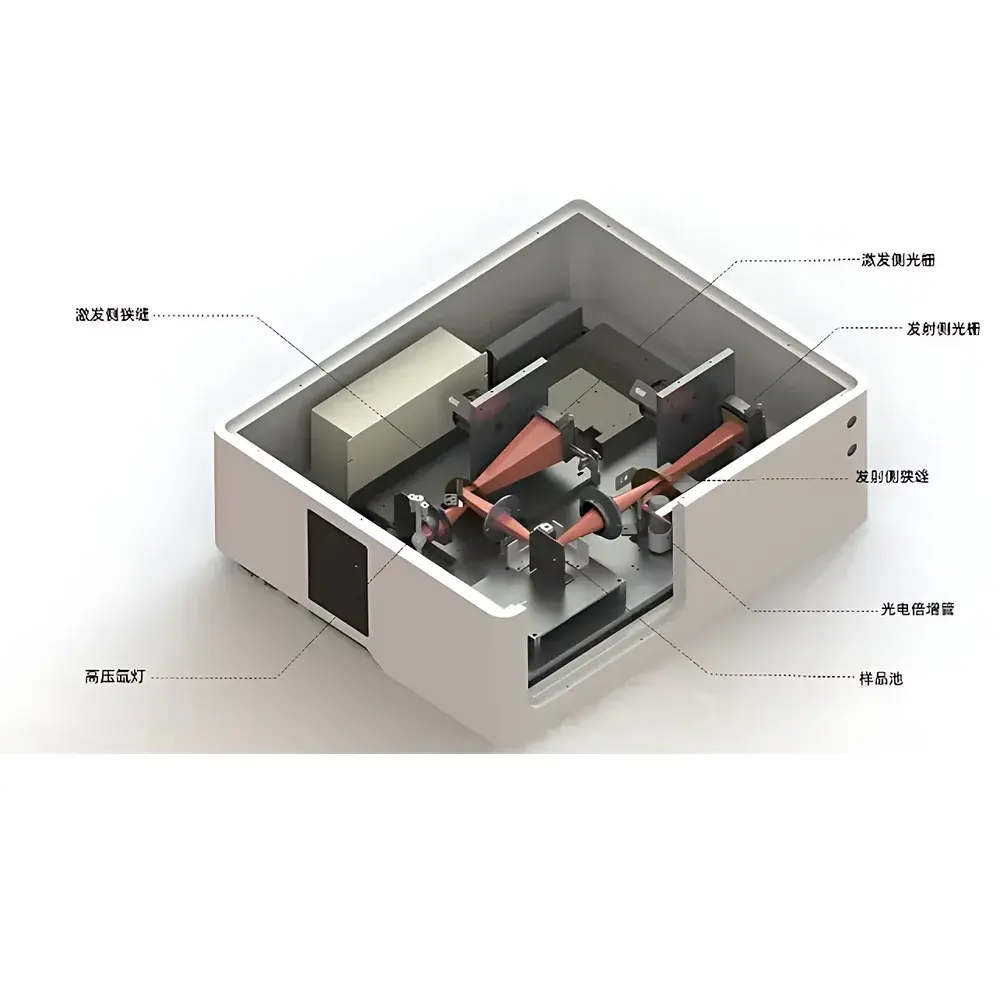
| Excitation/Emission Monochromators | Czerny-Turner with Holographic Grating |
| Slit Width (Spectral Bandpass) | 1–20 nm |
| Optical Resolution | ≤1 nm (FWHM at 546.1 nm) |
| Wavelength Accuracy | ±1 nm |
| Sensitivity | >300 P-P, >1200 RMS, >15,000 RMS (Background-Subtracted) |
| Light Source | 150 W Pulsed or Continuous Xenon Arc Lamp |
| Detector | R928P Photomultiplier Tube (PMT) |
| Data Acquisition Modes | Emission Scan, Excitation Scan, Synchronous Scan, Time-Based Intensity Monitoring, 3D Excitation-Emission Matrix (EEM) |
Overview
The Topo FL820 Molecular Fluorescence Spectrometer is a high-performance steady-state fluorescence instrument engineered for quantitative and qualitative analysis of fluorescent molecular species in solution, solid, and thin-film states. Based on the principle of photoluminescence—where molecules absorb photons at specific excitation wavelengths and re-emit at longer wavelengths—the FL820 delivers precise spectral characterization via dual monochromator architecture (excitation and emission), minimizing stray light and enabling high signal-to-noise ratio (SNR) measurements. Designed for routine laboratory use in regulated and research environments, the system supports full spectral acquisition across a typical range of 200–900 nm, with wavelength accuracy maintained within ±1 nm and optical resolution ≤1 nm (FWHM). Its xenon arc lamp provides broad-spectrum, stable output ideal for multi-wavelength excitation studies without lamp replacement during extended operation.
Key Features
- Dual-grating monochromator design with independently adjustable excitation and emission slits (1–20 nm bandwidth), ensuring optimal balance between spectral resolution and photon throughput.
- Three primary scanning modes: emission scan (fixed excitation), excitation scan (fixed emission), and synchronous scan (Δλ = constant), facilitating rapid identification of optimal excitation-emission pairs and spectral peak tracking.
- Time-resolved intensity monitoring over user-defined intervals (0–180 min), with real-time SNR calculation post-acquisition for method validation and stability assessment.
- Comprehensive quantification suite: supports single-, dual-, and triple-wavelength calibration; polygonal standard curve construction from user-input concentration points; simultaneous display of calibration curve and sample measurement overlay.
- 3D Excitation-Emission Matrix (EEM) mapping with interactive contour and surface visualization; peak wavelength and intensity auto-tracking during dynamic scans.
- Flexible data export (CSV, TXT, XML) compatible with third-party chemometric software (e.g., MATLAB, Origin, Unscrambler) for multivariate analysis including PARAFAC decomposition.
Sample Compatibility & Compliance
The FL820 accommodates diverse sample formats—including liquid cuvettes (10 mm pathlength standard), powdered solids in quartz cells, and thin films mounted on reflective substrates—without hardware modification. Its optical design minimizes inner-filter effects through adjustable integration times and dynamic gain control. The instrument meets core requirements for analytical traceability under ISO/IEC 17025:2017 for testing laboratories and supports GLP-compliant workflows via audit-trail-enabled software logging (user actions, parameter changes, calibration history). While not pre-certified for FDA 21 CFR Part 11, its data structure and metadata tagging align with electronic record integrity principles required for pharmaceutical QC/QA applications per USP and ICH Q2(R2).
Software & Data Management
The proprietary FL820 Control Suite (v3.x) runs on Windows 10/11 and provides intuitive graphical interface navigation with context-sensitive help. All acquisition parameters—including slit width, PMT voltage, scan speed, dwell time, and baseline correction settings—are programmable and saveable as method templates. Raw spectral data include embedded metadata (date/time stamp, operator ID, instrument serial number, calibration status). Software supports automated background subtraction, smoothing (Savitzky-Golay), peak deconvolution, and quantum yield calculation using reference standards (e.g., quinine sulfate in 0.1 M H2SO4). Exported datasets retain wavelength-intensity fidelity and are compatible with LIMS integration via ODBC drivers.
Applications
The FL820 serves critical roles across multiple sectors: in pharmaceutical development, it enables impurity profiling, excipient interaction studies, and stability-indicating assays for APIs; in environmental labs, it quantifies polycyclic aromatic hydrocarbons (PAHs), humic substances, and dissolved organic matter in water matrices; in food safety, it detects aflatoxins, melamine, and vitamin B2 with sub-nanomolar sensitivity; in materials science, it characterizes conjugated polymers, quantum dots, and MOF-based sensors via emission lifetime and anisotropy analysis. Its robustness in handling turbid or scattering samples—via front-face or right-angle detection geometry—extends utility to clinical biofluids (serum, urine) and cell lysates.
FAQ
What types of detectors are used in the FL820?
The FL820 employs a side-on, bialkali photocathode R928P photomultiplier tube (PMT) optimized for UV-Vis sensitivity (200–650 nm), with optional NIR extension available via InGaAs detector module.
Can the FL820 perform fluorescence lifetime measurements?
No—the FL820 is a steady-state spectrometer and does not support time-correlated single-photon counting (TCSPC) or phase-modulation lifetime analysis. Lifetime capability requires add-on modules or dedicated time-resolved systems.
Is the instrument compliant with 21 CFR Part 11?
The base configuration supports electronic signature and audit trail features, but formal Part 11 compliance requires validated installation qualification (IQ), operational qualification (OQ), and documented change control procedures executed by the end user or authorized service partner.
What is the recommended maintenance schedule?
Xenon lamp replacement every 500–800 operating hours; grating alignment verification annually or after mechanical shock; PMT high-voltage calibration quarterly using certified reference standards.
Does the FL820 support temperature-controlled sample compartments?
Yes—optional Peltier-cooled cuvette holders (-10°C to +80°C) and flow-cell adapters are available for kinetic and thermodynamic studies.





