
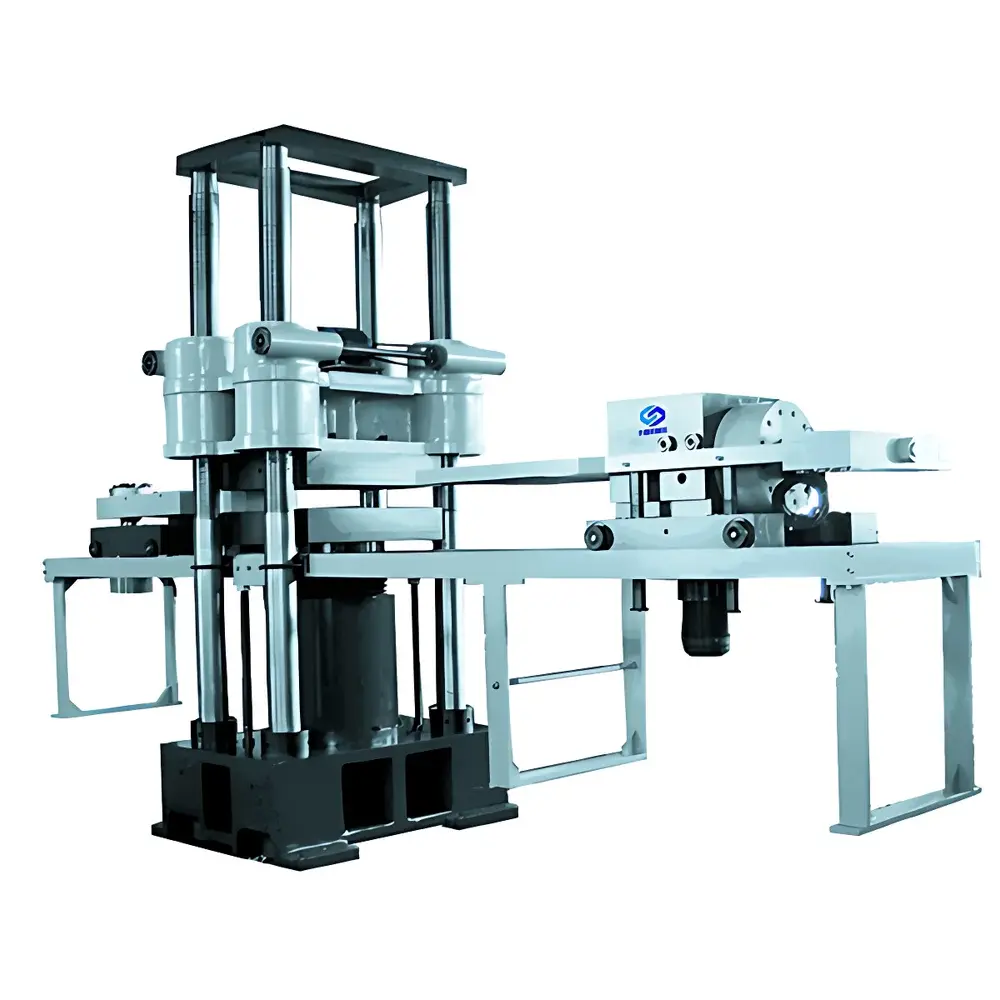
CIMACH YNS-YJ Electro-Hydraulic Servo Compression-Shear Testing Machine
| Brand | CIMACH |
|---|---|
| Origin | Jilin, China |
| Model | YNS-YJ |
| Axial Load Capacity | 5000–20000 kN |
| Shear Load Capacity | 1000–4000 kN |
| Rotation Load Capacity | 500–2000 kN |
| Force Accuracy | ±1% |
| Force Measurement Range | 2–100% FS |
| Deformation Accuracy | ±1% |
| Deformation Range | 2–100% FS |
| Max Vertical Spacing | 1000–2000 mm |
| Axial/Shear Piston Stroke | 180/100 – 250/200 mm |
| Total Power | 10–25 kW |
| Dimensions (L×W×H) | 3900×1460×3500 – 6000×1950×6800 mm |
Overview
The CIMACH YNS-YJ Electro-Hydraulic Servo Compression-Shear Testing Machine is a high-capacity, multi-axis structural testing system engineered for the precise mechanical characterization of bridge bearing assemblies under combined axial compression, lateral shear, and rotational loading conditions. Based on closed-loop electro-hydraulic servo control architecture, the system implements real-time force and displacement feedback to maintain strict load trajectory fidelity during static, quasi-static, and low-cycle fatigue testing protocols. Its design adheres to fundamental principles of structural mechanics and tribological interface analysis—enabling simultaneous measurement of axial stiffness, shear modulus, rotational flexibility, coefficient of friction, and ultimate compressive strength in elastomeric and spherical bearing systems. The machine serves as a primary verification tool for quality assurance, type approval, and R&D validation in civil infrastructure component manufacturing and third-party certification laboratories.
Key Features
- Triple-actuator independent loading system: Separately controlled axial, shear, and rotation actuators enable true coupled loading paths per JT/T 4–2004 and GB/T 17955–2000 requirements.
- High-stiffness monolithic frame with precision-machined loading platens and self-aligning bearing interfaces to minimize parasitic moments and ensure uniform stress distribution.
- Digital servo controller with 1 kHz sampling rate, supporting user-defined ramp-hold, triangle-wave, and step-load profiles for low-cycle fatigue simulation (e.g., seismic displacement history replication).
- Integrated overload protection suite: Hardware-limited current cutoff, velocity monitoring, stroke end-stop sensing, and dual-stage force limit enforcement (warning + emergency stop).
- Modular calibration architecture compliant with ISO 376:2011 for force transducer traceability; deformation sensors calibrated per ISO 9513:2012 for extensometer accuracy class 1.
- Full-range force measurement from 2% to 100% of full scale with ±1% indication error, verified per ASTM E4 calibration procedures.
Sample Compatibility & Compliance
The YNS-YJ accommodates plate-type, pot-type, and spherical elastomeric bridge bearings up to 2000 mm in plan dimension and 800 mm in height. It supports standardized test configurations defined in JT/T 4–2004 (Highway Bridge Plate Rubber Bearings), JT 391–1999 (Highway Bridge Pot-Type Rubber Bearings), and GB/T 17955–2000 (Spherical Bearings for Bridges). Additional adaptability includes concrete cylinder testing (per GB/T 50081), grout prism evaluation, and layered composite interface studies. All test sequences are structured to satisfy GLP documentation requirements—including operator ID, environmental timestamping, and raw data immutability—and support audit-ready reporting aligned with ISO/IEC 17025:2017 clause 7.8.
Software & Data Management
The embedded test software provides ISO 17025-compliant data acquisition with 16-bit ADC resolution and synchronized multi-channel logging (axial force, shear force, rotation torque, vertical displacement, lateral displacement, angular rotation). Test plans are programmable via XML-based script templates, enabling repeatable execution of complex multi-step protocols such as sequential compression-shear-friction cycles. Raw binary data (.bin) and ASCII export (.csv) formats preserve full temporal fidelity. Audit trail functionality records all parameter modifications, manual interventions, and calibration events with digital signature timestamps—fully compatible with FDA 21 CFR Part 11 electronic record requirements when deployed on validated Windows OS platforms.
Applications
- Determination of compressive elastic modulus and shear elastic modulus of laminated elastomeric bearings under service-level and ultimate limit states.
- Measurement of allowable shear deformation angle and residual deformation after cyclic loading per AASHTO LRFD Bridge Design Specifications.
- Friction coefficient evaluation at PTFE–stainless steel and rubber–steel interfaces under varying normal pressure and sliding velocity.
- Rotational stiffness characterization of spherical bearings under moment-controlled or rotation-controlled boundary conditions.
- Low-frequency cyclic testing (0.01–0.1 Hz) simulating seismic displacement histories for performance-based assessment of isolation systems.
- Compression testing of high-strength concrete cylinders (up to C100), mortar prisms, and fiber-reinforced polymer (FRP) confined columns.
FAQ
What standards does the YNS-YJ system fully support?
The system is configured to execute all mandatory test sequences specified in JT/T 4–2004, GB/T 17955–2000, JT 391–1999, and ASTM D4014 for structural bearing qualification.
Can the machine perform independent shear or rotation tests without axial load?
Yes—each actuator operates independently with dedicated PID tuning, allowing pure shear, pure rotation, or decoupled multi-axis modes.
Is the system suitable for long-term creep testing?
It supports constant-load hold modes up to 72 hours with thermal drift compensation and automatic zero-drift correction algorithms.
How is force calibration maintained across the full range?
Calibration uses NIST-traceable deadweight standards and reference load cells per ISO 376 Annex B; verification intervals follow ISO/IEC 17025 clause 6.6.3.
Does the software generate certified test reports?
Yes—reports include test metadata, raw curve plots, tabulated results with uncertainty budgets, technician sign-off fields, and PDF/A-1b archival output.



