
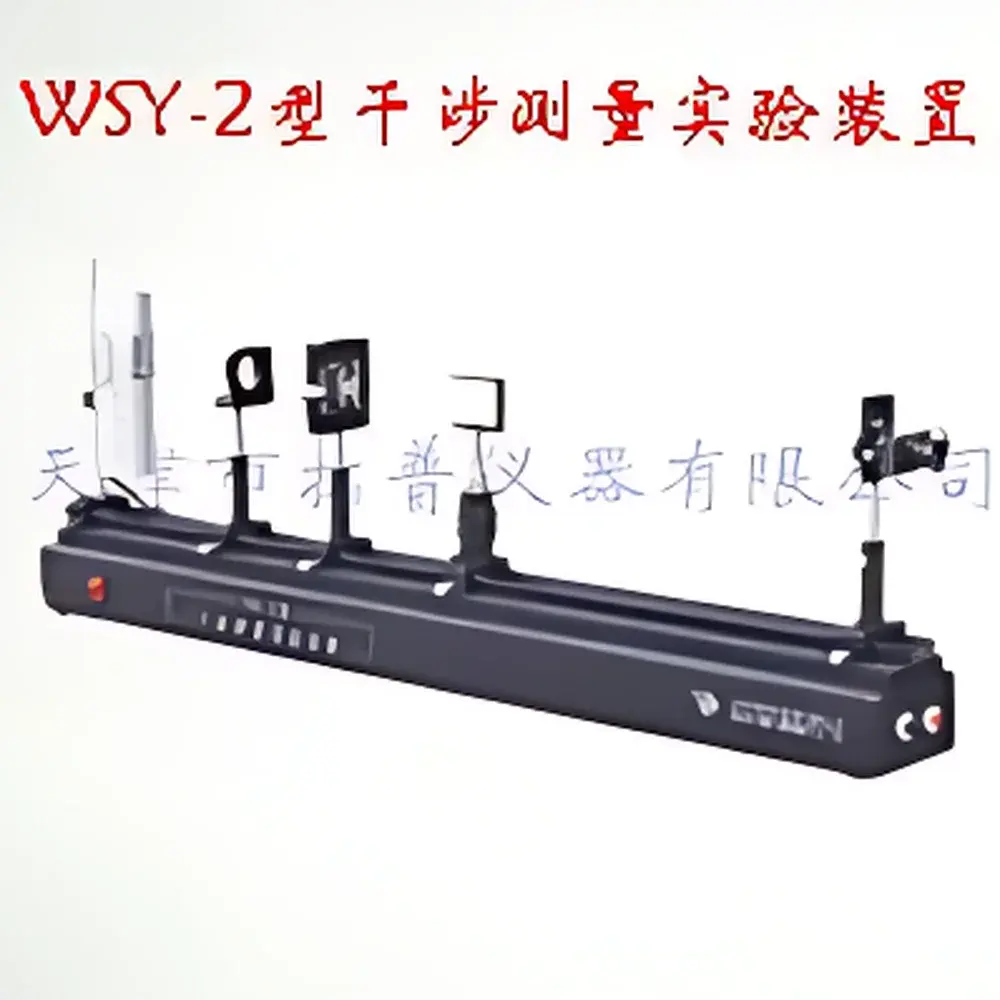
WSY-2 Interferometry Experimental Setup by Top Optics
| Brand | Top Optics (TP) |
|---|---|
| Origin | Tianjin, China |
| Manufacturer Type | Direct Manufacturer |
| Country of Origin | China |
| Model | WSY-2 |
| Pricing | Available Upon Request |
| Core Components | Optical Rail, 2D Adjustable Mounts, Photographic Plate Holder, White Screen, Single-Sided Adjustable Slit, Low-Pressure Sodium Lamp, Fresnel Biprism, Newton’s Rings Set, Convex Lenses, Measuring Microscope, Double-Slit Assembly |
Overview
The WSY-2 Interferometry Experimental Setup is a pedagogical and research-grade optical instrumentation platform engineered for the quantitative study of wave interference phenomena in undergraduate physics laboratories, optics teaching labs, and metrology training environments. Based on the principle of division of wavefront—specifically employing a Fresnel biprism to split coherent light from a low-pressure sodium lamp into two virtual sources (S₁ and S₂)—the system enables precise determination of wavelength via measurement of fringe spacing (Δx) and source separation (d), using the fundamental relation λ = (d·Δx)/D, where D is the effective optical path length to the observation plane. The setup integrates classical interferometric methodology with hands-on alignment control, supporting both qualitative visualization and quantitative analysis of monochromatic interference patterns under controlled coherence conditions.
Key Features
- Modular optical rail system (standardized 900 mm length) with precision T-slot mounting interface for repeatable component positioning and longitudinal stability.
- Fresnel biprism-based wavefront division architecture optimized for high-contrast, stable fringe formation with sodium D-line illumination (λ ≈ 589.3 nm).
- Dual-scale measurement capability: high-resolution reading microscope (0.01 mm vernier scale) for fringe spacing; secondary imaging method using convex lenses to resolve and measure separation between virtual slits S₁ and S₂.
- Comprehensive component set includes calibrated adjustable single slit, double-slit assembly, Newton’s rings test plate, and white diffusing screen for real-time pattern observation and contrast optimization.
- Low-pressure sodium lamp (5.5 V/0.3 A) providing narrowband quasi-monochromatic output with coherence length > 10 cm—sufficient for stable biprism interference over typical benchtop distances (0.8–1.5 m).
- All mechanical mounts feature micrometer-adjustable pitch/yaw/tip controls enabling sub-milliradian angular alignment critical for fringe uniformity and contrast maximization.
Sample Compatibility & Compliance
The WSY-2 is designed exclusively for use with standard optical components and laboratory-grade light sources. It accommodates standard 25.4 mm (1″) diameter optics mounted in kinematic or adjustable holders. No sample chamber or fluid cell is integrated; applications are limited to air-path optical interference demonstrations. While not certified to ISO/IEC 17025 or ASTM E2877, the system adheres to pedagogical standards referenced in national university physics curricula (e.g., GB/T 22577–2008 for optical teaching equipment). Component materials comply with RoHS Directive 2011/65/EU for restricted hazardous substances. All glass optics meet JIS B 7151 surface quality specifications (scratch-dig 60–40), and metal parts are anodized aluminum or stainless steel for corrosion resistance and dimensional stability.
Software & Data Management
The WSY-2 operates as a fully manual, hardware-only experimental platform with no embedded electronics or digital interface. Data acquisition is performed manually using the reading microscope and recorded in laboratory notebooks or spreadsheets. However, the system is compatible with third-party image capture solutions: when paired with a USB CMOS camera (e.g., Thorlabs DCU223M) mounted on the microscope eyepiece, fringe images can be acquired for digital fringe analysis using open-source tools such as ImageJ with Fringe Analysis Plugin or MATLAB-based FFT-based fringe detection algorithms. For institutions requiring audit-ready documentation, manual measurements may be entered into LIMS-compatible templates aligned with GLP principles—including operator ID, date/time stamp, environmental notes (ambient temperature, vibration status), and uncertainty propagation per GUM (JCGM 100:2018).
Applications
- Undergraduate instruction in physical optics: verification of wave theory, coherence requirements, and superposition principle.
- Determination of sodium D-line wavelength with estimated combined standard uncertainty < ±0.3 nm under controlled lab conditions.
- Quantitative evaluation of optical alignment sensitivity: e.g., effect of biprism tilt angle on fringe visibility (V = (Imax − Imin)/(Imax + Imin)).
- Comparative study of interference geometry: direct comparison of biprism vs. Young’s double-slit vs. Newton’s rings configurations using shared light source and detection apparatus.
- Calibration reference for introductory interferometer alignment workshops prior to deployment of Michelson or Fabry–Pérot systems.
FAQ
Is the WSY-2 suitable for research-grade interferometric measurements beyond teaching?
It is primarily intended for educational validation and foundational metrology training. Its mechanical repeatability and lack of active stabilization limit its use in high-precision research applications requiring sub-nanometer path-length control.
Can the sodium lamp be replaced with a laser diode?
Yes, but with caveats: replacing the sodium lamp with a 589 nm DPSS laser requires beam expansion and spatial filtering to emulate extended source behavior; unfiltered laser illumination introduces speckle and reduces fringe contrast due to excessive temporal coherence.
Does the system include calibration certificates for individual components?
No. Calibration documentation is not provided by default; users must perform in-house verification using traceable reference standards (e.g., NIST-traceable gauge blocks for rail length, certified wavelength filters for spectral verification).
What is the minimum recommended ambient lighting condition for optimal fringe visibility?
Operation requires dimmed ambient illumination (< 50 lux); direct overhead lighting or daylight exposure degrades contrast significantly due to stray light ingress at the white screen and microscope objective.
Are replacement biprisms or slits available with custom apex angles or slit widths?
Top Optics offers OEM component customization upon request, including biprisms with apex angles of 0.5°–2.0° and slits with widths ranging from 20 µm to 200 µm, subject to MOQ and lead time confirmation.



