
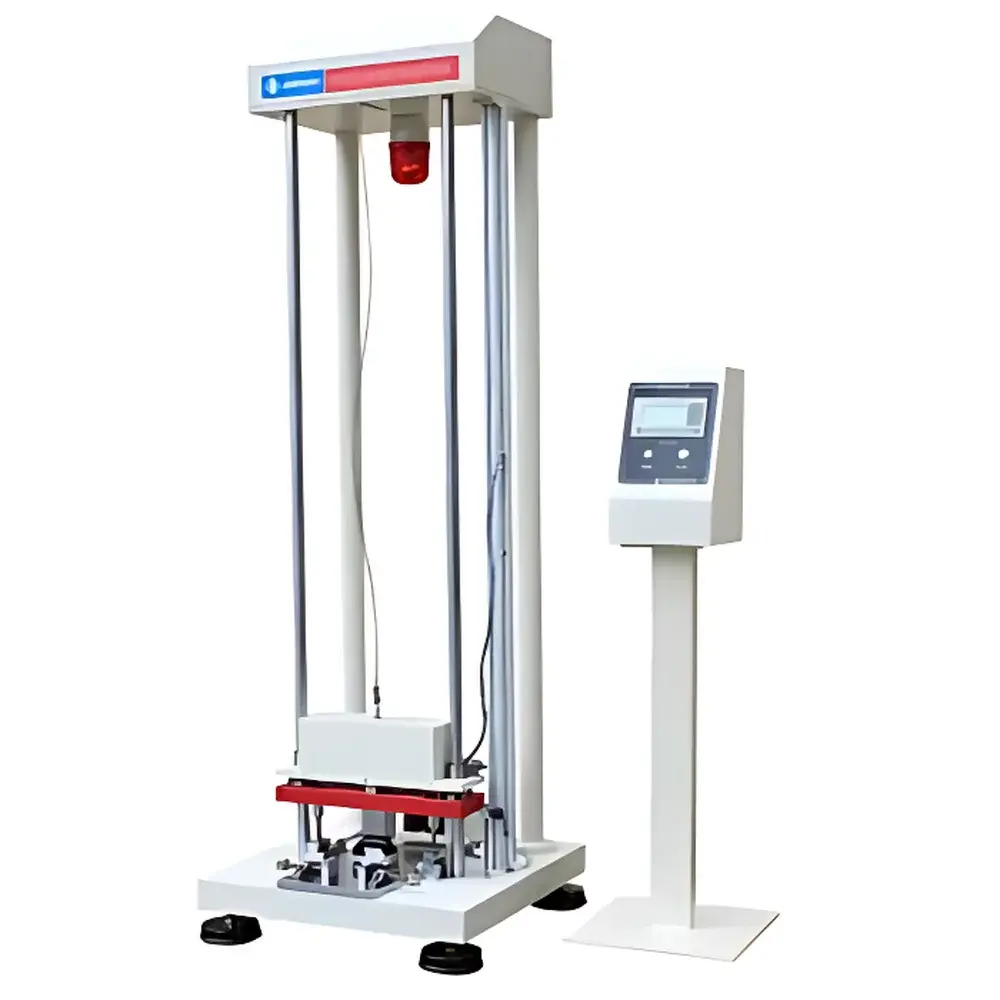
HY-610 EN 20344 Safety Footwear Impact Tester
| Origin | Tianjin, China |
|---|---|
| Manufacturer Type | Authorized Distributor |
| Origin Category | Domestic (China) |
| Model | HY-610 |
| Pricing | Available Upon Request |
| Impact Mass | 20.0 ± 0.2 kg |
| Impact Edge Geometry | Axe-shaped, Edge Radius R = 3.0 ± 0.1 mm |
| Impact Blade Dimensions | 60 mm length, included angle 90° ± 1°, tip radius 3.0 ± 0.1 mm |
| Cylindrical Anvil | Ø25 mm × H20 mm and Ø25 mm × H25 mm |
| Selectable Impact Energy | 200 ± 4 J or 100 ± 2 J |
| Clamp Assembly | Steel plate ≥150 mm × 150 mm × 19 mm thick, hardness 60 HRC |
| Anti-rebound Mechanism | Integrated mechanical lockout ensuring single-strike operation |
| Optional Ankle Protection Test Module | Guide mass 5000 ± 10 g |
| Force Measurement System | 120 kN load cell, resolution 0.1 kN |
| Calibration Documentation | CNAS-accredited calibration certificate per ISO/IEC 17025 |
Overview
The HY-610 EN 20344 Safety Footwear Impact Tester is a precision-engineered mechanical test system designed to evaluate the toe protection performance of safety footwear under standardized dynamic impact loading conditions. It operates on the principle of controlled gravitational drop-weight impact, where a calibrated mass is released from a defined height onto a standardized impact blade positioned directly above the toe cap of a secured footwear sample. The resulting deformation or penetration depth—measured either visually or via integrated force transduction—is evaluated against pass/fail criteria specified in harmonized international standards including EN ISO 20344:2022, EN 344 (superseded but historically referenced), and GB/T 20991–2007. This apparatus is not a general-purpose impact tester; it is purpose-built for footwear certification laboratories, PPE manufacturers’ QC departments, and third-party testing facilities requiring traceable, repeatable, and auditable compliance verification.
Key Features
- Traceable impact energy delivery: Dual selectable impact energies—200 ± 4 J and 100 ± 2 J—achieved through precise mass-height combinations validated per ISO 17025 methodology.
- Axe-shaped impact blade conforming to EN ISO 20344 Annex B: 20.0 ± 0.2 kg mass, 60 mm blade length, 90° ± 1° included angle, and tip radius 3.0 ± 0.1 mm—manufactured from hardened tool steel (≥60 HRC) and supplied with full dimensional certification.
- Integrated anti-rebound locking mechanism: Prevents secondary contact or oscillation after initial impact, ensuring strict adherence to single-impact requirement per Clause 6.3.2 of EN ISO 20344.
- Rigid clamping station: Features a 150 mm × 150 mm × 19 mm hardened steel base plate (60 HRC) with M8 threaded fasteners torqued to 3 ± 1 N·m—guaranteeing consistent sample positioning and minimizing energy loss at the fixture interface.
- Optional ankle protection module: Compliant with EN ISO 20344 Clause 6.4.2, includes 5000 ± 10 g guided mass, 80 mm × 40 mm impact hammer with R = 5 ± 1 mm edge, and reinforced semi-circular anvil (radius 25 mm, arc length 175 ± 25 mm, mass ≥600 kg) for lateral energy absorption evaluation.
- High-fidelity force measurement subsystem: Includes a 120 kN load cell with 0.1 kN resolution and real-time analog output, enabling quantitative peak force recording during impact events—critical for root-cause analysis and material behavior characterization.
Sample Compatibility & Compliance
The HY-610 accommodates all standard safety footwear configurations—including steel-toe, composite-toe, and aluminum-toe variants—with toe caps installed in accordance with EN ISO 20344 Section 4.2 mounting requirements. Sample fixation utilizes the standardized clamp assembly, eliminating variability introduced by non-uniform support. All mechanical components—including anvils, blades, and clamps—are dimensionally verified against EN ISO 20344 Annexes B and C. The system supports full compliance testing workflows aligned with ISO/IEC 17025 accredited laboratories, and its CNAS-accredited calibration certificate—issued by an ILAC-MRA signatory lab—ensures metrological traceability to national standards (e.g., NIM, China). While not itself certified to IEC 61000-4-x or CE machinery directive, the instrument is intended for use within laboratory environments governed by ISO/IEC 17025, GLP, and internal QA protocols that require documented equipment qualification (IQ/OQ/PQ).
Software & Data Management
The HY-610 operates as a hardware-dedicated test platform with optional digital integration capability. Its 120 kN force sensor provides analog output (±10 V) compatible with industry-standard data acquisition systems (e.g., National Instruments DAQmx, Keysight BenchVue). Users may configure custom sampling rates (up to 10 kHz) and apply real-time filtering to extract peak force, impulse, and time-to-peak metrics. Raw force-time datasets are exportable in CSV or TDMS format for post-processing in MATLAB, Python (NumPy/Pandas), or statistical software such as JMP or Minitab. Audit trails—including operator ID, test date/time, sample ID, energy setting, and calibration status—are maintained manually per test log or via optional LIMS linkage. The system complies with documentation rigor expected under FDA 21 CFR Part 11 when paired with validated electronic record systems, though native software is not embedded.
Applications
- Pre-market type approval testing of safety footwear per EN ISO 20344:2022 Clause 6.3 (toe cap impact resistance) and Clause 6.4 (ankle protection assessment).
- Periodic in-house quality control verification for PPE manufacturers producing ASTM F2413-compliant footwear (where EN ISO 20344 alignment is required for EU market access).
- Root-cause failure analysis following field reports of toe cap deformation or fracture—leveraging quantitative force data to correlate material thickness, alloy grade, and structural geometry with impact response.
- Comparative evaluation of novel toe cap materials (e.g., carbon fiber composites, high-strength polymers) against baseline steel or aluminum references under identical impact boundary conditions.
- Supporting technical documentation packages for EU Declaration of Conformity (DoC) and Notified Body assessments (e.g., SATRA, UL, SGS).
FAQ
Does the HY-610 meet current EN ISO 20344:2022 requirements?
Yes—the impact blade geometry, energy tolerances, clamping specifications, and anvil dimensions fully comply with Clauses 6.3 and 6.4 of EN ISO 20344:2022, including Annexes B and C.
Is the CNAS calibration certificate sufficient for ISO/IEC 17025 accreditation?
Yes—CNAS is the ILAC-MRA signatory for China; its accredited calibration reports satisfy metrological traceability requirements for ISO/IEC 17025 Clause 6.5.2.
Can the system be used for ASTM F2413 impact testing?
While not configured out-of-the-box for ASTM F2413–23 (which specifies different impact masses and heights), the HY-610’s modular design permits adaptation via recalibration and fixture reconfiguration—subject to user validation per ASTM E29.
What maintenance is required to sustain measurement integrity?
Biannual verification of impact height using certified gauge blocks, annual re-calibration of the load cell and torque wrench, and visual inspection of blade edge wear (R ≤ 2.9 mm triggers replacement) per manufacturer’s SOP.
Is operator training included with purchase?
Yes—on-site or remote technician-led training covers safe operation, sample mounting per EN ISO 20344, energy selection logic, data capture protocol, and basic troubleshooting—documented in a signed training log.





