
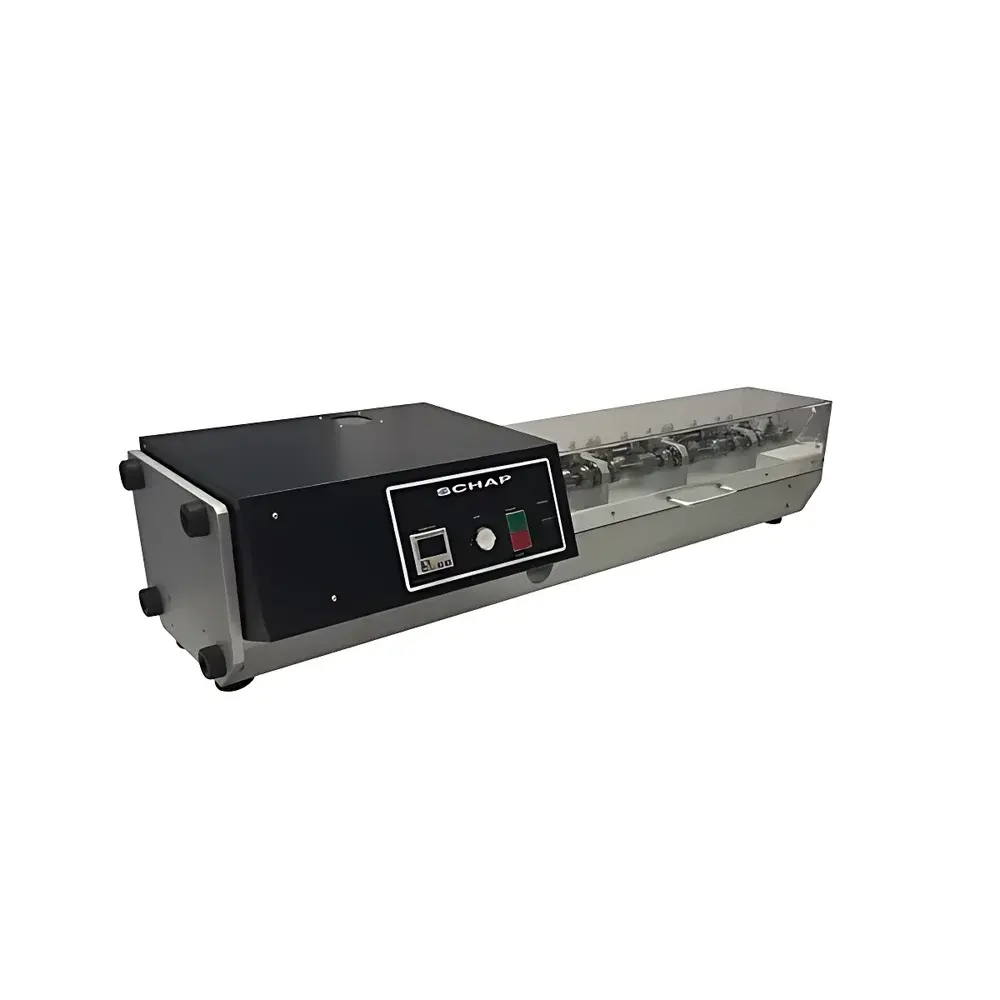
ASTM D 2097 Newark Flexural Fatigue Tester
| Brand | HENGYU |
|---|---|
| Model | ASTM D 2097 |
| Standard Compliance | ASTM D 2097, GM 9226P / 9216P, Ford FLTM BN 102-02, MF-MH BN2-2, TSL5101G Section 3.14.1 B |
| Dimensions (L×W×H) | 60 × 40 × 40 cm |
| Weight | 80 kg |
| Power Supply | AC 220 V, 50 Hz, 500 W |
| Operating Environment | 20 ± 2 °C, 65 ± 4 % RH |
| Configuration | Main Unit × 1, User Manual × 1 |
Overview
The ASTM D 2097 Newark Flexural Fatigue Tester is a precision-engineered mechanical testing instrument designed to evaluate the flexural endurance and interlayer adhesion integrity of coated textiles, automotive leather trim, synthetic upholstery materials, and laminated flexible composites. It operates on the principle of controlled cyclic bending—repetitively folding or flexing a standardized specimen over a fixed-radius mandrel under defined load and frequency conditions—thereby simulating real-world mechanical stress encountered during vehicle interior use, seat articulation, door panel flexing, or steering wheel rotation. The system strictly implements the test methodology outlined in ASTM D 2097 (“Standard Test Method for Flexing Endurance of Coated Fabrics”), which defines specimen geometry, mandrel diameter (typically 12.7 mm), stroke amplitude (±15° or ±20° depending on specification), and counting logic for failure detection (e.g., cracking, delamination, or coating fracture visible under 10× magnification). Its mechanical architecture ensures high reproducibility across laboratories and supports traceable, auditable fatigue data generation essential for material qualification under OEM-supplier quality agreements.
Key Features
- Robust cast-iron frame with vibration-dampening base, ensuring stable operation during extended cycling tests (up to 100,000+ cycles without drift)
- Adjustable mandrel diameter and angular displacement settings to accommodate variant test protocols per GM 9226P (12.7 mm mandrel, ±20°) and Ford FLTM BN 102-02 (10 mm mandrel, ±15°)
- Digital cycle counter with non-volatile memory, retaining count data after power interruption and supporting manual reset with password-protected access
- Integrated specimen clamping mechanism featuring dual-point pneumatic locking (optional upgrade) or precision-machined mechanical grips for consistent grip force and minimal slippage
- Modular design enabling rapid calibration verification using NIST-traceable angle gauges and calibrated torque wrenches
- Compliance-ready construction: all electrical components meet IEC 61000-6-2/6-3 EMC standards; safety interlock circuitry conforms to ISO 13857 requirements
Sample Compatibility & Compliance
The tester accommodates specimens measuring 25.4 mm × 101.6 mm (1 in × 4 in) as specified in ASTM D 2097, with optional fixtures available for 15 mm × 75 mm strips per TSL5101G. It supports both single-layer coated fabrics and multi-layer assemblies (e.g., PU-coated polyester backing + foam substrate). All test parameters—including bending radius, oscillation frequency (standardized at 60–90 cycles/min), and environmental conditioning—are aligned with OEM-specific validation requirements. The instrument satisfies audit readiness for IATF 16949 clause 7.1.5.3 (measurement traceability) and supports GLP-compliant documentation when paired with validated test records. Full compliance documentation—including Declaration of Conformity, calibration certificate templates, and test method cross-reference matrix—is provided with each unit.
Software & Data Management
While the base configuration operates via standalone electromechanical control, an optional PC-integrated software module (v3.2+) enables automated test sequencing, real-time cycle logging, and export of timestamped CSV reports compliant with FDA 21 CFR Part 11 requirements (electronic signatures, audit trail, user role management). Data fields include cycle count, elapsed time, ambient temperature/humidity (when interfaced with external sensors), operator ID, and pass/fail status per visual inspection criteria. Raw data files are structured for direct import into LIMS platforms or statistical process control (SPC) tools such as Minitab or JMP. Software validation packages—including IQ/OQ documentation and risk-based URS—are available upon request for regulated manufacturing environments.
Applications
- Qualification of automotive interior leather and vinyl substrates against GM, Ford, and Toyota material specifications
- Supplier pre-release testing of coated textile composites used in headliners, door panels, and center consoles
- Root-cause analysis of coating adhesion failure during thermal cycling or humidity exposure studies
- Comparative evaluation of alternative binders, crosslinkers, or surface treatments in R&D labs
- Supporting PPAP submissions with documented repeatability (R&R) studies per AIAG MSA guidelines
- Training and internal capability development for QC technicians performing ASTM-aligned physical testing
FAQ
Does this tester support automated failure detection?
No—the standard configuration relies on post-test visual inspection per ASTM D 2097 Section 7. Optional machine vision add-ons (e.g., integrated USB microscope with image-triggered capture at user-defined intervals) are available for semi-automated crack detection.
Is calibration certification included with shipment?
Yes—a factory calibration report with measurement uncertainty values (k=2) for angular displacement and cycle timing is supplied. On-site calibration services and annual recalibration contracts are offered globally.
Can the unit be operated in a conditioned environmental chamber?
Yes—the mechanical design permits integration into walk-in chambers (minimum internal clearance: 75 cm W × 55 cm D × 55 cm H); power and signal feedthroughs must comply with chamber manufacturer specifications.
What maintenance schedule is recommended?
Lubrication of pivot bearings every 5,000 cycles; inspection of mandrel surface finish and grip jaw wear every 20,000 cycles; full mechanical verification annually or per 100,000 cycles—whichever occurs first.
Are replacement mandrels and specimen holders available as spare parts?
Yes—standard 12.7 mm stainless steel mandrels, 10 mm GM-spec mandrels, and universal clamp inserts are stocked and shipped within 3 business days worldwide.



