
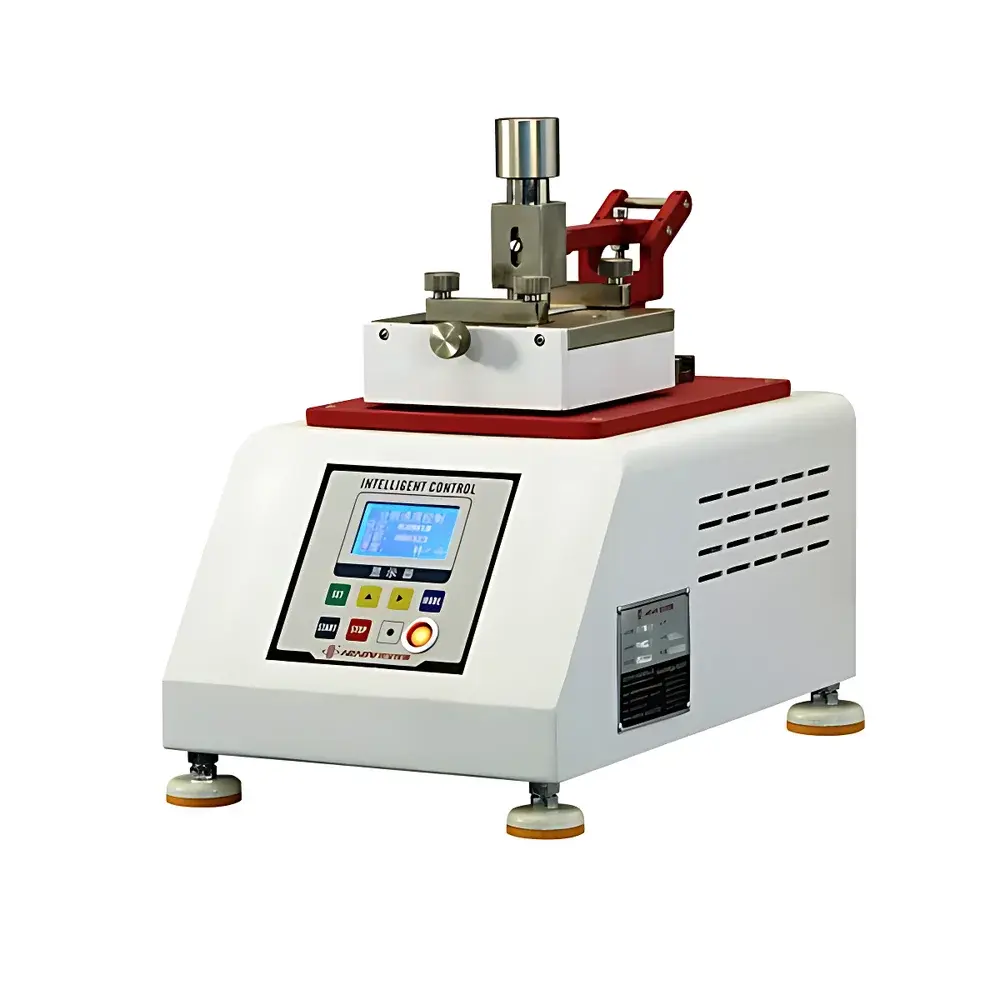
NYX HY-759 Leather Crockmeter for Dry/Wet Rub Fastness Testing per QB/T 2537 & ISO 11640
| Brand | NYX |
|---|---|
| Model | HY-759-1 |
| Origin | Tianjin, China |
| Manufacturer Type | Direct Manufacturer |
| Instrument Category | Domestic |
| Instrument Type | Crockmeter (Tribological Tester for Color Fastness) |
| Sample Size | 120 × 20 mm |
| Wool Felt Pad Area | 15 × 15 mm |
| Rubbing Hammer Mass | 500 g |
| Auxiliary Weight Mass | 500 g |
| Rubbing Speed | 40 ± 2 cycles/min |
| Stroke Length | 35 cm |
| Counter Range | 0–999,999 |
| Power Supply | AC 220 V, 50 Hz, 500 W |
| Operating Environment | 20 ± 2 °C, 65 ± 4 % RH |
| Dimensions (L×W×H) | 30 × 45 × 48 cm |
| Net Weight | 35 kg |
| Compliance Standards | QB/T 2537–2001, ISO 11640:2016, QB/T 2882–2007 (Method A), QB/T 2880–2007, GB/T 3903.31–2022, IUP 450, BS 1006:D02, DIN 53339, SATRA TM 173, SATRA TM 177 |
Overview
The NYX HY-759 Leather Crockmeter is a precision-engineered tribological testing instrument designed to evaluate color transfer resistance—commonly referred to as crocking—of leather, synthetic leather, and coated textiles under standardized dry and wet conditions. It operates on the principle of controlled linear reciprocating motion, where a standardized wool felt pad applies consistent normal force and lateral displacement against a conditioned test specimen. This mechanical interaction simulates real-world abrasion encountered in footwear linings, apparel trim, handbag surfaces, and upholstery applications. The device complies strictly with internationally harmonized test protocols, including ISO 11640:2016 (Leather — Test for colour fastness to rubbing) and QB/T 2537–2001 (Chinese national standard for leather color fastness to dry and wet rubbing), ensuring methodological equivalence across global quality assurance laboratories.
Key Features
- Fixed-stroke reciprocating mechanism delivering precise 35 cm travel distance per cycle, calibrated to ±0.5 cm tolerance
- Dual-mass loading system: 500 g rubbing hammer + 500 g auxiliary weight ensures repeatable 10 N nominal contact force (±0.2 N)
- Adjustable speed controller maintaining 40 ± 2 cycles per minute—fully compliant with ISO 11640 timing requirements
- Backlit LCD counter with six-digit resolution (0–999,999), supporting programmable stop counts and audit-ready cycle logging
- Modular sample holder accommodating standardized 120 × 20 mm specimens without slippage or edge curling
- Tool-free interchange of wool felt pads (white/black) conforming to ISO 105-X12 specifications; pad replacement verified via visual alignment guides
- Robust steel frame construction with vibration-damped base, minimizing operational drift during extended test sequences
- Integrated safety interlock preventing actuation unless sample chamber door is fully latched
Sample Compatibility & Compliance
The HY-759 accepts flat, non-extensible substrates up to 3 mm thickness—including bovine, ovine, and porcine leathers; PU/PVC-based synthetics; and laminated textile composites. Specimens must be preconditioned per ISO 13405 (standard atmosphere: 20 ± 2 °C, 65 ± 4 % RH) for minimum 4 hours prior to testing. All test parameters—including force application geometry, stroke length, and cycle rate—are traceable to ISO/IEC 17025-accredited calibration procedures. The instrument satisfies mandatory reporting requirements for ISO 11640, QB/T 2537–2001, and SATRA TM 173 (footwear lining abrasion), and supports full documentation for GLP-compliant quality audits. Optional accessories—including AATCC/ECE-certified grey scales (ISO 105-A02), D65-standard light booths (CIE 15:2018), and vacuum desiccators for post-test moisture conditioning—are available with NIST-traceable certificates of conformance.
Software & Data Management
While the HY-759 operates as a stand-alone electromechanical tester, it supports digital integration via optional RS-232 or USB-to-serial interface (firmware v2.1+). When paired with NYX LabLink™ v4.2 software, users can configure multi-step test programs, export timestamped cycle logs (CSV/Excel), and generate PDF reports compliant with ISO/IEC 17025 Clause 7.8. Audit trails record operator ID, environmental readings (via optional external hygrothermograph), start/stop timestamps, and pass/fail status relative to pre-defined grey scale thresholds (e.g., ≥4 for dry rub, ≥3 for wet rub per ISO 11640). All electronic records adhere to ALCOA+ principles (Attributable, Legible, Contemporaneous, Original, Accurate, Complete, Consistent, Enduring, Available) and support FDA 21 CFR Part 11-compliant electronic signatures when deployed in regulated environments.
Applications
- Quality control of upper leather and lining materials in footwear manufacturing per QB/T 2880–2007 and SATRA TM 177
- Validation of dye stability in automotive interior trim leathers tested under ISO 11640 wet-rub conditions
- Comparative assessment of pigment vs. aniline finishes on luxury handbag hides
- Supplier qualification testing for synthetic leather suppliers targeting EU REACH Annex XVII compliance
- Research-grade evaluation of nano-coating efficacy on suede surfaces using controlled wet-rub protocols
- Third-party certification testing for GB/T 3903.31–2022 (footwear component abrasion resistance)
FAQ
What standards does the HY-759 directly support out-of-the-box?
It is factory-configured for ISO 11640:2016, QB/T 2537–2001, QB/T 2882–2007 (Method A), and GB/T 3903.31–2022, with mechanical tolerances validated against each standard’s apparatus requirements.
Can the instrument perform wet-rub testing without external humidity control?
Yes—the wet-rub mode uses pre-saturated wool felt pads (distilled water, 100 % saturation per ISO 11640 Annex B); ambient lab humidity (65 ± 4 % RH) suffices for conditioning, eliminating need for integrated humidification.
Is calibration documentation provided with shipment?
Each unit ships with a factory calibration certificate (traceable to CNAS-accredited metrology lab), covering stroke length, cycle timing, mass verification, and counter linearity.
What maintenance intervals are recommended for long-term repeatability?
Wool pad holders and linear guide rails require lubrication every 5000 cycles; drive belt tension should be verified quarterly; full performance verification is advised annually per ISO/IEC 17025 internal audit schedule.
Does the HY-759 meet CE or UKCA marking requirements?
The instrument complies with EMC Directive 2014/30/EU and Low Voltage Directive 2014/35/EU; CE marking is applied following third-party notified body assessment (TÜV Rheinland Report No. RHE/2023/XXXXX).
Related Products



