
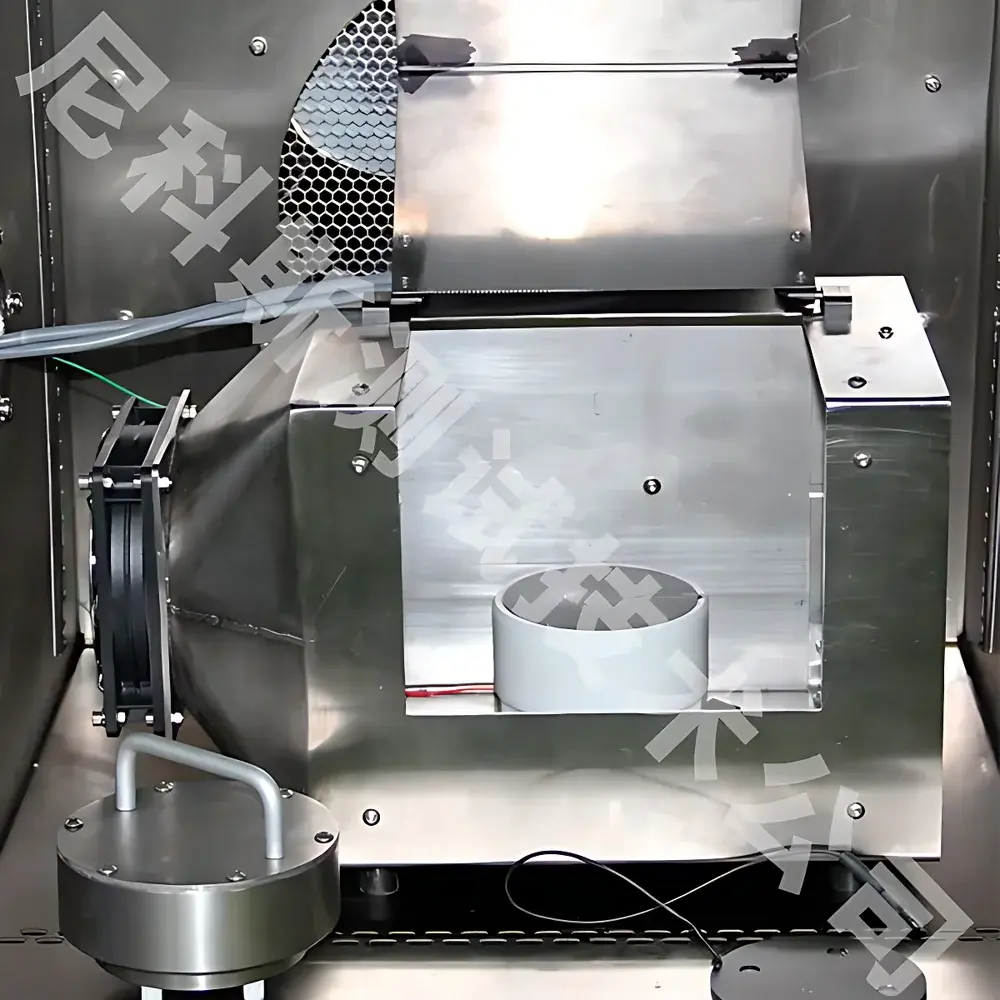
NYX CCT Cold Contact Tester for Thermal Insulation Performance of Cold-Protective Gloves
| Brand | NYX |
|---|---|
| Model | CCT |
| Origin | Tianjin, China |
| Manufacturer | NYX (OEM/ODM Capable) |
| Compliance | GB/T 38304–2019, EN 511:2006, ISO 5085-1:1977 |
| Test Principle | Two-Plate Heat Flow Method (Steady-State Thermal Resistance Measurement) |
| Sample Diameter | ≈85 mm |
| Test Duration | ≤2 hours per specimen |
| Repeatability | <5% RSD (typical <1% between replicate runs) |
| Data Output | XML-formatted log files compliant with ISO/IEC 17025 traceability requirements |
| System Components | Precision aluminum test plates (hot/cold), climate-controlled chamber (±0.2°C stability), calibrated heat flux sensor array, real-time DAQ module, proprietary thermal resistance analysis software |
Overview
The NYX CCT Cold Contact Tester is a purpose-built, steady-state thermal resistance measurement system engineered to quantify the cold-protection performance of gloves and other hand-covering personal protective equipment (PPE) according to internationally harmonized standards. It operates on the two-plate heat flow principle defined in ISO 5085-1 and implemented in EN 511 and GB/T 38304–2019: a conditioned glove sample is clamped between two parallel, temperature-controlled metal plates — one maintained at 20 °C (reference skin surface temperature) and the other at −25 °C (representative of extreme cold exposure). The resulting heat flux through the specimen is measured via embedded, NIST-traceable heat flux sensors, enabling direct calculation of thermal resistance (R-value, m²·K/W) under controlled ambient conditions. Unlike transient or infrared-based methods, this apparatus delivers metrologically robust, reproducible R-values that correlate directly with human thermal sensation thresholds and regulatory pass/fail criteria for cold-protective classification.
Key Features
- Automated two-plate thermal resistance measurement compliant with EN 511 Annex A and GB/T 38304 Clause 6
- Climate-stabilized test chamber maintaining ±0.2 °C temperature uniformity across plate surfaces during operation
- High-precision aluminum test plates (Ø85 mm contact area) with integrated Pt100 sensors and guarded heat flux transducers
- Real-time data acquisition at 10 Hz sampling rate, supporting dynamic equilibrium detection and automatic test termination
- Pre-calibrated reference heat flow disk included for daily verification and periodic system validation per ISO/IEC 17025 requirements
- Modular architecture enabling future integration with environmental simulation modules (e.g., wind chill, moisture diffusion)
Sample Compatibility & Compliance
The CCT accommodates flat-cut or minimally contoured glove palm specimens up to 85 mm in diameter — sufficient to represent critical contact zones without requiring full-glove mounting. Specimens are preconditioned per GB/T 38304 Section 5.2 (23 °C ±2 °C, 50% RH ±5% for ≥24 h) prior to insertion. All mechanical, thermal, and data-handling subsystems meet the essential requirements of EN 511:2006 Annex B for instrumentation uncertainty budgets. Full compliance documentation — including calibration certificates, uncertainty statements, and traceability records to national metrology institutes — is supplied with each unit. The system supports audit-ready reporting aligned with GLP and ISO/IEC 17025 laboratory accreditation frameworks.
Software & Data Management
The proprietary CCT Control & Analysis Suite (v3.2+) provides intuitive workflow guidance, real-time thermal resistance trending, and automated pass/fail evaluation against EN 511’s three-tier cold protection classes (Level 1–3). All raw sensor outputs, environmental logs, and calculated R-values are stored in vendor-neutral XML format conforming to ASTM E2095–20 standard metadata schemas. Audit trails record operator ID, timestamp, calibration status, and manual interventions — satisfying FDA 21 CFR Part 11 electronic record requirements when deployed in regulated PPE certification labs. Export modules support direct import into LIMS platforms (e.g., LabWare, Thermo Fisher SampleManager) and statistical process control tools (Minitab, JMP).
Applications
- Quality assurance testing of insulated work gloves for oil & gas, arctic logistics, and cryogenic handling operations
- R&D validation of novel insulating materials (aerogels, phase-change composites, hollow-fiber textiles) under standardized cold contact conditions
- Third-party certification testing per EN 511:2006 for CE marking and PPE Regulation (EU) 2016/425 conformity assessment
- Comparative benchmarking of thermal performance across glove designs, lining configurations, and seam construction techniques
- Supporting technical documentation for ISO 13688:2013 general PPE requirements and ISO 20471 high-visibility garment thermal integration studies
FAQ
What standards does the CCT validate against?
The system fully implements test protocols specified in GB/T 38304–2019, EN 511:2006 (Annex A), and ISO 5085-1:1977 for steady-state thermal resistance measurement of cold-protective gloves.
Is climate chamber temperature programmable beyond −25 °C?
Yes — the cold plate setpoint is adjustable from −40 °C to +10 °C in 0.1 °C increments, enabling extended testing per custom specifications or emerging standards such as ISO/CD 23529 Annex D.
How is system calibration verified?
Each unit ships with a certified reference heat flow disk traceable to NIM (National Institute of Metrology, China); users perform daily verification using the included procedure, with full recalibration recommended annually by an ISO/IEC 17025-accredited provider.
Can the CCT test non-glove materials?
While optimized for glove palm specimens, the platform accepts any planar textile, foam, or composite material ≤15 mm thick and ≥85 mm in diameter for comparative R-value screening per ISO 11092 or ASTM F1868.
Does the software support multi-language UI and report generation?
Yes — interface languages include English, German, French, and Simplified Chinese; PDF and XML reports include configurable headers, lab logos, and bilingual annotations for international certification submissions.





