
Tisch TE-PMD Dual-Channel PM10/PM2.5 Ambient Air Sampler
| Brand | Tisch |
|---|---|
| Origin | USA |
| Manufacturer Type | Authorized Distributor |
| Import Status | Imported |
| Model | TE-PMD |
| Pricing | Available Upon Request |
Overview
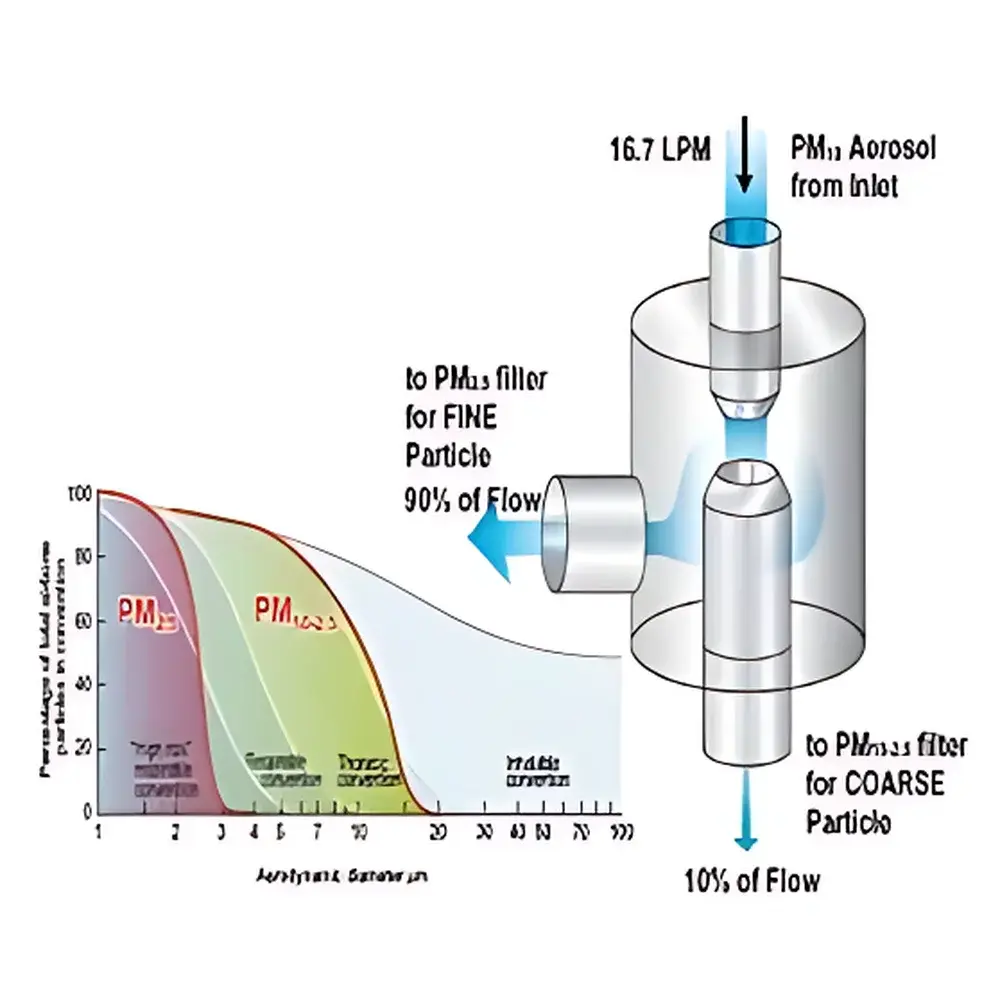
The Tisch TE-PMD Dual-Channel PM10/PM2.5 Ambient Air Sampler is a precision-engineered, gravimetric reference-grade instrument designed for concurrent, size-fractionated collection of atmospheric particulate matter in accordance with U.S. EPA Reference Method PS-1 and ISO 7708:1995. It operates on the principle of inertial impactor separation—utilizing a dual-stage, parallel-flow cascade impactor assembly to physically segregate airborne aerosols into two discrete aerodynamic diameter fractions: PM2.5 (particles ≤2.5 µm) and PM10 (particles ≤10 µm), with the coarse fraction (PM10–2.5) collected separately from the fine fraction. This architecture ensures compliance with regulatory definitions for inhalable and respirable particulate mass determination, enabling traceable, filter-based mass concentration quantification per ASTM D6216 and EN 12341.
Key Features
- Dual independent volumetric flow control system: Each channel maintains a stable, user-selectable sampling rate (standard configuration: 16.7 L/min for PM10, adjustable for PM2.5 per site-specific protocols) via calibrated critical orifices and feedback-regulated diaphragm pumps.
- Integrated environmental monitoring: Onboard pressure, temperature, and relative humidity sensors provide real-time metrological correction of volumetric flow to standard conditions (25 °C, 101.325 kPa), with data logged at user-defined intervals (1–60 min).
- Touchscreen HMI with intuitive graphical interface: Enables full operational control—including method selection, event scheduling, calibration verification, and error diagnostics—without specialized training.
- Network-enabled data acquisition: All operational parameters (flow rates, elapsed time, ambient conditions, pump status) are timestamped and stored internally; exportable via Ethernet/IP to external servers or LIMS using standard TCP/IP protocols.
- Modular expandability: Optional integrated meteorological station supports concurrent measurement of wind speed/direction, ambient temperature, barometric pressure, relative humidity, and precipitation accumulation—all synchronized and archived to internal solid-state storage.
- Compliance-ready hardware: Accepts standard 47-mm polytetrafluoroethylene (PTFE) or quartz fiber filters in reusable stainless-steel cassettes; inlet geometry conforms to EPA PM10 design specifications (16.7 L/min nominal flow, sharp 50% cut-point at 10 µm ±0.2 µm).
Sample Compatibility & Compliance
The TE-PMD accommodates standard 47-mm membrane filters (e.g., PTFE, quartz, cellulose ester) compatible with subsequent gravimetric analysis, ion chromatography (IC), X-ray fluorescence (XRF), and thermal-optical carbon analysis (OC/EC). Its physical separation mechanism eliminates cross-contamination between size fractions, supporting method validation under ISO/IEC 17025:2017. The instrument meets U.S. EPA equivalency criteria for Federal Reference Methods (FRMs) when operated per 40 CFR Part 53 Appendix L, and supports data integrity requirements for GLP-compliant environmental health studies. All firmware and data logs retain full audit trails, satisfying FDA 21 CFR Part 11 electronic record retention expectations for regulated research environments.
Software & Data Management
Data acquisition and instrument control are managed through embedded firmware with configurable logging intervals and alarm thresholds. Raw sensor outputs (differential pressure across impactor stages, thermistor resistance, piezoresistive pressure transducer voltage) are converted in real time using NIST-traceable calibration coefficients. Exported CSV files include metadata headers compliant with EPA Air Quality System (AQS) format requirements. Optional Tisch DataLink™ software provides remote monitoring, automated report generation (daily summary, QC flagging), and integration with third-party environmental databases via ODBC or RESTful API. All stored data are encrypted at rest and support SHA-256 hash verification for forensic integrity validation.
Applications
- Long-term ambient air quality monitoring networks requiring simultaneous PM2.5 and PM10–2.5 mass concentration datasets for source apportionment modeling (e.g., CMB, PMF).
- Epidemiological cohort studies linking coarse vs. fine particle exposure to cardiovascular and respiratory endpoints.
- Regulatory compliance verification at industrial fence-line and urban background sites per EU Directive 2008/50/EC and U.S. NAAQS implementation rules.
- Method development and intercomparison campaigns involving filter-based speciation (e.g., water-soluble ions, elemental carbon, metals) where spatial and temporal co-location of size-resolved samples is essential.
- Calibration transfer studies between reference-grade samplers and continuous monitors (e.g., beta attenuation, tapered element oscillating microbalance) under controlled field conditions.
FAQ
What filter types are validated for use with the TE-PMD?
Standard 47-mm PTFE, quartz fiber, and cellulose nitrate filters are supported; all must be pre- and post-weighed in ISO 17025-accredited balance labs using controlled humidity and static-dissipative protocols.
Does the TE-PMD meet U.S. EPA FRM designation requirements?
Yes—when configured with the certified PM10 inlet and operated at 16.7 L/min with appropriate impactor calibration, it satisfies the performance criteria outlined in 40 CFR Part 53 Appendix L for PM10 FRMs.
Can the instrument operate unattended for extended periods?
Yes—designed for continuous operation up to 30 days with scheduled filter changes; internal battery backup sustains clock and memory during brief power outages.
Is remote firmware update capability available?
Firmware updates require secure USB connection and authenticated Tisch technical credentials; no over-the-air updates are permitted to preserve regulatory audit integrity.
How is flow calibration verified in the field?
Built-in electronic flow calibrator (optional accessory) enables direct traceable verification against primary standards (e.g., dry gas meter, bubble flowmeter) without disassembly.







