
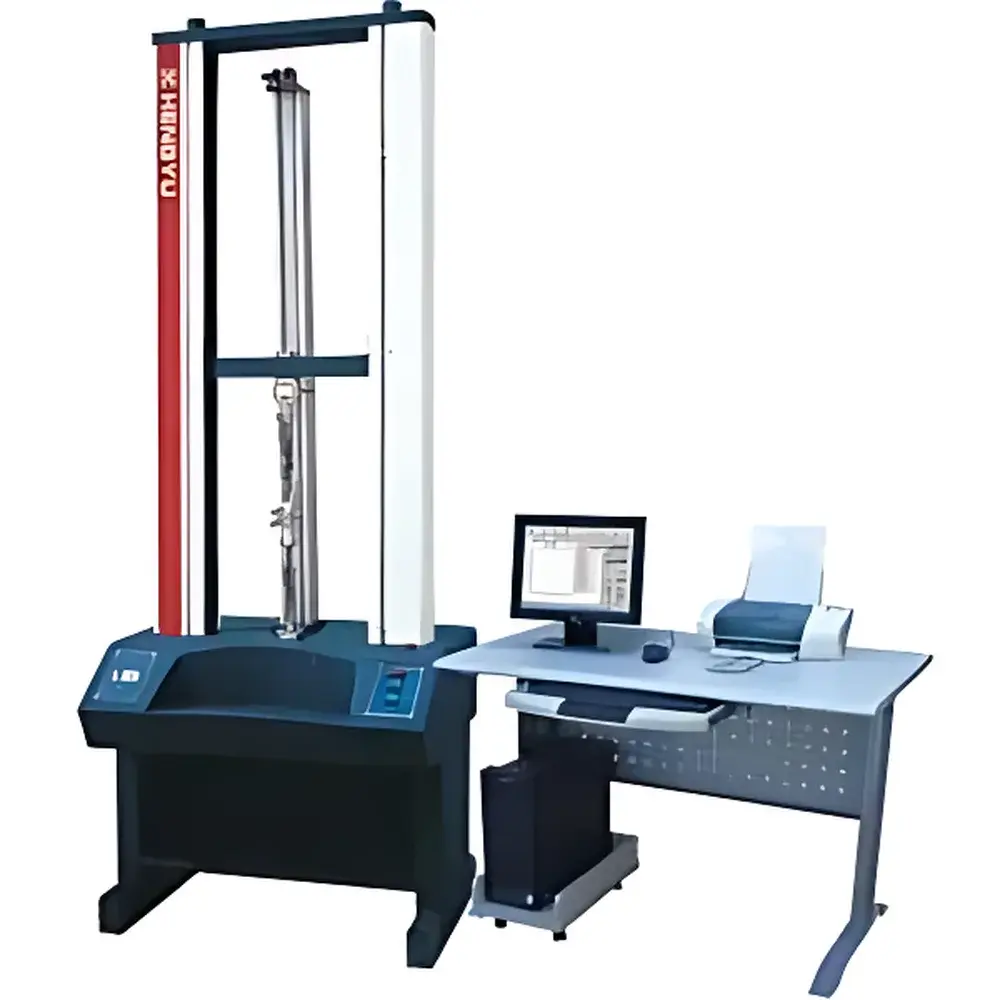
Hengyu HY-932CS Computer-Controlled Servo Electronic Fabric Tensile Tester (Universal Material Testing Machine)
| Brand | Hengyu |
|---|---|
| Model | HY-932CS |
| Capacity Options | 2–2000 kg (selectable) |
| Load Accuracy | ±0.5% of reading (within 0.4–100% of full scale) |
| Load Resolution | ±1/200,000 of maximum test force (24-bit A/D, 200 Hz sampling) |
| Displacement Accuracy | ±0.5% of reading (within 2–100% FS) |
| Displacement Resolution | 0.005 mm |
| Large Deformation Range | 10–800 mm |
| Large Deformation Accuracy | ±0.5% of reading |
| Large Deformation Resolution | 0.008 mm |
| Drive System | Panasonic 750 W servo motor + HIWIN ball screw + rotary encoder |
| Speed Range | 0.05–500 mm/min (optional 0.1–1000 mm/min) |
| Speed Accuracy | ±0.5% of set value |
| Effective Test Width | 420 mm (or 560 mm) |
| Test Stroke | 1000 mm (adjustable gauge length, fixture not included) |
| Software Platform | Windows-based proprietary testing software with modular standard compliance, multi-language UI (EN/CN), auto-scaling real-time graphs, and export to Excel, TXT, HTML |
Overview
The Hengyu HY-932CS is a computer-controlled, servo-driven universal material testing system engineered specifically for high-reproducibility mechanical characterization of textile fabrics and related soft materials. It operates on the fundamental principle of controlled-force or controlled-displacement uniaxial loading—applying precisely regulated tensile, compressive, bending, or shear loads to specimens while continuously acquiring synchronized load, displacement, and deformation data. Designed in accordance with international textile mechanics standards—including ISO, ASTM, GB/T, JIS, and FZ/T—the HY-932CS delivers traceable, audit-ready results suitable for R&D laboratories, quality control departments, and third-party certification bodies operating under GLP, ISO/IEC 17025, or GMP-aligned workflows.
Key Features
- Precision dual-channel closed-loop control architecture integrating Panasonic 750 W servo motor, HIWIN preloaded ball screw, and high-resolution rotary encoder for repeatable speed and position fidelity across the full operational range (0.05–500 mm/min).
- High-fidelity load measurement system featuring up to four independently calibrated load cells (max 20 kN total), each equipped with 24-bit analog-to-digital conversion and 200 Hz real-time sampling—ensuring resolution down to ±1/200,000 of full-scale capacity.
- Sub-micron displacement resolution (0.005 mm) and extended large-deformation capability (10–800 mm, ±0.5% accuracy) enable precise quantification of elongation, recovery, creep, and hysteresis in elastic and viscoelastic textiles.
- Modular test mode selection: constant rate of extension (CRE), constant rate of loading (CRL), constant stress, constant strain rate, load-hold, displacement-hold, and cyclic protocols—including programmable ramp-hold-relax sequences for fatigue and relaxation analysis.
- Configurable mechanical interface: standardized T-slot crosshead and base plate accommodate ASTM/ISO-compliant clamps (pneumatic, wedge, roller, pneumatic self-tightening), seam slippage fixtures, tear jigs (tongue, trapezoidal), burst domes (steel-ball method per GB/T 19976), and peel test assemblies.
Sample Compatibility & Compliance
The HY-932CS supports mechanical testing of woven, knitted, nonwoven, coated, laminated, and composite textile structures—including technical textiles, geotextiles, medical fabrics, and smart textiles—as well as auxiliary materials such as leather, rubber sheets, plastic films, paperboard, and thin metallic foils. Its firmware embeds over 40 preconfigured test methods aligned with globally recognized standards: GB/T 3923.1–2 (tensile strength, strip/grab), GB/T 3917.2–3 (tear resistance), GB/T 13772.1–2 (seam slippage), GB/T 13773.1–2 (seam strength), GB/T 19976 (burst strength), ASTM D5034/D5035 (grab/strip tensile), ASTM D2261/D5587 (tear), ASTM D1683 (seam slippage), JIS L1096 (Japanese textile standard), and FZ/T series for apparel-specific evaluations. All test configurations comply with ISO 7500-1 (static calibration), ISO 5893 (dynamic performance), and support audit trails required under FDA 21 CFR Part 11 when configured with electronic signature and data integrity modules.
Software & Data Management
The HY-932CS runs on a dedicated Windows-based application built for regulatory-grade data integrity. It provides fully customizable test templates, user-defined parameter libraries (material type, specimen geometry, conditioning history), and formula-editable calculation modules—enabling seamless adaptation to evolving internal SOPs or new standard revisions. Real-time graphical overlays include load–displacement, stress–strain, load–time, and force–extension curves with auto-scaling and dynamic switching during active tests. Post-test analysis automatically computes key metrics: maximum load, breaking strength, elongation at break, yield point, modulus (secant/tangent), seam slippage distance, tear propagation energy, burst height, peel adhesion, and statistical summaries (mean, SD, CV%). Raw and processed data export natively to Excel (.xlsx), plain text (.txt), and HTML reports—with optional PDF generation and timestamped digital signatures. Audit logs record operator ID, test sequence, parameter changes, calibration events, and software version history.
Applications
This system serves as a primary mechanical evaluation platform across textile supply chains—from fiber producers validating staple strength and filament tenacity, to fabric mills certifying GSM-dependent tensile performance, garment manufacturers verifying seam integrity under dynamic stress, and PPE developers assessing abrasion-resistant layer bonding. It is routinely deployed for: (1) ISO 13934-compliant tensile benchmarking of warp/weft yarns; (2) ASTM D5587 trapezoidal tear assessment of filtration media; (3) GB/T 19976 steel-ball burst testing of surgical gowns; (4) FZ/T 80007.1 peel adhesion validation of fusible interlinings; (5) cyclic fatigue testing of elastic waistbands per FZ/T 70006; and (6) comparative creep analysis of biodegradable nonwovens under controlled humidity and temperature conditions. Its versatility extends into academic research on structure–property relationships in novel textile architectures, including auxetic weaves and shape-memory polymer composites.
FAQ
What textile standards does the HY-932CS natively support?
It includes pre-loaded configurations for all major textile mechanical standards: GB/T, ASTM, ISO, JIS, BS, and FZ/T—covering tensile, tear, burst, seam slippage, seam strength, peel, and elasticity testing.
Can the system be validated for ISO/IEC 17025 accreditation?
Yes—when paired with NIST-traceable load cell calibration certificates, documented uncertainty budgets, and enabled audit-trail functionality, it meets the metrological and procedural requirements for accredited laboratory use.
Is third-party calibration documentation available?
A certified third-party calibration report (including as-found/as-left data, uncertainty statements, and traceability to national standards) can be supplied upon request and is recommended annually or after major maintenance.
How is data integrity ensured for regulated environments?
The software supports role-based access control, electronic signatures, immutable audit logs, and 21 CFR Part 11-compliant data archiving—provided the host PC meets validated OS and network configuration requirements.
What accessories are required for seam slippage testing per GB/T 13772.1?
A pair of standardized seam slippage clamps (with 10 mm grip width and adjustable preload) and a calibrated 100 N load cell are standard; optional digital extensometer integration enables direct slip-distance measurement.





