
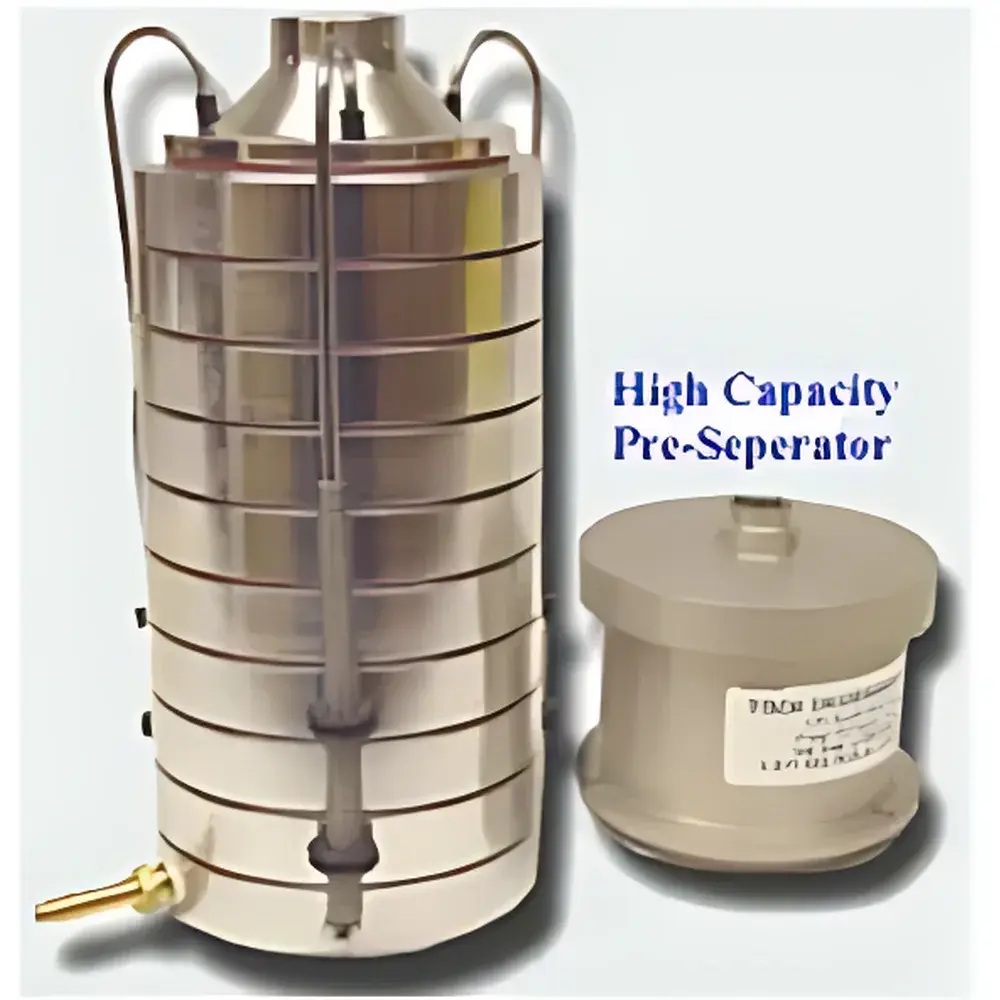
Tisch TE-20-800 Eight-Stage Impactor Aerosol Sampler
| Brand | Tisch |
|---|---|
| Origin | USA |
| Model | TE-20-800 |
| Sampling Flow Rate | 28.3 L/min |
| Stage Cut Points (aerodynamic diameter) | Pre-separator ≥10.0 µm, Stage 0: 9.0 µm, Stage 1: 5.8 µm, Stage 2: 4.7 µm, Stage 3: 3.3 µm, Stage 4: 2.1 µm, Stage 5: 1.1 µm, Stage 6: 0.7 µm, Stage 7: 0.4 µm |
| Collection Substrate | 81 mm circular filters or petri dishes |
| Material | Anodized aluminum impactor stages, stainless steel collection plates, silicone O-rings |
| Compliance | Meets U.S. EPA, OSHA, and ACGIH criteria for respirable and inhalable particulate fractionation |
Overview
The Tisch TE-20-800 Eight-Stage Impactor Aerosol Sampler is a precision-engineered inertial cascade impactor designed to physically separate airborne particles according to their aerodynamic equivalent diameter. Based on the fundamental principles of inertial impaction—where particles with sufficient mass deviate from the sampled airflow streamlines upon encountering abrupt directional changes—the TE-20-800 achieves discrete size-fractionated collection across nine aerodynamic cut points (including the pre-separator). This enables quantitative assessment of mass concentration distribution across eight defined particle size ranges—from coarse (>10 µm) to ultrafine (<0.4 µm)—under a standardized volumetric flow rate of 28.3 L/min (1 ft³/min). Its design closely emulates human respiratory tract deposition mechanics, supporting regulatory alignment with inhalable (ISO/ACGIH), thoracic (OSHA), and respirable (NIOSH/US EPA) particulate definitions. The instrument serves as a reference-grade sampling platform in ambient air quality monitoring, occupational hygiene surveys, source apportionment studies, and aerosol toxicology research.
Key Features
- Eight-stage anodized aluminum impactor assembly with precisely machined jet orifices calibrated to NIST-traceable aerodynamic cut points
- Dedicated pre-separator stage for efficient removal of particles ≥10.0 µm, minimizing overloading of downstream stages and enhancing measurement fidelity for fine fractions
- Stainless steel collection plates (8 units) compatible with gravimetric analysis, microscopy, elemental composition (e.g., SEM-EDS), or molecular assays (e.g., PCR for bioaerosols)
- Standard 81 mm circular substrates—including quartz fiber, PTFE, or polycarbonate membrane filters—facilitating direct weighing on analytical balances (0.1 µg resolution) and subsequent extraction protocols
- Integrated silicone O-ring sealing system (11 pieces) ensuring leak-tight integrity across all inter-stage interfaces at operating pressure differentials
- Corrosion-resistant, wear-resistant alloy construction suitable for long-term deployment in field environments including industrial stack testing and urban monitoring networks
- Modular vacuum pump interface accommodating optional mass-flow-controlled systems for ISO 17025-compliant flow calibration and real-time flow logging
Sample Compatibility & Compliance
The TE-20-800 is validated for collection of both viable and non-viable aerosols—including mineral dusts, combustion soot, fungal spores, bacterial cells, and engineered nanoparticles—without significant particle bounce or re-entrainment due to optimized jet-to-plate standoff distances and surface energy management. It conforms to U.S. Federal Reference Method (FRM) specifications for size-selective samplers and satisfies performance criteria outlined in EPA Method IO-3.2, OSHA Method ID-202, and ACGIH Technical Report TR-10. When operated per manufacturer-specified procedures—including pre- and post-sampling filter conditioning, flow verification via primary standard calibrators (e.g., bubble meters or critical orifice manometers), and environmental parameter logging—it supports data defensibility under GLP and ISO/IEC 17025 accreditation frameworks. Its stage-wise cut points are traceable to the American Conference of Governmental Industrial Hygienists (ACGIH) particle size-selective sampling conventions.
Software & Data Management
While the TE-20-800 operates as a passive mechanical sampler requiring no embedded electronics, its integration into modern environmental monitoring workflows is enabled through complementary digital infrastructure. Users routinely pair it with certified volumetric flow controllers (e.g., DryCal or Bios International devices) that generate timestamped, temperature- and pressure-compensated flow logs compliant with FDA 21 CFR Part 11 audit trail requirements. Gravimetric results are entered into LIMS platforms using standardized templates aligned with ASTM D1357 (for aerosol sampling protocol documentation) and ISO 11097 (for particle size distribution reporting). Optional accessories include programmable timer switches and barometric pressure/temperature/humidity sensors for comprehensive metadata capture—essential for PM₂.₅ and PM₁₀ equivalence calculations per EPA regulatory guidance.
Applications
- Ambient air quality assessment: Quantifying size-resolved PM mass concentrations for compliance with National Ambient Air Quality Standards (NAAQS)
- Occupational exposure monitoring: Differentiating inhalable, thoracic, and respirable fractions in manufacturing, mining, and pharmaceutical cleanroom environments
- Bioaerosol characterization: Collecting culturable and non-culturable microorganisms for viability assays, metagenomic sequencing, and endotoxin quantification
- Source emission profiling: Resolving particle size distributions from combustion stacks, agricultural operations, and construction sites to inform control strategy development
- Atmospheric science research: Supporting cloud condensation nuclei (CCN) activation studies and secondary organic aerosol (SOA) formation modeling
- Toxicological dose reconstruction: Enabling lung deposition modeling using MPPD (Multiple-Path Particle Dosimetry) software inputs derived from stage-specific mass loadings
FAQ
What particle size ranges does the TE-20-800 resolve, and how are cut points determined?
The TE-20-800 resolves particles across nine aerodynamic diameter intervals, from ≥10.0 µm (pre-separator) down to <0.4 µm (Stage 7), with cut points empirically validated using monodisperse aerosol standards and referenced to Stokes number theory.
Is the TE-20-800 suitable for viable bioaerosol collection?
Yes—when paired with nutrient agar or specialized collection media in stainless steel petri dishes, and operated at ≤28.3 L/min with controlled relative humidity, it maintains microbial viability for subsequent culturing and identification.
Can the impactor be cleaned and reused between sampling events?
All aluminum stages and stainless steel plates are autoclavable or solvent-cleanable; however, jet orifice geometry must be verified post-cleaning using optical inspection or flow calibration to ensure dimensional integrity.
Does the TE-20-800 meet ISO or EU regulatory requirements?
While primarily designed to U.S. federal criteria, its cut points align with EN 481 (inhalable dust) and CEN/TS 15255 (respirable fraction), and it has been accepted in cross-border validation studies coordinated by the European Monitoring and Evaluation Programme (EMEP).
What vacuum pump specifications are recommended?
A minimum 35 L/min free-air displacement pump with ≥–60 kPa ultimate vacuum and integrated flow regulation is advised; pumps must be oil-free if collecting for organic or elemental analysis to avoid hydrocarbon contamination.
Related Products







