
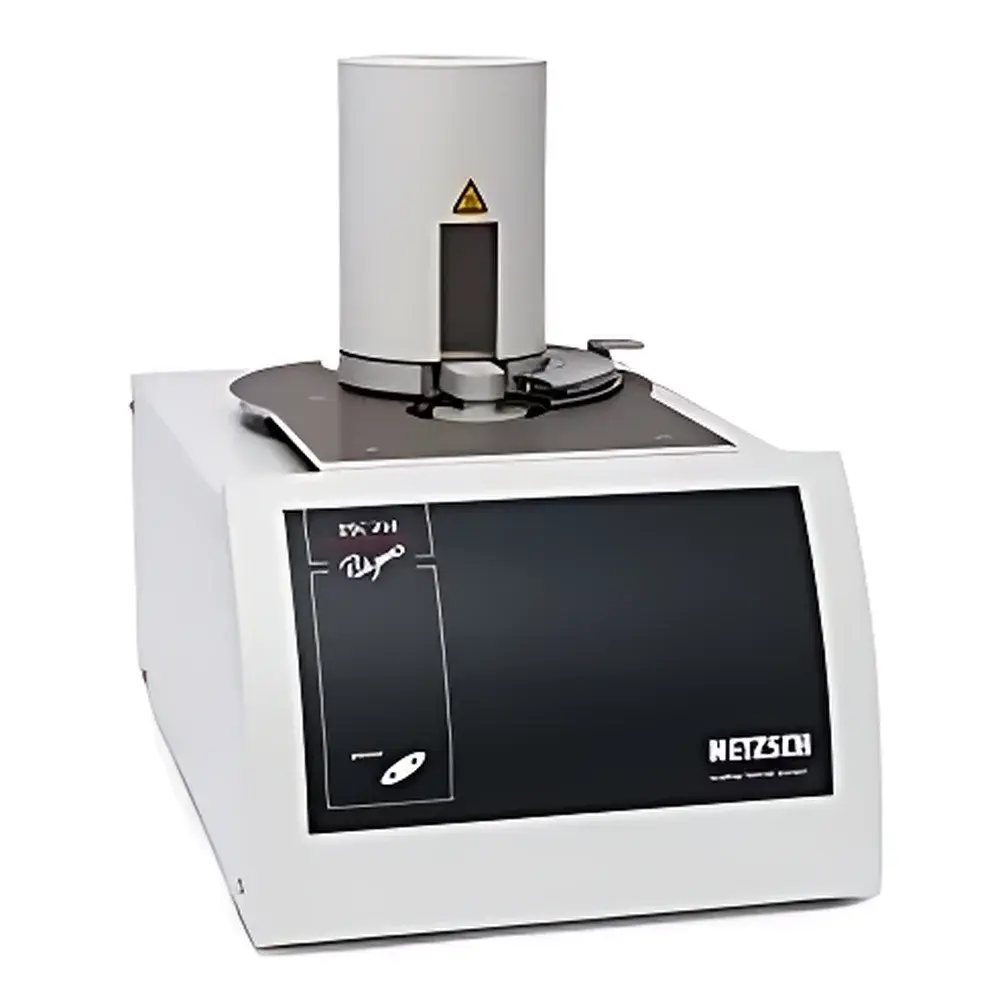
Netzsch DSC 214 Polyma Differential Scanning Calorimeter
| Brand | Netzsch |
|---|---|
| Origin | Germany |
| Model | DSC 214 Polyma |
| Temperature Range | −170 °C to 600 °C / 700 °C (depending on furnace) |
| Temperature Accuracy | ±0.1 °C (against standard metals) |
| Heating/Cooling Rate | 0.001–500 K/min |
| Baseline Drift | 10 μW (−50 °C to 300 °C) |
| DSC Signal Range | ±750 mW |
| Enthalpy Sensitivity | 0.1 μW |
| Enthalpy Accuracy | ±0.05% (against standard metals) |
| Thermal Response Ratio | >100 mW/K |
Overview
The Netzsch DSC 214 Polyma is a high-performance, heat-flux differential scanning calorimeter engineered for precision thermal characterization of polymeric, pharmaceutical, and advanced material systems. It operates on the fundamental principle of measuring the differential heat flow between a sample and an inert reference as both are subjected to a controlled temperature program—enabling quantitative determination of enthalpic transitions including glass transitions (Tg), melting (Tm), crystallization (Tc), cold crystallization, oxidative induction time (OIT), and reaction enthalpies. Designed with a low-mass elliptical furnace (Arena furnace), the instrument achieves unprecedented dynamic performance for a heat-flux DSC: heating and cooling rates up to 500 K/min enable simulation of industrial processing conditions—such as injection molding or rapid quenching—that cannot be replicated with conventional DSCs limited to ≤20 K/min. Its modular architecture supports seamless integration of optional modules including modulation capability (MDSC), automated sample handling, and multi-cooling configurations—making it suitable for routine QC laboratories as well as R&D environments requiring traceable, GLP-compliant thermal data.
Key Features
- Corona sensor technology: A patented dual-alloy sensor (chromium–nickel inner ring, constantan outer ring) diffusion-bonded for exceptional thermal symmetry, signal stability, and long-term reproducibility.
- Arena furnace: Ultra-low thermal mass elliptical geometry enabling rapid thermal response and minimizing thermal lag—critical for high-rate experiments and accurate kinetic analysis.
- Concavus crucibles: Precision-engineered aluminum crucibles with reinforced concave base ensure optimal thermal contact with the sensor surface, reducing inter-run variability and improving baseline flatness.
- 3-in-1 Box packaging system: Anti-static, stackable storage trays holding 96 crucible–lid pairs with integrated labeling cards—designed for audit-ready sample traceability and efficient lab workflow management.
- Multi-cooling flexibility: Compatible with compressed air, mechanical refrigeration (IC40/IC70), and liquid nitrogen cooling—software-controlled switching between cooling modes without hardware reconfiguration.
- Triple-gas control: Three independently regulated mass flow controllers support dynamic atmosphere switching (inert, oxidizing, reducing) during a single run, compliant with ASTM D3895 (OIT), ISO 11357, and USP <1163>.
Sample Compatibility & Compliance
The DSC 214 Polyma accommodates a broad range of sample formats—including powders, granules, films, fibers, composites, and viscous resins—using crucibles fabricated from aluminum, copper, silver, stainless steel (high-pressure), and other inert alloys. Crucible selection adheres to ISO 11357-1 requirements for thermal conductivity, chemical inertness, and phase stability across the full operating range. The system meets essential regulatory expectations for analytical instrumentation: full audit trail functionality (including user action logging, method versioning, and raw data immutability) satisfies FDA 21 CFR Part 11 when deployed with Proteus® software in validated environments. Calibration traceability is maintained via multi-point, non-linear correction using certified reference materials (e.g., indium, zinc, tin, bismuth), aligned with ISO/IEC 17025 and ASTM E967 practices. Optional Tau-R correction and FRC-modulated calibration further enhance accuracy for complex thermal events under non-isothermal conditions.
Software & Data Management
Proteus® 7.0 software—standard with the DSC 214 Polyma—provides dual-mode operation: SmartMode guides novice users through standardized polymer testing protocols (e.g., Tg, Tm, OIT) via intuitive wizards and preconfigured methods derived from NETZSCH’s Polymer Property Poster database; ExpertMode unlocks full parameter control, manual peak deconvolution, and advanced modeling. Core automated functions include AutoCalibration (fully scripted multi-point thermal and enthalpy calibration), AutoEvaluation (algorithm-driven identification and quantification of glass transition, melt, recrystallization, and degradation events), and Identify (pattern-matching against an expandable spectral library for material classification and batch-to-batch comparison). All raw and processed data are stored in vendor-neutral, timestamped .tdb files with embedded metadata—supporting long-term archival, cross-platform reprocessing, and integration into LIMS or ELN systems. The software runs natively on Windows 7/8.1/10 and supports remote access via networked PCs or tablets—enabling decentralized operation without compromising data integrity.
Applications
The DSC 214 Polyma serves critical roles across multiple sectors: In polymer science, it quantifies crystallinity, monitors curing kinetics of thermosets, evaluates thermal stability of composites, and validates resin formulation consistency. In pharmaceutical development, it characterizes polymorphic transitions, assesses excipient compatibility, determines amorphous content, and supports ICH Q5C stability studies. For quality assurance, it performs incoming raw material verification, release testing per USP <1163>, and root-cause analysis of thermal-related product failures. Its high-speed capability enables quasi-isothermal crystallization studies, cold-crystallization mapping, and accelerated aging simulations—providing data directly relevant to process design and shelf-life prediction. When combined with optional modulated DSC or simultaneous TGA-DSC coupling, it supports comprehensive thermal decomposition pathway analysis under controlled atmospheres.
FAQ
What cooling options are available for the DSC 214 Polyma, and how do they affect the usable temperature range?
The instrument supports three independent cooling solutions: compressed air (to ambient), mechanical refrigeration (IC40: −40 °C to 600 °C; IC70: −70 °C to 600 °C), and liquid nitrogen (−170 °C to 600 °C or 700 °C with high-temp furnace). Cooling mode selection is software-controlled and does not require physical reconfiguration.
Is the DSC 214 Polyma compliant with FDA 21 CFR Part 11 for regulated environments?
Yes—when operated with Proteus® software in validated configuration (including electronic signatures, audit trail activation, and secure user authentication), the system meets core technical requirements for electronic records and signatures under 21 CFR Part 11.
Can the AutoEvaluation function analyze unknown polymer blends or filled systems?
AutoEvaluation is optimized for homopolymers, copolymers, and common thermoplastic elastomers. For complex blends or highly filled systems, ExpertMode provides manual baseline placement, peak deconvolution, and custom enthalpy referencing—ensuring scientifically defensible interpretation.
How does the Concavus crucible improve measurement reproducibility compared to standard DSC pans?
Its reinforced concave geometry ensures uniform, gap-free contact with the sensor surface—reducing interfacial thermal resistance and minimizing position-dependent signal variation. This design yields sub-0.01 °C temperature repeatability and <1% enthalpy RSD across ≥50 replicate measurements.
Is Tau-R correction included as standard, and what does it correct for?
Tau-R (time-constant corrected) analysis is built into Proteus® and automatically compensates for sensor thermal lag and finite heat transfer rates—improving accuracy of onset temperatures and peak shapes, especially at high heating rates (>50 K/min) or for narrow transitions.



