
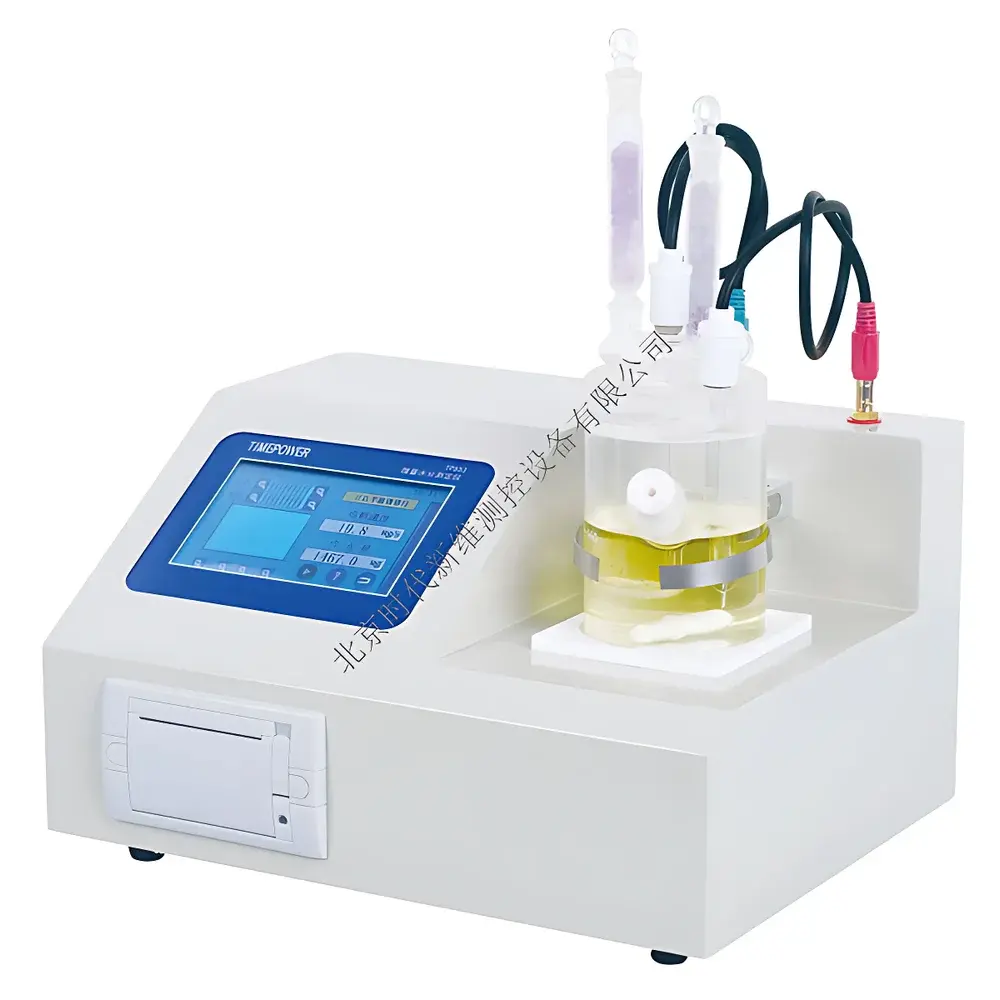
Timepower TP553 Karl Fischer Coulometric Moisture Analyzer
| Brand | Timepower |
|---|---|
| Origin | Beijing, China |
| Manufacturer Type | Direct Manufacturer |
| Product Category | Domestic |
| Model | TP553 |
| Titration Method | Coulometric (Karl Fischer) |
| Measurement Resolution | 0.1 µg |
| Water Content Range | 3 µg – 100 mg |
| Accuracy | ≤0.3% (for samples >1 mg) |
| Minimum Sample Injection Volume | 0.5 µL |
| Titration Control Precision | 0.1 µg |
| Electrolysis Current Range | 0–400 mA |
| Max. Electrolysis Rate | 2.4 mg/min |
| Operating Temperature | 20–30 °C |
| Relative Humidity Limit | ≤85% RH |
| Power Supply | AC 220 V ±10%, 50 Hz ±10% |
| Max. Power Consumption | ≤30 W |
| Dimensions | 320 × 240 × 200 mm |
| Weight | 5 kg |
Overview
The Timepower TP553 Karl Fischer Coulometric Moisture Analyzer is a precision laboratory instrument engineered for trace-level water quantification in liquid, solid, and gaseous samples using the electrochemical coulometric Karl Fischer titration principle. Unlike volumetric KF methods, this analyzer generates iodine *in situ* via controlled electrolysis at the anode—where iodide ions are oxidized to molecular iodine—and measures water content stoichiometrically based on Faraday’s law: one mole of I₂ reacts with one mole of H₂O. This enables absolute quantification without calibration standards, delivering high reproducibility and intrinsic accuracy for moisture levels as low as 3 µg. Designed for compliance with international standard test methods—including ASTM D6304, ISO 760, and USP —the TP553 is widely deployed in quality control laboratories across power generation (e.g., transformer oil analysis per GB/T 7600), petrochemical refining (SH/T 0246, SH/T 0255), pharmaceutical manufacturing (ICH Q5C, FDA guidance on residual solvents), and fine chemical synthesis.
Key Features
- 5.0-inch capacitive touch LCD interface enabling intuitive parameter setup, real-time titration curve visualization, and direct moisture readout in µg or % w/w.
- Advanced signal processing architecture with dual compensation algorithms: blank current correction and endpoint drift compensation—ensuring stable baseline and minimized systematic error during extended operation.
- High-fidelity electrode signal generation and detection circuitry optimized for rapid, unambiguous endpoint discrimination—even under variable sample matrix conditions or low-conductivity solvents.
- Hermetically sealed, waterproof electrolytic cell design featuring shortened equilibration time (200 tests per fill under controlled conditions).
- Adjustable electrolysis current (0–400 mA) and 10-step gain control for optimal response across diverse sample types—from low-water-content hydrocarbons to hygroscopic APIs.
- Integrated diagnostics including automatic open-circuit and short-circuit detection of measuring electrodes, reducing downtime and operator dependency.
- Non-volatile memory storage for up to 256 timestamped measurement records (date, time, sample ID, result, method parameters), retained for ≥10 years after power loss.
- Configurable calculation modes: three built-in formulas support direct reporting as µg H₂O, % w/w, or ppm; all calculations comply with GLP audit trail requirements when paired with optional software export.
Sample Compatibility & Compliance
The TP553 accommodates a broad spectrum of industrial matrices: polar solvents (methanol, ethanol, acetone), non-polar hydrocarbons (mineral oils, diesel, lubricants), viscous substances (polymers, resins, greases), and volatile compounds (chlorinated solvents, ethers, esters). It supports both direct injection (via 0.5 µL or 50 µL syringes) and headspace sampling for gases or thermally labile solids. All operational protocols align with regulatory expectations for analytical instrumentation: data integrity safeguards meet FDA 21 CFR Part 11 principles (when used with compliant software), and system performance verification adheres to ISO/IEC 17025 clause 5.5. The instrument satisfies mandatory testing criteria in GB/T 6283 (industrial chemicals), SH/T 0246 (petroleum products), and pharmacopeial monographs requiring coulometric KF determination (e.g., EP 2.5.12, JP 2.05).
Software & Data Management
While the TP553 operates autonomously via its embedded firmware, it supports RS-232 serial communication for bidirectional data exchange with LIMS or laboratory informatics platforms. Raw measurement logs—including cumulative charge (C), calculated water mass (µg), endpoint voltage profile, and user-defined metadata—can be exported in CSV format. When integrated into validated environments, the device supports electronic signature-enabled report generation and full audit trail capture (user actions, parameter changes, calibration events) meeting GMP Annex 11 and ALCOA+ data governance frameworks. Optional PC-based configuration utility allows method template creation, password-protected access levels, and automated backup scheduling.
Applications
- Power industry: Quantitative moisture assessment in insulating oils (IEC 60814), SF₆ gas, and turbine lubricants to prevent dielectric breakdown.
- Petrochemical QA/QC: Verification of water limits in jet fuel (ASTM D95), crude assay fractions, and catalyst feedstocks where trace H₂O induces corrosion or deactivation.
- Pharmaceutical development: Residual moisture profiling in lyophilized biologics, active pharmaceutical ingredients (APIs), and excipients per ICH Q5C stability guidelines.
- Agrochemical manufacturing: Moisture specification enforcement in pesticide formulations, herbicidal concentrates, and wettable powders affecting shelf-life and efficacy.
- Electronics-grade solvent certification: Final QC for acetone, isopropanol, and NMP used in semiconductor cleaning processes where sub-10 ppm H₂O is critical.
FAQ
What is the fundamental difference between coulometric and volumetric Karl Fischer titration?
Coulometric KF generates iodine electrochemically within the titration cell, enabling absolute quantification without standardized reagent titrants—ideal for samples containing 100 µg).
Does the TP553 require daily recalibration?
No. As a coulometric system, it relies on Faraday’s constant and electrode geometry—not reagent concentration—so only periodic performance verification (e.g., with certified water standards like 1.00 mg/g Hydranal®) is required per ISO 12099.
Can the instrument analyze solid samples directly?
Yes—using oven coupling (optional accessory) or dissolution in compatible KF-compatible solvents (e.g., chloroform-methanol mixtures) followed by direct injection.
Is the electrolyte hazardous? What safety precautions apply?
Standard two-component KF electrolytes contain pyridine or imidazole derivatives, SO₂, and iodine—classified as toxic, corrosive, and flammable. Handling must occur in a certified fume hood with nitrile gloves and eye protection per SDS guidelines.
How does the TP553 handle drifting baselines during long-term analysis?
It applies real-time blank current subtraction and adaptive endpoint threshold adjustment, minimizing false endpoints caused by ambient humidity ingress or electrolyte aging—validated per ASTM D6304 Annex A2.
Related Products





