
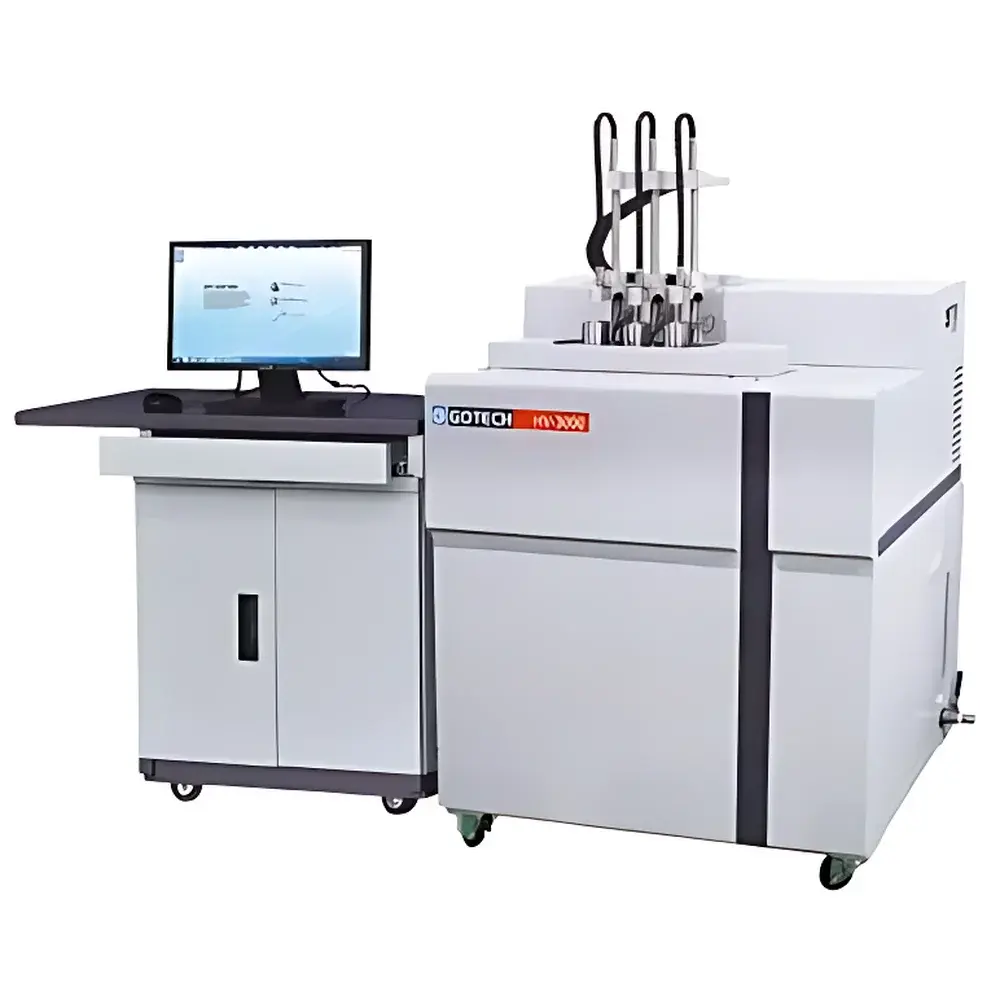
GOTECH HV-3000-P3C Advanced HDT & Vicat Softening Point Tester
| Brand | GOTECH TESTING MACHINES CO., LTD. |
|---|---|
| Origin | Taiwan |
| Manufacturer Type | Authorized Distributor |
| Model | HV-3000-P3C |
| Compliance Standards | ASTM D1525, ASTM D648, ISO 306, ISO 75, DIN 53460, DIN 53461 |
| Temperature Range | Ambient to 300 °C |
| Temperature Control Accuracy | ±0.5 °C |
| Deformation Measurement Range | 0.001–3.500 mm (LVDT-based) |
| Specimen Span Options | 64 mm, 100 mm, 101.6 mm |
| Stirring Method | Eddy-current magnetic stirring |
| Cooling Options | External tap water + optional rapid low-temperature cooling system |
| Dimensions (W×D×H) | 108 × 55 × 150 cm |
| Weight | ~200 kg |
| Power Supply | 1-phase, 220 V, 50 Hz |
Overview
The GOTECH HV-3000-P3C is a dual-mode thermal analysis instrument engineered for precise determination of Heat Deflection Temperature (HDT) and Vicat Softening Point (VSP) in thermoplastic and thermosetting polymers. It operates on the fundamental principles of controlled-load thermal deformation: under standardized axial loading, specimens are heated at a defined rate (e.g., 120 °C/h or 50 °C/h per ASTM D648/ISO 75), and the temperature at which a prescribed deflection occurs—either 0.34 mm (HDT) or 1 mm (Vicat)—is recorded as the material’s thermal resistance index. The system integrates a closed-loop oil bath with eddy-current magnetic stirring, ensuring exceptional thermal homogeneity (<±0.3 °C spatial deviation across the test zone) and minimizing convective drift during prolonged ramping. Its architecture conforms to ISO/IEC 17025 traceability requirements for mechanical testing laboratories, supporting calibration verification via NIST-traceable LVDT and PT100 sensors.
Key Features
- High-resolution linear variable differential transformer (LVDT) sensor with 1 µm resolution and real-time digital compensation for mechanical hysteresis and thermal drift—enabling sub-micron deformation detection over full 0.001–3.500 mm range.
- Motorized specimen support stage and weight carrier assembly: eliminates manual handling of standard loads (e.g., 10 N, 50 N) during sample replacement; cycle time reduced by >40% versus manual systems.
- Adjustable LVDT mounting bracket with micrometer-scale positioning—facilitates rapid alignment across varying specimen geometries without recalibration.
- Integrated thermal deformation correction algorithm compensates for both specimen flexure and structural frame expansion, isolating true polymer response from system artifacts.
- Hermetically sealed oil bath with integrated fume extraction ducting—meets OSHA PEL and EU Directive 2004/108/EC electromagnetic compatibility and occupational hygiene standards.
- Compact oil reservoir design (reduced volume by ~35% vs. conventional baths) lowers thermal mass, accelerating heating/cooling rates by up to 2.1× while reducing thermal oil consumption by ≥30%.
- Standardized PC-based control interface with GOTECH Advance software—supports simultaneous acquisition and overlay of up to six independent deformation-time-temperature curves per run.
Sample Compatibility & Compliance
The HV-3000-P3C accommodates rectangular bars (standard dimensions per ASTM D648: 127 × 13 × 3.2 mm; ISO 75: 80 × 10 × 4 mm) and cylindrical Vicat needles (1 mm² or 3.18 mm² cross-section). Specimen span options (64 mm, 100 mm, 101.6 mm) allow direct alignment with ISO 75-1, ASTM D648 Method A/B, and DIN 53461 configurations. All test protocols—including load application sequence, heating rate selection, and endpoint criteria—are preconfigured per ISO/IEC 17025 Annex A3 and fully auditable. The system supports GLP-compliant data integrity through enforced electronic signatures, immutable audit trails, and 21 CFR Part 11–ready user access controls when deployed with validated software configuration.
Software & Data Management
GOTECH Advance software provides native implementation of ASTM D1525 (Vicat), ASTM D648 (HDT), ISO 306, ISO 75, and DIN 53460/53461 test methods. It features synchronized multi-channel acquisition (temperature, LVDT displacement, load status), automatic pass/fail evaluation against specification limits, and export-ready reporting in PDF/A-1b and CSV formats. Raw datasets include timestamped metadata (operator ID, calibration certificate IDs, environmental ambient logs), enabling full forensic traceability. Data encryption (AES-256) and role-based permissions align with IEC 62443-3-3 cybersecurity requirements for laboratory instrumentation networks.
Applications
This instrument serves quality control and R&D laboratories in polymer compounding, automotive interior materials validation, medical device polymer certification (ISO 10993-12), and packaging resin qualification. Typical use cases include comparative thermal stability screening of polypropylene copolymers, batch release testing of flame-retardant ABS for electronics housings, and regulatory submission support for FDA 510(k) dossiers requiring ISO 75 compliance evidence. Its dual-mode capability eliminates cross-instrument method transfer uncertainty—critical for harmonized global manufacturing sites operating under IATF 16949 or ISO 13485 frameworks.
FAQ
Does the HV-3000-P3C support automated calibration verification?
Yes—built-in diagnostic routines validate LVDT linearity and PT100 accuracy prior to each test sequence using internal reference standards traceable to NIST SRM 1750a.
Can test data be exported to LIMS platforms?
Yes—via configurable ODBC drivers and HL7-compliant XML schema mapping for integration with Thermo Fisher SampleManager, LabVantage, or Waters Empower.
Is the rapid cooling option required for ISO 75-2 Method B (50 °C/h ramp)?
Not mandatory, but strongly recommended: the optional cryogenic heat exchanger enables consistent 50 °C/h ramps down to 23 °C start temperature without external chiller dependency.
How is mechanical hysteresis compensated during repeated HDT cycling?
The Advance software applies dynamic offset correction using a proprietary hysteresis model trained on >10,000 cycles of load-unload-reload sequences across 15 polymer families.
What maintenance intervals are specified for oil bath integrity?
Thermal oil viscosity and acid number must be verified quarterly per ASTM D975; full oil replacement is required every 24 months or after 2,000 cumulative test hours, whichever occurs first.




