
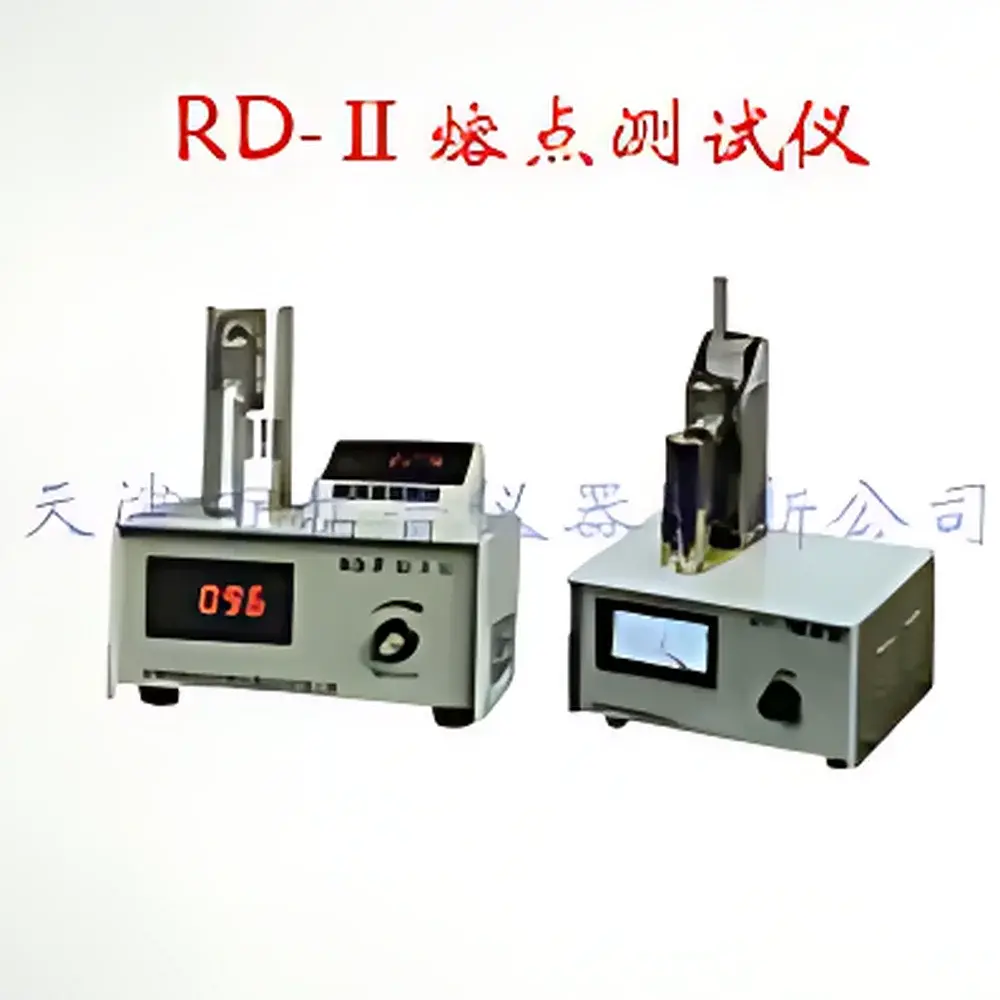
Melting Point Tester RD-2 by Topo
| Brand | Topo |
|---|---|
| Origin | Tianjin, China |
| Manufacturer Type | Direct Manufacturer |
| Country of Origin | China |
| Model | RD-2 |
| Pricing | Upon Request |
| Control Mode | Intelligent Manual Operation |
Overview
The Topo RD-2 Melting Point Tester is a precision thermal analysis instrument engineered for reliable and repeatable determination of melting point ranges in pharmaceutical solids, organic compounds, and reference standards. It operates on the classical capillary tube method—complying with pharmacopoeial requirements including USP <741>, Ph. Eur. 2.2.17, and JP 2.60—where solid samples are loaded into sealed glass capillaries and heated at a controlled, linear ramp rate while observed visually or via integrated digital imaging. Unlike automated optical melt detection systems, the RD-2 employs an intelligent manual observation interface: users initiate heating, monitor sample transition in real time through a high-magnification optical eyepiece (with dual-scale ocular graticule), and record onset and clear-point temperatures using synchronized digital timers and calibrated thermistor-based temperature sensing. Its design prioritizes operational transparency, method traceability, and full user control—making it particularly suitable for QC laboratories requiring audit-ready documentation under GLP and GMP frameworks.
Key Features
- Intelligent manual operation mode with real-time thermal feedback and adjustable heating rate (0.5–3.0 °C/min in 0.1 °C increments)
- Dual-scale ocular graticule for simultaneous visual assessment of both sample morphology and temperature progression
- High-stability thermistor sensor with NIST-traceable calibration certificate (±0.3 °C accuracy across 25–300 °C range)
- Optically isolated viewing chamber with anti-fog LED illumination and glare-free magnification (10× objective + 10× eyepiece)
- Integrated digital timer with dual-channel logging (onset time / clear-point time) and USB export capability
- Robust aluminum alloy housing with passive thermal shielding to minimize ambient drift and ensure inter-day reproducibility
- No consumables required beyond standard 1-mm OD borosilicate capillaries (compliant with USP <741> dimensions)
Sample Compatibility & Compliance
The RD-2 accommodates crystalline and semi-crystalline powders, granules, and purified small-molecule APIs with minimal sample mass (1–3 mg per capillary). It supports routine testing of excipients (e.g., lactose monohydrate, microcrystalline cellulose), active pharmaceutical ingredients (e.g., paracetamol, ibuprofen), and compendial reference standards. All operational procedures align with ICH Q5A(R2) guidelines for identity confirmation and batch release testing. The instrument’s manual observation architecture satisfies regulatory expectations for human-in-the-loop verification—critical for FDA pre-approval inspections and EMA Annex 11 assessments where automated decision logic must be justified and validated. Temperature calibration records, operator signatures, and raw timing logs are retained locally and support 21 CFR Part 11-compliant electronic signature integration when paired with validated LIMS environments.
Software & Data Management
While the RD-2 functions as a standalone instrument, its digital timer module provides timestamped CSV output via USB interface, compatible with common laboratory data systems (e.g., LabWare LIMS, Thermo Fisher SampleManager). No proprietary software installation is required; exported files include columns for sample ID, operator initials, date/time stamps, onset temperature (°C), clear-point temperature (°C), heating rate (°C/min), and environmental conditions (recorded manually). Audit trails are maintained through sequential file naming and folder-level version control. For laboratories operating under full 21 CFR Part 11 compliance, the RD-2 can be deployed within a validated workflow where temperature calibration logs, operator training records, and equipment maintenance history are managed externally in accordance with ALCOA+ principles (Attributable, Legible, Contemporaneous, Original, Accurate, Complete, Consistent, Enduring, Available).
Applications
- Pharmaceutical quality control: Identity testing and purity assessment per USP/EP monographs
- Raw material qualification and supplier verification of API and excipient batches
- Stability study endpoint evaluation (e.g., detecting polymorphic transitions after accelerated storage)
- Academic and contract research labs performing method development for thermal characterization
- Regulatory submission support: Generating compendially acceptable melting point data for ANDA/NDA dossiers
- Teaching laboratories: Demonstrating fundamental solid-state phase behavior and thermal analysis principles
FAQ
Does the RD-2 meet USP <741> requirements for melting point determination?
Yes—the RD-2 implements the capillary tube method with manual visual endpoint detection, fully satisfying USP <741> Section 1 (Apparatus) and Section 2 (Procedure). Calibration and operational protocols are documented in the included SOP template.
Is temperature calibration traceable to national standards?
Each unit ships with a NIST-traceable calibration certificate covering the full 25–300 °C operating range, verified using certified reference materials (e.g., indium, caffeine, phenacetin).
Can the RD-2 be integrated into a 21 CFR Part 11-compliant environment?
Yes—while the instrument itself does not embed electronic signatures, its data export functionality and procedural transparency enable validation within a broader compliant ecosystem when supported by appropriate administrative controls and audit documentation.
What capillary specifications are recommended?
Standard 1.0 mm outer diameter, 0.1–0.15 mm wall thickness, 100 mm length borosilicate capillaries—identical to those specified in USP <741> and widely available from certified lab suppliers.
Is service and technical support available outside China?
Topo provides international technical documentation, remote troubleshooting assistance, and collaborates with authorized regional service partners for calibration and preventive maintenance—subject to local distributor agreements.
Related Products






