
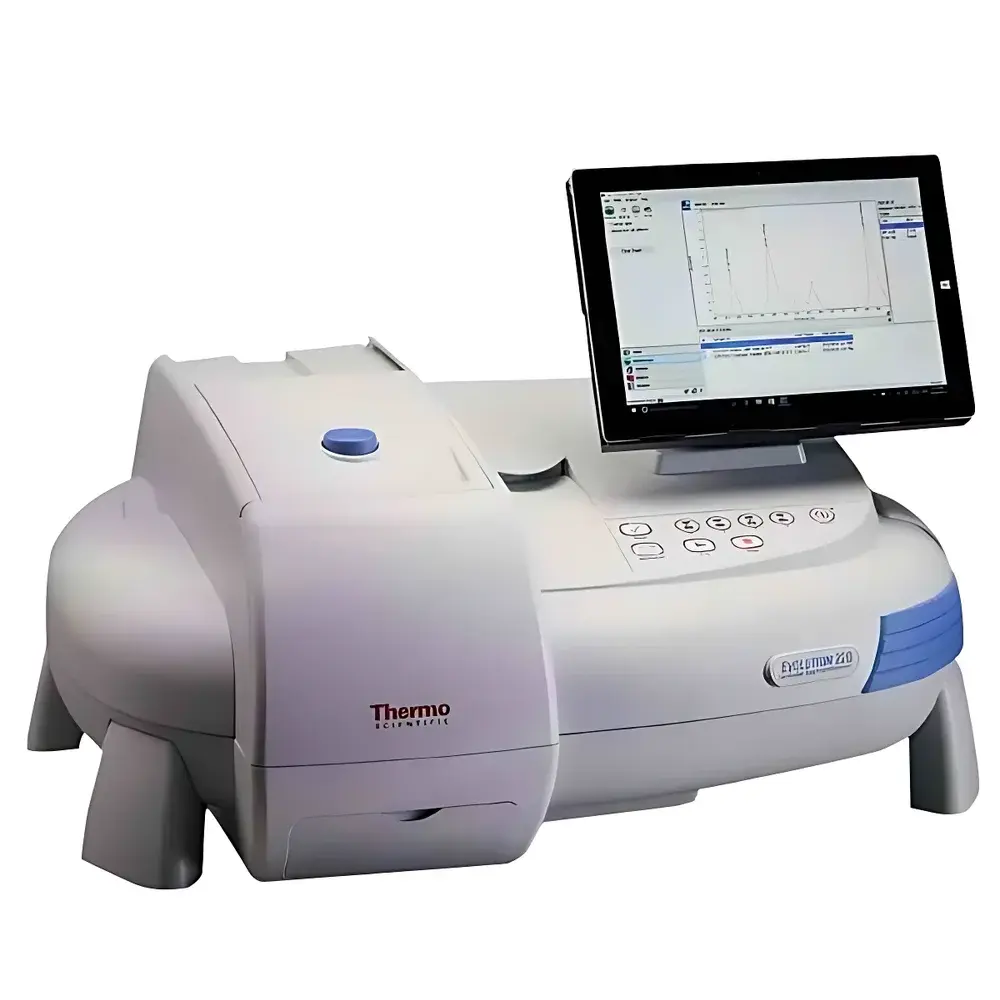
Thermo Fisher Evolution 260 Bio UV-Visible Spectrophotometer
| Brand | Thermo Fisher |
|---|---|
| Origin | USA |
| Distributor Type | Authorized Distributor |
| Origin Category | Imported |
| Model | Evolution 260 Bio |
| Instrument Configuration | Double-Beam |
| Detector Type | Photodiode Array (PDA) |
| Wavelength Range | 190–1100 nm |
| Automation Level | Automatic Wavelength Scanning |
| Spectral Bandwidth | 1.0 nm, 2.0 nm |
| Wavelength Accuracy | ±0.8 nm |
| Stray Light | <1.0%T at 198 nm (KCl), <0.05%T at 220 nm (NaI), <0.03%T at 340 nm (NaNO₂) |
Overview
The Thermo Fisher Evolution 260 Bio UV-Visible Spectrophotometer is a research-grade double-beam instrument engineered for precision, reproducibility, and regulatory compliance in life science laboratories. It operates on the fundamental principle of absorbance spectroscopy—measuring the attenuation of ultraviolet and visible light as it passes through a sample—to quantify nucleic acids, proteins, labeled biomolecules, and other chromophores across a broad spectral range (190–1100 nm). Its optical architecture integrates a xenon flash lamp (eliminating warm-up delay), advanced optical beam focusing (AFBG), and a high-resolution photodiode array detector to deliver rapid, stable, and noise-resistant spectral acquisition. Designed specifically for biological applications, the system couples robust hardware with application-optimized software to support routine QC, method development, and GxP-aligned workflows without compromising analytical rigor.
Key Features
- Double-beam optical design ensures real-time reference compensation—critical for kinetic assays, temperature-dependent measurements, or samples exhibiting time-sensitive degradation.
- Xenon flash lamp source enables instantaneous measurement initiation, eliminates thermal drift, and extends lamp lifetime beyond that of conventional deuterium/tungsten systems.
- Photodiode array (PDA) detection provides full-spectrum capture in milliseconds, supporting high-throughput scanning and dynamic spectral monitoring.
- Adjustable spectral bandwidth (1.0 nm or 2.0 nm) allows optimization between resolution and signal-to-noise ratio depending on sample matrix and analyte specificity.
- Integrated 7-inch color touchscreen display and embedded computing platform enable fully autonomous operation—no external PC required for standard measurements.
- Electronic triggering synchronizes data acquisition with rapid mixing events, ensuring temporal fidelity in enzyme kinetics and ligand-binding studies.
- Precision monochromator mechanics guarantee wavelength accuracy of ±0.8 nm and exceptional long-term stability—validated per ASTM E275 and ISO 6223 standards.
Sample Compatibility & Compliance
The Evolution 260 Bio accommodates diverse sample formats—including cuvettes (standard, microvolume, and ultra-micro), solid reflectance accessories, and flow cells—enabling analysis of clear solutions, turbid suspensions, and heterogeneous biological matrices. Its AFBG optics enhance light throughput for low-volume or scattering samples, improving sensitivity in protein quantitation and oligonucleotide characterization. The system supports full traceability and audit readiness: Thermo Scientific INSIGHT Security software implements role-based access control, electronic signatures, and immutable audit trails compliant with FDA 21 CFR Part 11, EU Annex 11, and GLP/GMP requirements. Integrated CVC (Certified Validation Check) and mercury lamp auto-detection routines facilitate automated performance verification. System qualification documentation—including IQ/OQ/PQ templates—is aligned with ISO 9001:2015, USP , and ISPE GAMP 5 guidelines.
Software & Data Management
INSIGHT software serves as both an intuitive interface and a validated data management environment. Its modular architecture includes dedicated, pre-validated workflows for nucleic acid quantification (A260, A260/A280, A260/A230), protein analysis (A205, A280, Pierce 660, Bradford, BCA, Lowry), fluorophore labeling efficiency, and microarray dye incorporation. The customizable dashboard supports drag-and-drop protocol assembly, while CUE scripting enables creation of instrument-specific user interfaces—ideal for standardized lab SOPs. Workbooks automate calculation chains, enforce unit consistency, and embed metadata (operator ID, timestamp, instrument serial number, calibration status) directly into result files. All raw spectra, processed data, and audit logs are stored in secure, encrypted SQLite databases with configurable backup policies and export options (CSV, PDF, XML) compatible with LIMS integration.
Applications
- Quantitative determination of DNA, RNA, ssDNA, and siRNA concentrations using native UV absorbance at 260 nm.
- Assessment of nucleic acid purity via A260/A280 (protein contamination) and A260/A230 (organic/inorganic contaminants) ratios.
- Direct protein quantitation at 205 nm (peptide bond) or 280 nm (aromatic residues), including formulation stability studies under thermal or chemical stress.
- Validation of conjugation efficiency for fluorescent dyes (e.g., Cy3/Cy5), biotin, or haptens in probe synthesis and immunoassay development.
- High-throughput screening of enzyme kinetics, ligand binding, and redox reactions using time-resolved spectral acquisition.
- Quality control of therapeutic proteins, viral vectors, and mRNA-LNP formulations in biomanufacturing environments.
FAQ
Does the Evolution 260 Bio support regulatory-compliant data integrity?
Yes—the system includes INSIGHT Security software with 21 CFR Part 11-compliant features: electronic signatures, audit trail generation, user authentication, and data immutability controls.
Can I perform temperature-controlled measurements without an external chiller?
Yes—integrated Peltier temperature control modules (single-cell or 8-position Smart Peltier) enable precise regulation from 0 °C to 100 °C without auxiliary cooling units.
Is method transfer possible between Evolution 260 Bio and older Evolution platforms?
Method files (.mth) and spectrum archives (.spc) are backward-compatible with Evolution 200/220 systems, facilitating seamless instrument upgrades and cross-lab harmonization.
How is stray light performance verified during qualification?
Stray light is validated using NIST-traceable KCl, NaI, and NaNO₂ filters at specified wavelengths; results are automatically logged and compared against manufacturer specifications in the CVC report.
What maintenance is required to sustain wavelength accuracy over time?
The monochromator is factory-aligned and requires no user recalibration; annual verification using the Thermo Fisher UV Validation Kit (including holmium oxide and didymium filters) satisfies ISO/IEC 17025 and internal QA protocols.



