
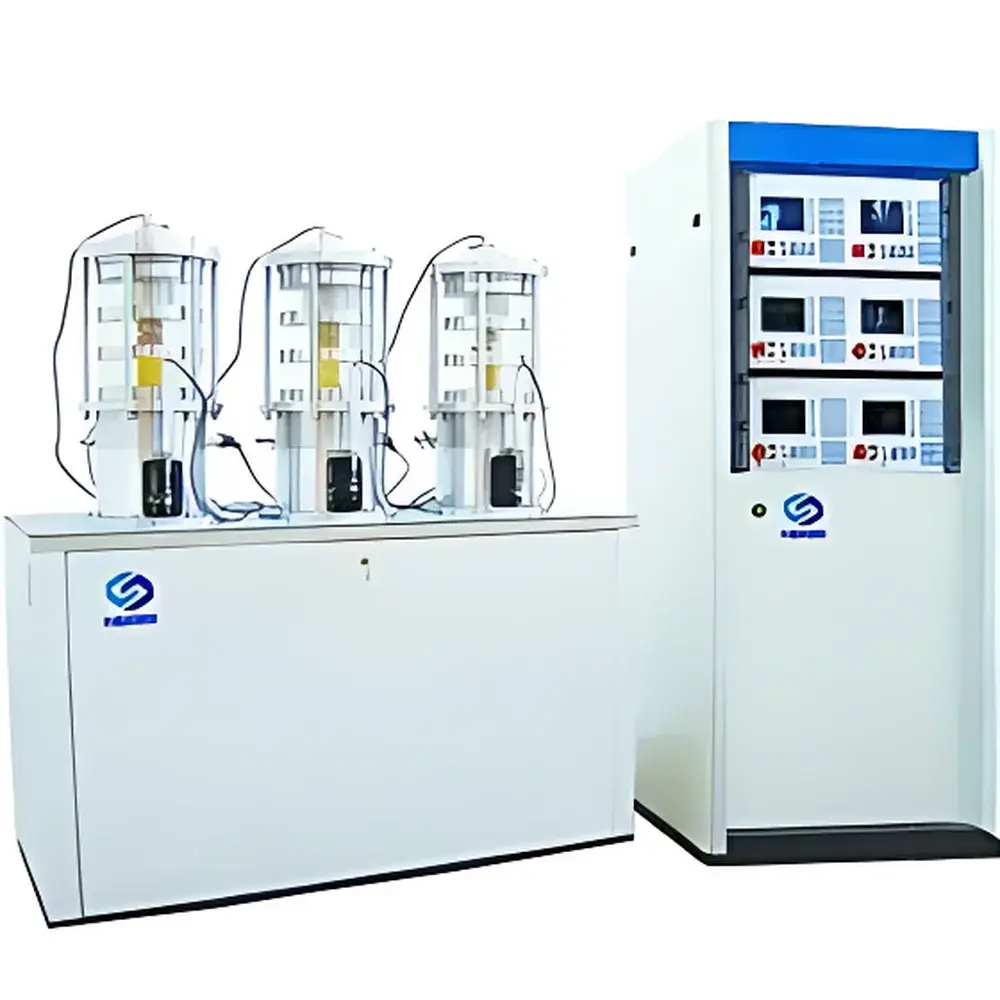
SINOTEST TSS10 Triaxial Rheological Testing System for Soils
| Brand | SINOTEST |
|---|---|
| Origin | Jilin, China |
| Manufacturer Type | Direct Manufacturer |
| Origin Category | Domestic (China) |
| Model | TSS10 |
| Quotation | Upon Request |
| Axial Load Capacity per Specimen | 10 kN |
| Confining Pressure Range | 0–2 MPa |
| Pore Water Pressure Range | 0–2 MPa |
| Pore Water Flow Range | 0–40 cm³ |
| Axial Deformation Range | 0–20 mm |
| Axial Force Accuracy | ±1% of reading (from 2% FS) |
| Confining Pressure Accuracy | ±1% FS |
| Pore Water Pressure Accuracy | ±0.5% FS |
| Pore Water Flow Accuracy | ±0.5% FS |
| Axial Deformation Accuracy | ±0.5% FS |
| Load & Confining Pressure Stability | ±1% FS |
| Dynamic Test Frequency | 0.01–0.5 Hz |
| Dynamic Waveforms | Triangle, Trapezoidal |
| Continuous Operation Duration | >500 hours |
| Specimen Dimensions | Φ39.1 mm × 80 mm |
| Host Dimensions | 1300 × 590 × 1460 mm (L×W×H) |
| Control Cabinet Dimensions | 600 × 600 × 1600 mm (L×W×H) |
| Power Supply | Single-phase 220 V, 50 Hz, 2 kW |
Overview
The SINOTEST TSS10 Triaxial Rheological Testing System for Soils is an engineered platform designed for controlled, long-term mechanical characterization of saturated and unsaturated geomaterials under combined axial and confining stress states. It operates on the fundamental principles of triaxial consolidation and rheological deformation analysis—applying simultaneous axial compression and isotropic or anisotropic confining pressure to cylindrical soil specimens while monitoring time-dependent axial strain, pore fluid response (pressure and volumetric flow), and load-displacement hysteresis. This system enables rigorous investigation of creep compliance, stress relaxation, secondary compression, and time-dependent strength evolution—critical parameters in geotechnical design of embankments, foundations, landfills, and reservoir slopes. Its architecture supports both static and dynamic loading protocols compliant with ASTM D2850, D4767, D7181, and ISO 17892-7 standards for triaxial testing of soils.
Key Features
- Triple-test-head configuration: Three independent triaxial cells operate simultaneously within a single structural frame, each with fully decoupled control of axial load, confining pressure, and pore fluid management—maximizing throughput without cross-talk or thermal/mechanical interference.
- High-fidelity dual-loop control: Integrated AC servo actuation and digital PID controllers enable precise force- or displacement-controlled testing modes—including constant-load creep, constant-strain relaxation, and cyclic loading with programmable amplitude, frequency, and waveform (triangle, trapezoidal).
- In-chamber load sensing: Load cells are mounted inside the pressure vessels, eliminating transmission errors from hydraulic lines or external linkages and ensuring accuracy under full 2 MPa confining pressure with corrosion-resistant sealing.
- Multi-parameter real-time acquisition: Synchronized measurement of axial force (±1% rdg), axial displacement (±0.5% FS), confining pressure (±1% FS), pore water pressure (±0.5% FS), and pore water volume change (±0.5% FS) at user-defined sampling intervals.
- Robust mechanical architecture: Rigid welded steel frame, precision-ground guide columns, and sealed high-pressure manifolds ensure dimensional stability and repeatability over extended tests (>500 h continuous operation).
Sample Compatibility & Compliance
The TSS10 accommodates standard cylindrical soil specimens (Φ39.1 mm × 80 mm), compatible with ASTM D698/D1557 compaction molds and conventional sample trimming tools. Optional specimen size adapters support alternative diameters (e.g., Φ50 mm, Φ100 mm) via modular cell inserts. All fluid-handling components meet ASTM D4753 requirements for inert, non-reactive wetted materials (316 stainless steel, fluoropolymer seals). The system supports saturated and partially saturated testing with automated B-value verification, Skempton’s coefficient determination, and back-pressure saturation protocols. Data acquisition and control firmware comply with GLP documentation requirements, including electronic audit trails, user access levels, and timestamped parameter logs—facilitating alignment with ISO/IEC 17025 accredited laboratory practices.
Software & Data Management
The proprietary TRIAX-CONTROL software provides intuitive test sequencing, real-time visualization of up to 12 synchronized channels (force, displacement, pressure, flow, time), and automated pass/fail evaluation against preconfigured acceptance criteria. It supports multi-stage loading programs with conditional branching (e.g., hold upon reaching target strain rate), automatic zero-drift compensation, and built-in calculation modules for coefficient of consolidation (cv), secondary compression index (Cα), and Burgers model fitting. Export formats include CSV, Excel (.xlsx), and XML for traceability; raw data files are digitally signed and version-stamped to satisfy FDA 21 CFR Part 11 requirements for electronic records in regulated environments.
Applications
- Time-dependent deformation modeling of clays and organic soils under sustained loading (e.g., post-construction settlement prediction)
- Evaluation of creep rupture thresholds in stabilized tailings and mine waste fills
- Calibration of viscoelastic constitutive models (e.g., Merchant, Kelvin-Voigt, generalized Maxwell) for finite element analysis
- Long-term permeability evolution studies during consolidation under variable effective stress paths
- Dynamic resilience assessment of subgrade soils subjected to repeated traffic loading (0.01–0.5 Hz range)
- Validation of coupled hydro-mechanical simulations in THM (Thermo-Hydro-Mechanical) modeling frameworks
FAQ
What specimen dimensions does the TSS10 support as standard?
Standard specimen geometry is Φ39.1 mm × 80 mm, conforming to ASTM D2850 and ISO 17892-7. Custom cell inserts allow adaptation to Φ50 mm and Φ100 mm specimens.
Can the system perform both drained and undrained triaxial rheological tests?
Yes—the TSS10 integrates configurable drainage valves, high-resolution pore water flow meters, and programmable back-pressure regulation to execute consolidated-drained (CD), consolidated-undrained (CU), and unconsolidated-undrained (UU) rheological protocols.
Is the software validated for use in ISO/IEC 17025-accredited laboratories?
TRIAX-CONTROL includes full audit trail functionality, electronic signatures, calibration certificate linkage, and data integrity safeguards aligned with ILAC-G8 and EURACHEM guidelines for accredited testing.
How is thermal drift managed during multi-day creep tests?
The system employs temperature-compensated transducers, isolated hydraulic circuits, and ambient temperature logging; optional environmental chamber integration maintains specimen temperature within ±0.5°C over extended durations.
Does the TSS10 support remote monitoring and control?
Yes—via secure Ethernet interface with TLS-encrypted web-based dashboard; authorized users can monitor live curves, adjust setpoints, and trigger emergency stop from off-site locations.



