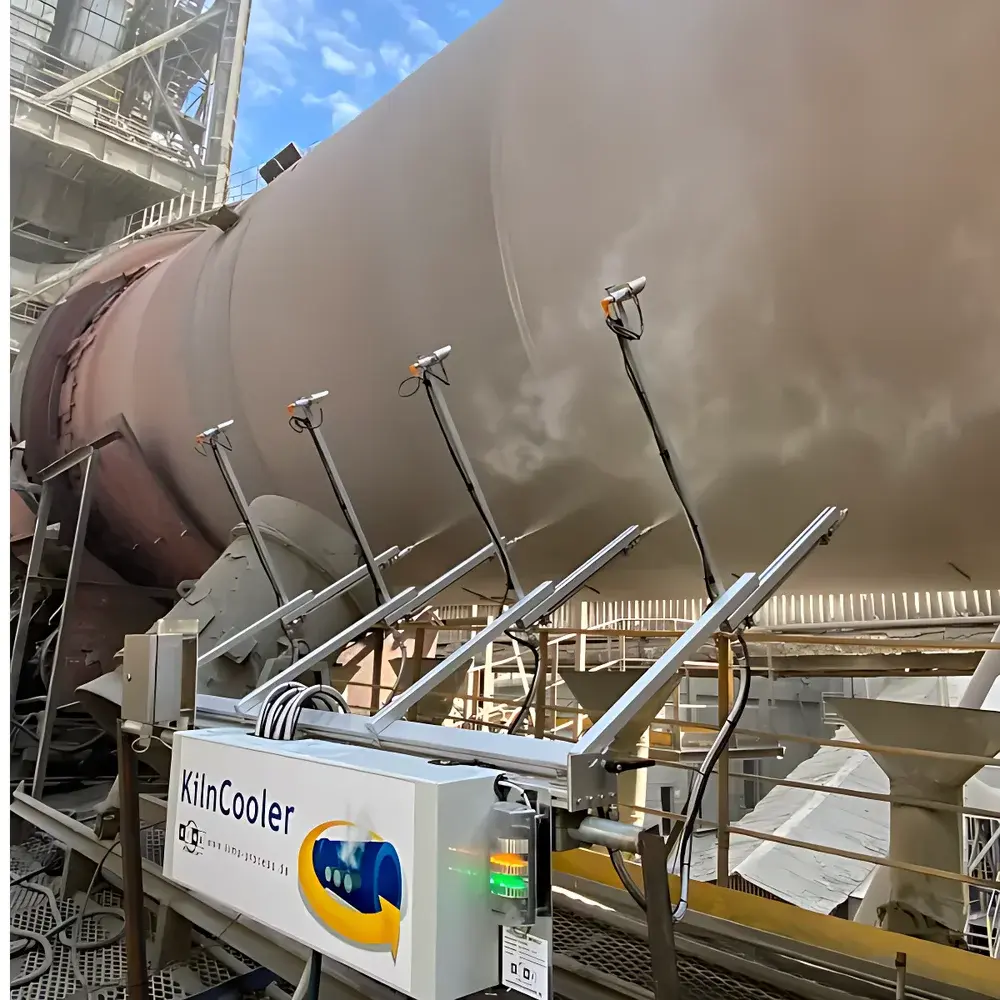
KIMA KilnCooler Rotary Kiln Shell Cooling System
| Brand | KIMA |
|---|---|
| Origin | Germany |
| Manufacturer Type | Authorized Distributor |
| Origin Category | Imported |
| Model | KilnCooler |
| Pricing | Upon Request |
| Cooling Rate | 2 °C/min |
| Power Consumption | 2–50 W (100–260 VAC, 50–60 Hz) |
| Compressed Air Requirement (4 nozzles) | 94 L/min at 1–16 bar |
| Water Consumption (4 nozzles) | up to 12 L/min at 3–8 bar |
Overview
The KIMA KilnCooler is an engineered rotary kiln shell cooling system designed for continuous, non-contact thermal management of cement, lime, and mineral processing kilns. It operates on the principle of controlled convective heat extraction via synchronized air–water mist injection through four precision-engineered nozzles mounted circumferentially around the kiln shell. Unlike passive cooling or intermittent water spraying, the KilnCooler delivers programmable, rate-limited cooling (up to 2 °C/min) to mitigate thermal stress, suppress refractory spalling, and extend lining service life. Its modular architecture integrates seamlessly with existing kiln support systems and is compatible with both single- and multi-drive kiln configurations. The system is purpose-built for harsh industrial environments—exposed to ambient temperatures up to 60 °C, dust loads exceeding 10 g/m³, and mechanical vibration typical of large-diameter rotating vessels.
Key Features
- Four independently regulated nozzles enabling uniform radial cooling coverage across the kiln shell circumference
- Dynamic cooling rate control (0.5–2 °C/min) maintained via closed-loop feedback from integrated infrared pyrometers (optional add-on)
- Low-power electronics architecture: total system draw remains within 2–50 W, supporting operation from standard industrial AC supplies (100–260 VAC, 50–60 Hz)
- Dual-fluid nozzle design optimized for atomization efficiency—minimizing water carryover while maximizing evaporative cooling capacity
- Pressure-resilient fluid handling: air supply rated for 1–16 bar; water supply rated for 3–8 bar—compatible with plant-wide compressed air and process water networks
- IP65-rated control cabinet with corrosion-resistant housing for outdoor mounting near kiln trunnions or riding rings
- Modular piping interface with quick-connect couplings for rapid commissioning and maintenance access
Sample Compatibility & Compliance
The KilnCooler is not a sample-based analytical instrument but a process-integrated thermal regulation system. It interfaces directly with kiln shell surfaces ranging from Ø2.4 m to Ø6.5 m and shell wall thicknesses of 25–65 mm (carbon steel or alloy variants). No material sampling or chemical interaction occurs during operation. The system complies with EN 61800-5-1 (adjustable speed electrical power drive safety), EN 60204-1 (electrical equipment of machines), and meets ATEX Zone 22 requirements for dust ignition protection when specified with optional enclosures. Documentation packages include EU Declaration of Conformity, CE marking files, and mechanical risk assessment per ISO 12100. Integration into automated kiln control systems supports compliance with IEC 61511 (functional safety for SIS) when configured with SIL2-rated shutdown interlocks.
Software & Data Management
The KilnCooler operates as a stand-alone subsystem or integrates via Modbus RTU/TCP or Profibus DP into central DCS/SCADA platforms (e.g., Siemens PCS7, Honeywell Experion, ABB 800xA). Optional KIMA KilnMonitor software provides real-time visualization of nozzle status, cooling rate trends, air/water flow diagnostics, and thermal gradient logs. All operational parameters—including actuation timestamps, pressure transients, and manual override events—are time-stamped and stored locally for ≥30 days. Audit trails meet GLP/GMP data integrity requirements per ALCOA+ principles, with optional 21 CFR Part 11-compliant user authentication and electronic signature modules available upon request. Raw data export supports CSV and OPC UA formats for third-party analytics integration.
Applications
- Preventive thermal management of rotary kiln shells in cement clinker production to reduce refractory fatigue and unplanned shutdowns
- Stabilization of kiln shell temperature profiles during ramp-up, load changes, or fuel transitions (e.g., co-processing alternative fuels)
- Mitigation of ovality-induced hot spots in kilns operating beyond design thermal cycles
- Support for predictive maintenance programs by correlating localized cooling demand with shell deformation measurements (e.g., from laser alignment systems)
- Compliance-enabling thermal control in kilns subject to environmental permits limiting radiant heat emissions or surface temperature thresholds
FAQ
What is the maximum allowable kiln shell surface temperature for safe KilnCooler operation?
The system is validated for continuous operation with shell surface temperatures up to 450 °C. Nozzle mounting brackets are fabricated from Inconel 625 to retain structural integrity under sustained radiant exposure.
Can the KilnCooler be retrofitted onto an existing kiln without structural modifications?
Yes—standard retrofit kits include adjustable cantilever mounts that attach to existing kiln support rollers or auxiliary platforms, requiring no welding or kiln downtime beyond scheduled maintenance windows.
Is water quality specification required for the cooling circuit?
Potable water or softened process water (hardness < 100 ppm CaCO₃, chloride < 50 ppm) is recommended. Optional inline filtration (5 µm) and anti-scaling dosing units are available for hard-water environments.
Does the system require external cooling water chillers?
No—the KilnCooler relies on ambient-temperature water and evaporative heat transfer; chiller integration is unnecessary unless site-specific dew point constraints necessitate sub-ambient mist conditioning (rare, project-specific option).
How is nozzle clogging prevented in high-dust environments?
Each nozzle incorporates self-cleaning vortex geometry and reverse-pulse air purging cycles triggered every 15 minutes during active cooling, verified by differential pressure monitoring across the filter manifold.