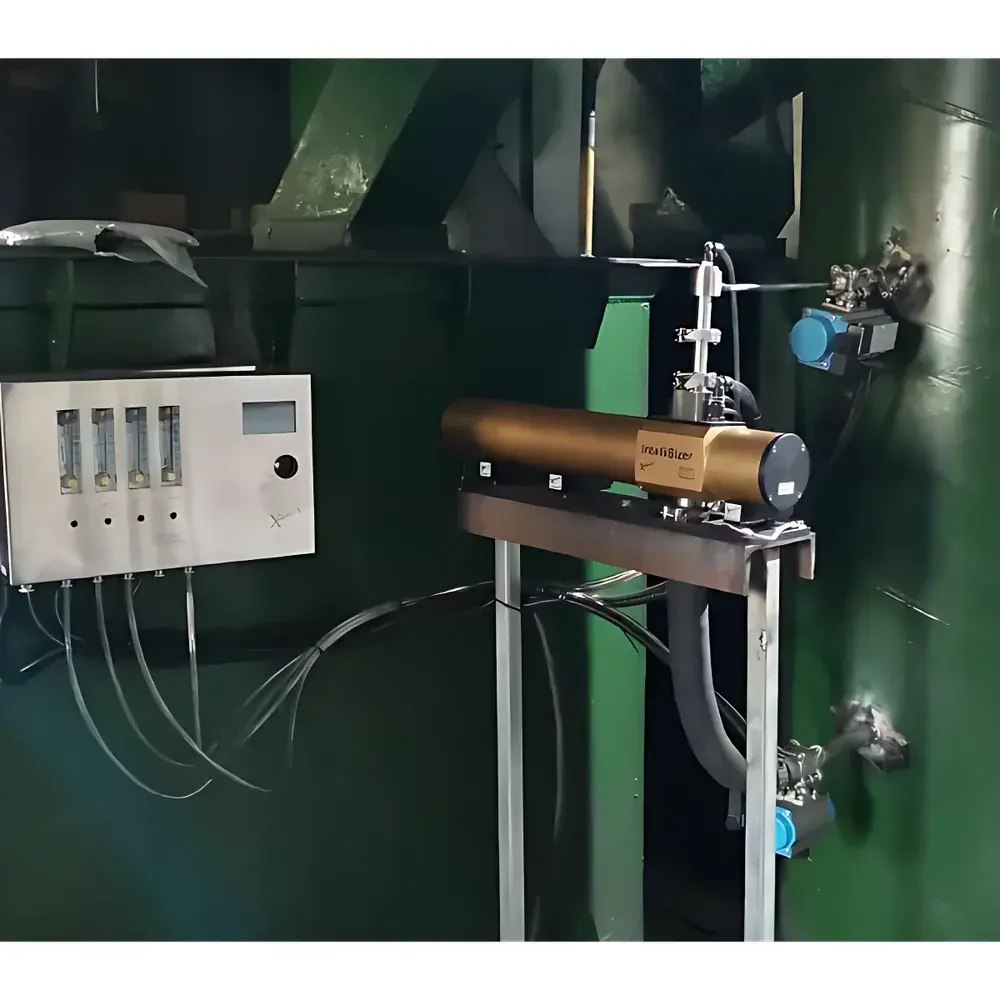
Xoptix XI550P Online Laser Diffraction Particle Size Analyzer for Metal Powder Production
| Brand | Xoptix |
|---|---|
| Model | XI550P |
| Origin | United Kingdom |
| Instrument Type | In-line Laser Diffraction Analyzer |
| Measurement Principle | Mie Scattering Theory |
| Operating Environment | Industrial Process Stream (Dry or Slurry Flow) |
| Temperature Range | −10 °C to +60 °C (Enclosure Rated IP65) |
| Pressure Rating | Up to 10 bar (Optional High-Pressure Probe) |
| Communication Interface | Ethernet/IP, Modbus TCP, OPC UA |
| Compliance | CE, RoHS, ATEX Zone 22 (Optional) |
| Data Output Frequency | Up to 1 Hz Real-Time Reporting |
Overview
The Xoptix XI550P is an industrial-grade, in-line laser diffraction particle size analyzer engineered specifically for continuous, real-time monitoring of metal powder streams during additive manufacturing feedstock production, gas atomization, plasma rotating electrode (PREP), and mechanical alloying processes. Unlike offline sieve or static laser diffraction systems, the XI550P integrates directly into process piping or powder conveyance ducts—enabling non-invasive, flow-through measurement without sample diversion, dilution, or manual intervention. Its optical architecture employs a dual-wavelength (405 nm + 638 nm) laser source coupled with a high-resolution multi-element detector array, allowing robust size distribution analysis from 0.1 µm to 2,000 µm (D10–D90) under dynamic flow conditions. The system operates on Mie scattering theory with refractive index compensation for metallic particles (n ≈ 0.2–0.5 + i3–5, typical for Ti-6Al-4V, Inconel 718, and SS316L), ensuring metrological traceability to ISO 13320:2020 standards.
Key Features
- In-situ optical probe with sapphire viewport and self-cleaning air purge interface—designed for abrasive metal powder environments and resistant to particle buildup.
- Real-time Dv10, Dv50, Dv90, span, and relative width calculation at user-configurable intervals (100 ms to 5 s).
- Integrated temperature and pressure sensors for automatic environmental compensation during transient process conditions.
- Ruggedized stainless-steel housing (IP65 rated) with optional ATEX-certified explosion protection for Class II, Division 2 / Zone 22 hazardous areas.
- Auto-alignment feedback loop maintains optical path stability across thermal cycling and mechanical vibration typical in atomization chambers and milling lines.
- Modular design supports retrofit installation on existing pneumatic conveying lines (DN50–DN200) or slurry pipelines (with optional wet-cell adapter).
Sample Compatibility & Compliance
The XI550P is validated for dry, free-flowing metal powders including titanium alloys, nickel-based superalloys, stainless steels, aluminum, and cobalt-chrome compositions. It accommodates particle morphologies ranging from spherical (gas-atomized) to irregular (mechanically milled), provided mass concentration remains within 0.5–5 g/m³ (dry) or 1–15 vol% (slurry). All firmware and calibration protocols comply with ISO/IEC 17025 requirements for testing laboratories, and raw data logging supports audit-ready traceability per FDA 21 CFR Part 11 when deployed in GMP-regulated AM powder manufacturing facilities. Optional GLP-compliant electronic signatures and change-control logs are available via the Xoptix Control Suite.
Software & Data Management
The instrument is managed through Xoptix Control Suite v4.2—a Windows-based SCADA-integrated platform supporting both local HMI operation and remote cloud synchronization via secure TLS 1.3 tunnels. Software features include automated baseline drift correction, multi-point calibration validation (NIST-traceable PSL and glass bead standards), trend overlay of up to eight historical batches, and configurable alarm thresholds for out-of-specification excursions (e.g., D50 shift > ±2.5 µm over 30 min). Export formats include CSV, XML, and ASAM ODS-compliant .atfx files for integration with MES (e.g., Siemens Opcenter, Rockwell FactoryTalk) and statistical process control (SPC) dashboards. Audit trails record all parameter changes, user logins, and calibration events with time-stamped digital signatures.
Applications
- Real-time closed-loop control of gas atomization nozzle parameters (gas pressure, melt temperature, feed rate) based on evolving D50 trends.
- Early detection of satellite formation or agglomeration during post-atomization sieving and classification stages.
- Verification of powder lot homogeneity prior to packaging—reducing reliance on destructive batch sampling per ASTM B855 and ISO 4490.
- Correlation of in-process particle size data with downstream SLM/EBSM build quality metrics (e.g., porosity, surface roughness, tensile strength).
- Supporting IATF 16949 and AS9100 process validation requirements for aerospace and medical-grade metal powder suppliers.
FAQ
Does the XI550P require sample extraction or dilution during operation?
No—it performs true in-line measurement using a flow-through optical cell; no bypass loops, splitters, or dilution systems are needed.
Can it distinguish between fused agglomerates and primary particles in irregular metal powders?
While laser diffraction reports equivalent spherical diameter (ESD), the system’s high angular resolution and multi-wavelength capability improve sensitivity to multimodal distributions often associated with partial agglomeration.
Is calibration traceable to national standards?
Yes—factory calibration uses NIST-traceable polystyrene latex (PSL) and ground glass standards; field verification kits include certified reference materials compliant with ISO 21501-4.
What maintenance intervals are recommended for continuous 24/7 operation?
Optical window inspection every 500 operating hours; full alignment verification and purge gas filter replacement every 2,000 hours; no laser source replacement required within 50,000-hour rated lifetime.
How does the system handle electrostatic charging common in fine metal powders?
The probe housing incorporates grounded conductive coatings and optional ionized air purge to mitigate charge-induced particle adhesion and signal noise.