
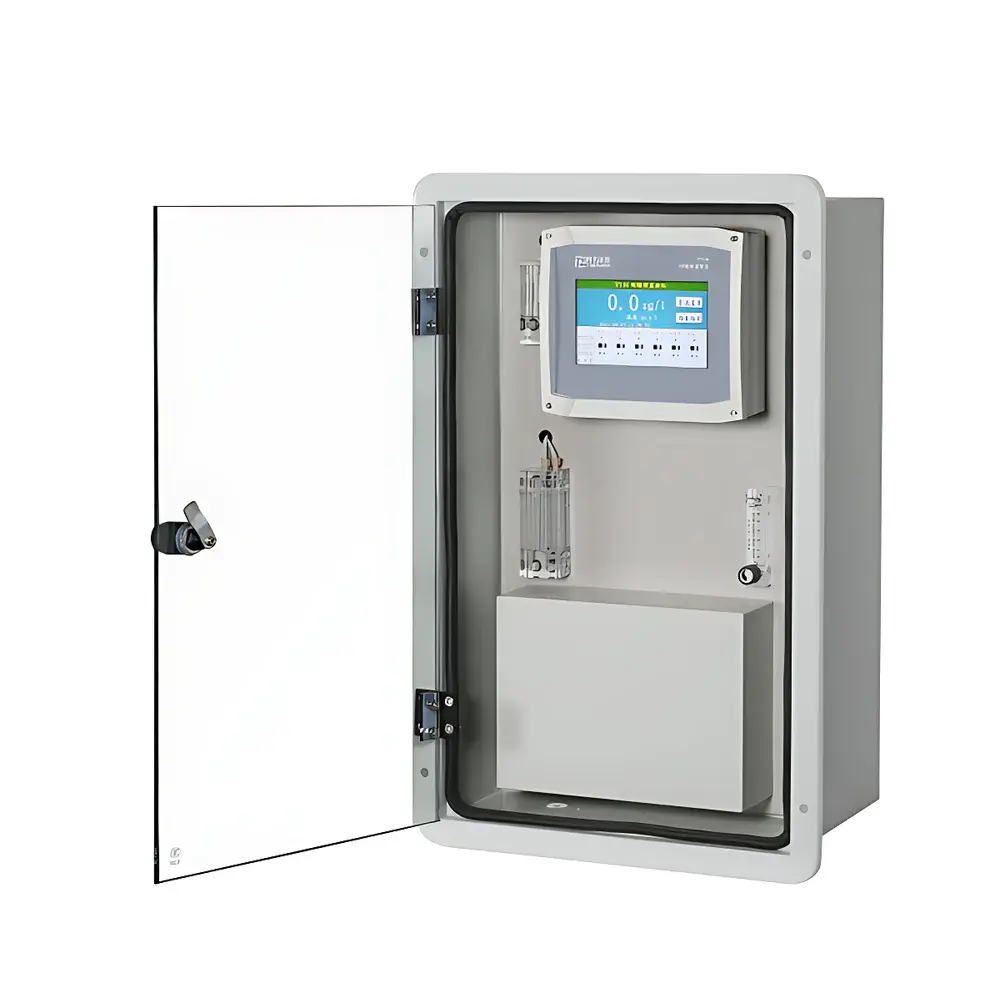
TimePower TP108 Online Hydrazine Analyzer
| Brand | TimePower |
|---|---|
| Model | TP108 |
| Origin | Beijing, China |
| Manufacturer | TimePower Instruments Co., Ltd. |
| Type | Online Colorimetric Hydrazine Monitor |
| Measurement Range | 0.0–100.0 μg/L |
| Display | 7.0-inch color TFT touchscreen (Chinese UI) |
| Accuracy | ±2% F.S. |
| Repeatability | ≤±1% F.S. |
| Drift | <±1% F.S./24 h |
| Response Time | <4 min |
| Cycle Time | ~3 min per channel |
| Sample Flow Rate | 10–40 L/h |
| Sample Temp. | 5–50 °C |
| Max. Suspended Solids | <5 µm, non-colloidal |
| Ambient Temp. | 5–45 °C |
| Ambient Humidity | ≤90% RH (non-condensing) |
| Light Source | Monochromatic cold LED |
| Valves | Imported high-precision solenoid valves |
| Calibration | Automated dual-point standard calibration on user-defined schedule |
| Data Storage | 30 days of historical data |
| Outputs | Isolated 0–20 mA / 4–20 mA / 0–10 mA (configurable) |
| Alarms | Independent per-channel high/low limit & flow-loss alerts |
| Power | AC 85–265 V, 45–65 Hz |
| Power Consumption | ≤100 W |
| Dimensions (W×H×D) | 460×720×280 mm |
| Panel Cutout | 670×410 mm |
| Weight | 22 kg |
| Channel Configurability | 1–6 channels selectable |
Overview
The TimePower TP108 Online Hydrazine Analyzer is a fully automated, multi-channel photometric analyzer engineered for continuous, real-time quantification of hydrazine (N₂H₄) in aqueous process streams. It operates on the principle of acid-catalyzed diazotization: under controlled acidic conditions, hydrazine reacts stoichiometrically with p-dimethylaminobenzaldehyde (DMAB) to form a stable yellow azo chromophore. Absorbance of this complex is measured at a fixed wavelength using a monochromatic cold LED light source, and concentration is calculated via the Lambert–Beer law. Designed specifically for high-purity water systems, the TP108 delivers trace-level detection (0.0–100.0 μg/L) with metrological rigor required in critical thermal power generation, chemical synthesis, pharmaceutical water-for-injection (WFI) loops, and municipal drinking water treatment. Its architecture adheres to fundamental requirements of ISO 9001-compliant manufacturing and supports integration into plant-wide monitoring frameworks governed by IEC 61511 (functional safety) and ANSI/ISA-84 standards.
Key Features
- Modular 1–6 channel configuration enables scalable deployment across boiler feedwater trains, condensate polishing units, or multi-stream chemical dosing control points—optimizing CAPEX without compromising analytical integrity.
- Imported high-reliability electromagnetic sampling and reagent valves ensure precise fluidic metering, minimizing carryover and cross-contamination between cycles; validated lifetime exceeds 500,000 actuations under continuous operation.
- Automated dual-point calibration routine—programmable from 1 hour to 7 days—maintains long-term accuracy and reduces manual intervention, supporting unattended operation for >30 days between maintenance events.
- Stable monochromatic LED optical system eliminates lamp aging drift and thermal wavelength shift, delivering consistent photometric performance over instrument lifetime (>50,000 hours MTBF).
- Isolated analog outputs (0–20 mA / 4–20 mA / 0–10 mA) are individually assignable per channel and support direct interfacing with DCS, PLC, or automated hydrazine dosing controllers—fully compliant with NAMUR NE43 signal fault detection protocols.
- 7.0-inch capacitive touchscreen interface displays real-time concentration trends, multi-channel overlay curves, and event-triggered alarm logs—all in native English or Chinese (user-selectable), with intuitive navigation and audit-ready parameter change history.
Sample Compatibility & Compliance
The TP108 accepts filtered liquid samples with flow rates between 10–40 L/h, temperature stability within 5–50 °C, and particulate content limited to suspended solids <5 µm in diameter and free of colloidal material—requirements aligned with ASTM D859 (Standard Test Method for Silica in Water) sample preparation guidelines. Instrument housing meets IP54 ingress protection for indoor industrial environments; electrical design conforms to IEC 61000-4 immunity standards and UL 61010-1 safety certification. Data integrity features—including time-stamped measurement records, calibration logs, and alarm archives—support GLP/GMP documentation practices and facilitate FDA 21 CFR Part 11 compliance when deployed with validated electronic signature workflows.
Software & Data Management
Onboard firmware implements cyclic data acquisition, linearized absorbance-to-concentration conversion, and automatic baseline correction using reference blank measurements. All operational parameters—including calibration coefficients, alarm thresholds, output scaling, and channel enable/disable states—are stored in non-volatile memory with write-protection. Historical data (minimum 30 days at 1-minute resolution) is retained locally and exportable via USB port in CSV format. Remote diagnostics and configuration updates are supported via optional Ethernet module (IEEE 802.3, Modbus TCP), enabling centralized supervision through SCADA or cloud-based asset management platforms. Audit trails record all user-initiated actions with timestamp, operator ID (if authenticated), and pre-/post-change values—meeting ISO/IEC 17025 clause 7.9 traceability requirements.
Applications
- Thermal power plants: Continuous monitoring of hydrazine residual in boiler feedwater and condensate systems to verify oxygen scavenging efficacy and prevent corrosion-induced tube failures.
- Fertilizer & petrochemical facilities: In-line verification of hydrazine dosing in high-pressure synthesis water circuits where sub-ppb oxygen control is mandated.
- Pharmaceutical utilities: Compliance-driven surveillance of WFI and purified water distribution loops per USP and EP 2.2.48 specifications.
- Municipal water treatment: Monitoring of hydrazine used as a secondary disinfectant residual in advanced oxidation processes, ensuring regulatory adherence to EPA Method 351.2 equivalents.
- Research laboratories: Reference-grade validation of hydrazine removal efficiency in membrane filtration, ion exchange, and catalytic degradation studies.
FAQ
What is the recommended maintenance interval for the TP108?
Routine maintenance—including filter replacement, tubing inspection, and reagent reservoir refill—is advised every 30 days under typical operating conditions; full system verification (span and zero check) should be performed quarterly or after any hardware service.
Can the TP108 be integrated with a DCS using Modbus RTU?
Yes—the optional RS-485 communication module supports Modbus RTU protocol (slave mode), enabling seamless read/write access to all real-time measurements, status flags, and configurable parameters.
Does the analyzer comply with ISO 5667-3 for water sampling?
While the TP108 itself is not a sampling device, its inlet conditioning requirements (flow, filtration, temperature) align with ISO 5667-3 guidance for representative online analysis of treated water streams.
How is calibration traceability established?
Users must employ NIST-traceable hydrazine standard solutions (e.g., 10 μg/mL certified reference material); the TP108 stores calibration date, standard lot number, and operator ID to support laboratory accreditation audits.
Is remote firmware update supported out-of-the-box?
Firmware updates require local USB media loading; however, the Ethernet option enables secure remote diagnostics and configuration backup/restore—subject to customer network security policies.
Related Products







