
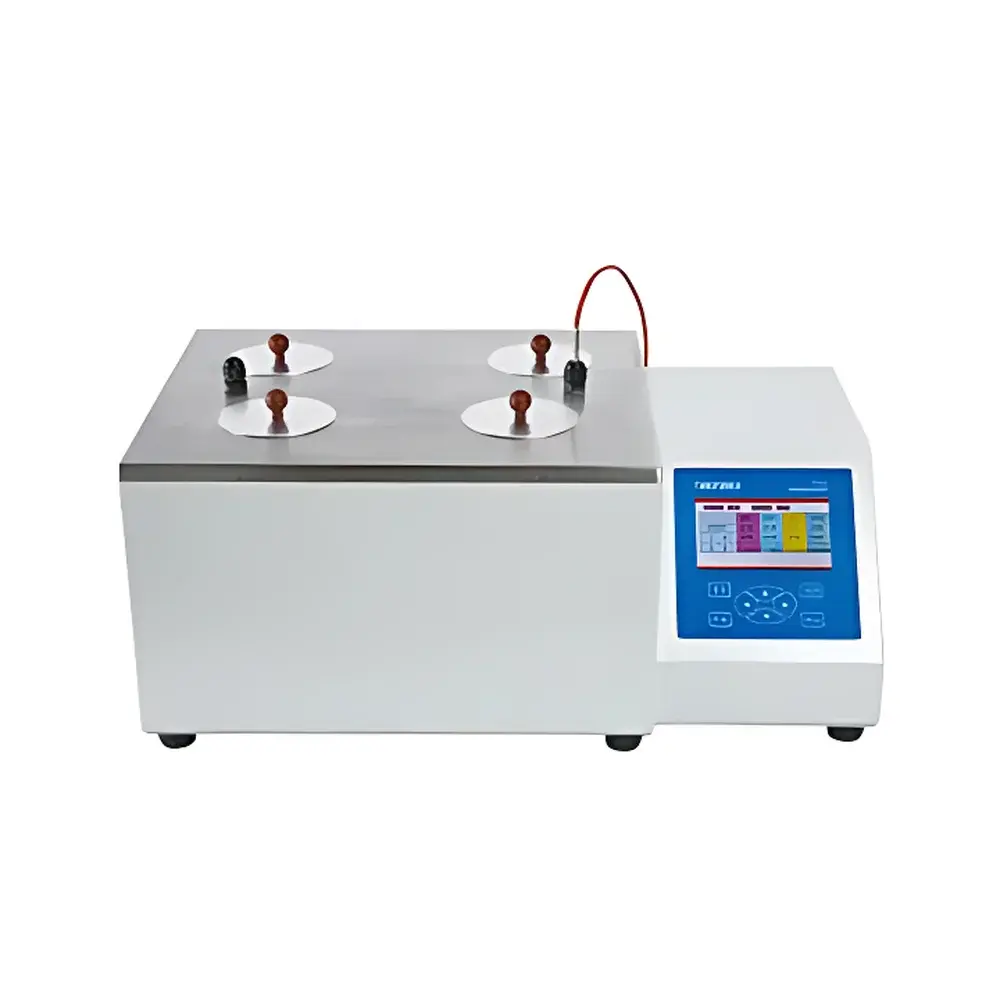
Timepower TP633 Liquid-Phase Rust Test Apparatus
| Brand | Timepower |
|---|---|
| Origin | Beijing, China |
| Manufacturer Type | Direct Manufacturer |
| Country of Origin | China |
| Model | TP633 |
| Quotation | Upon Request |
| Display | 480×272 color LCD, Chinese UI |
| Temperature Control Range | Ambient to 100 °C |
| Temperature Accuracy | ±1 °C |
| Temperature Resolution | 0.1 °C |
| Test Capacity | 4 independent stations |
| Stirring Speed | 1000 ± 25 rpm |
| Heating Method | Immersion-type electric heating element |
| Heating Power | ≤1200 W |
| Total Power Consumption | ≤1500 W |
| Stirring Motor Power | ≤100 W |
| Temperature Sensor | Pt100 platinum resistance thermometer |
| Ambient Operating Conditions | 5–40 °C, RH ≤85% |
| Dimensions (W×D×H) | 530 × 300 × 200 mm |
| Weight | 9.5 kg |
| Sample Volume | 300 mL oil + 30 mL distilled water or synthetic seawater |
| Test Duration | Adjustable (typically 24 h per ASTM D665 / GB/T 11143) |
| Compliance | GB/T 11143–2008, ASTM D665–2023, ISO 7120:2018 |
Overview
The Timepower TP633 Liquid-Phase Rust Test Apparatus is a precision-engineered instrument designed to evaluate the rust-inhibiting performance of petroleum-based lubricants—including turbine oils, hydraulic fluids, circulating oils, and inhibited mineral oils—when exposed to water under controlled thermal and mechanical conditions. It operates in strict accordance with the test methodology defined in GB/T 11143–2008, which aligns with international standards ASTM D665 (Standard Test Method for Rust-Preventing Characteristics of Inhibited Mineral Oil in the Presence of Water) and ISO 7120:2018. The apparatus subjects standardized steel test rods to simultaneous immersion in a defined mixture of 300 mL sample oil and 30 mL distilled water or synthetic seawater, while maintaining a constant bath temperature of 60 °C and applying continuous magnetic stirring at 1000 ± 25 rpm. After the prescribed exposure period—commonly 24 hours but configurable up to 99 hours—the test rods are removed, cleaned, and visually assessed for rust staining, pitting, or discoloration according to standardized rating criteria. This method quantifies the efficacy of corrosion inhibitors in preventing electrochemical oxidation of ferrous surfaces in aqueous-lubricant interfaces—a critical parameter for power generation, refinery operations, and industrial fluid lifecycle management.
Key Features
- Four independent test stations enable parallel evaluation of multiple samples or replicates, improving throughput and statistical robustness.
- Microprocessor-controlled恒温 bath with Pt100 platinum resistance sensor ensures stable temperature regulation within ±1 °C across the full operating range (ambient to 100 °C), with 0.1 °C resolution for traceable thermal fidelity.
- Imported permanent-magnet stirring motors deliver consistent rotational speed (1000 ± 25 rpm) without drift or torque fluctuation—critical for reproducible interfacial shear and oxygen mass transfer during testing.
- 480×272 color LCD interface supports fully localized Chinese menu navigation, real-time display of bath temperature and countdown timer, and intuitive parameter entry without external software dependency.
- Integrated safety architecture includes over-temperature cutoff, low-water-level detection, and electrical isolation compliant with IEC 61010-1 for laboratory use.
- Modular design facilitates maintenance and calibration; optional accessories include dedicated steel rod polishing units, calibrated test rods (ASTM-grade 1018 steel), and certified synthetic seawater reagents.
Sample Compatibility & Compliance
The TP633 is validated for use with a broad spectrum of hydrocarbon-based fluids: steam turbine oils (ISO-L-TGA), hydraulic oils (ISO-L-HM, L-HV), circulating system oils, and rust-inhibited transformer oils. All test procedures adhere to the specimen preparation, rod conditioning (cleaning with petroleum ether or iso-octane only), and handling protocols specified in ASTM D665 Annex A1 and GB/T 11143 Clause 6. The instrument meets the physical and operational requirements of ISO/IEC 17025-accredited laboratories conducting rust inhibition testing under GLP or internal quality assurance frameworks. Its design supports audit-ready documentation when paired with time-stamped log exports (via optional RS232/USB interface) and satisfies traceability prerequisites for regulatory submissions in energy and petrochemical sectors.
Software & Data Management
While the TP633 operates as a standalone benchtop unit with embedded firmware, its digital control module supports timestamped event logging—including start/stop times, setpoint deviations, and thermal stabilization history—accessible via serial output for integration into LIMS or electronic lab notebooks (ELN). Optional firmware upgrades enable CSV-formatted data export compatible with common QA/QC platforms. For laboratories subject to FDA 21 CFR Part 11 or EU Annex 11 compliance, the device can be deployed within a validated environment where user access controls, electronic signatures, and audit trail generation are managed externally through validated enterprise systems. No proprietary cloud services or vendor-hosted platforms are involved.
Applications
- Routine quality control of new and in-service turbine oils in power plants and cogeneration facilities.
- Formulation development and inhibitor screening for rust-preventive additives in lubricant R&D labs.
- Third-party certification testing for ISO 8502-3-compliant surface cleanliness verification prior to coating application.
- Contractual acceptance testing between refineries and end-users under API RP 500 or ASTM D975 specifications.
- Comparative assessment of biodegradable hydraulic fluids versus conventional mineral oils in marine and offshore environments.
FAQ
What standards does the TP633 comply with?
It conforms to GB/T 11143–2008, ASTM D665–2023, and ISO 7120:2018 for liquid-phase rust testing of petroleum products.
Can the instrument operate with synthetic seawater?
Yes—its bath design and corrosion-resistant components accommodate both distilled water and standardized synthetic seawater (per ASTM D1141) without degradation.
Is manual rod handling permitted during testing?
No—direct skin contact with test rods is prohibited after solvent cleaning; forceps or lint-free cloths must be used to prevent fingerprint-induced corrosion artifacts.
What is the maximum allowable test duration?
The programmable timer supports durations from 1 minute to 99 hours, allowing extended aging studies beyond the standard 24-hour protocol.
Does the TP633 require external cooling for ambient temperatures above 35 °C?
Not inherently—but sustained operation above 40 °C ambient may compromise thermal stability; installation in climate-controlled labs (20–25 °C) is recommended for optimal repeatability.






