
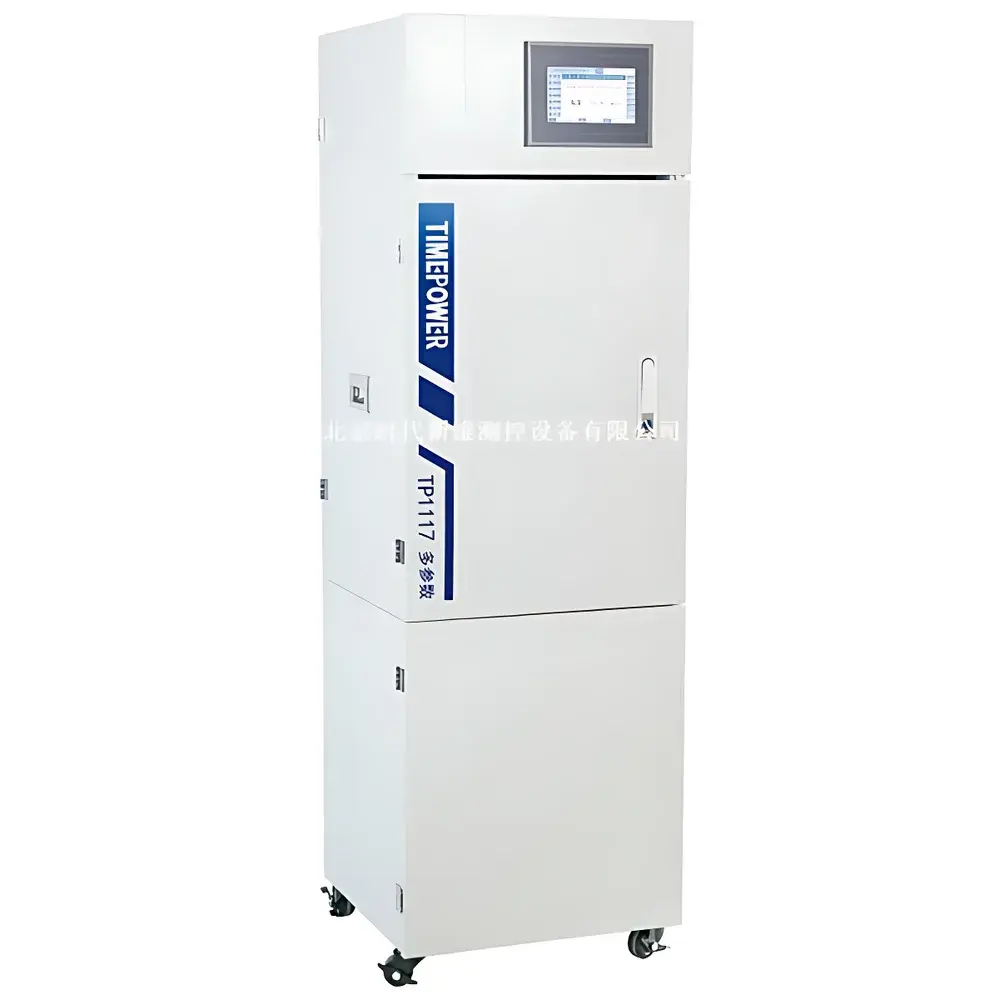
TimePower TP1116 Online Heavy Metals Analyzer for Water Quality Monitoring
| Brand | TimePower |
|---|---|
| Origin | Beijing, China |
| Manufacturer Type | OEM Manufacturer |
| Country of Origin | China |
| Model | TP1116 |
| Instrument Type | Online Analyzer |
| Detection Principle | Photometric (Spectrophotometric) Method |
| Detectable Metals | Cu, Fe, Ni, Mn, Pb, Cd, As, Zn, Cr (Total & Hexavalent), Cr(VI) |
| Detection Time | 30 min per cycle |
| Accuracy | ±10% at ≥0.2 mg/L |
| Resolution | 0.1 mg/L |
| Measurement Ranges | Cu: 0–3.00 mg/L |
| Fe | 0.00–5.00 mg/L |
| Ni | 0.00–2.00 / 0.10–10.00 mg/L |
| Mn | 0.00–5.00 mg/L |
| Pb | 0.00–3.00 mg/L |
| Cd | 0.00–3.00 mg/L |
| As | 0.00–3.00 mg/L |
| Zn | 0.00–3.00 mg/L |
| Cr (Total) | 0.00–3.00 mg/L |
| Cr(VI) | 0.00–2.00 / 0.10–10.00 mg/L |
| Repeatability | ≤±5% |
| Stability (24 h) | ≤±10% |
| Minimum Cycle Time | 30 min |
| Sampling Interval | 10–9999 min (programmable) or fixed-time mode |
| Calibration Interval | 1–99 days (configurable) |
| Outputs | RS-232, 4–20 mA, RS-485 (optional) |
| Operating Environment | +5 to +28 °C (temperature-controlled indoor space) |
| Power Supply | AC 230 V ±10%, 50 Hz ±10%, 5 A |
| Dimensions (H×W×D) | 1570 × 500 × 450 mm |
| Data Retention | Non-volatile memory preserves logs and calibration data during power loss |
| Interface | Touchscreen HMI with full operational control and real-time diagnostics |
Overview
The TimePower TP1116 Online Heavy Metals Analyzer is an industrial-grade, multi-parameter photometric system engineered for continuous, unattended monitoring of regulated heavy metal species in surface water, municipal influent/effluent, industrial process streams, and wastewater discharge points. It operates on standardized colorimetric reaction principles compliant with established ASTM and ISO reference methods—including EPA 200.7, ISO 6604 (Cr(VI)), ISO 8288 (Ni), ISO 11969 (Cu), and ISO 11969 (Zn)—and delivers trace-level quantification through high-stability optical detection. Each analyte channel employs dedicated reagent chemistry and optimized reaction kinetics, supported by integrated high-temperature, high-pressure digestion for total metal speciation (e.g., total Cr, total As, total Pb). The system’s modular architecture allows independent configuration of up to ten measurement parameters—total copper, total iron, total nickel, total manganese, total lead, total cadmium, total arsenic, total zinc, total chromium, and hexavalent chromium—with no cross-channel interference.
Key Features
- Modular multi-analyte platform supporting simultaneous or sequential determination of up to 10 heavy metal species without hardware modification
- Patented air-buffered negative-pressure aspiration system eliminates direct contact between aggressive reagents and peristaltic pump tubing, extending service life and ensuring long-term volumetric accuracy
- Optical reagent dosing via visible-light photometric feedback enables precise 1 mL reagent delivery per assay—reducing consumption by >40% versus conventional systems
- High-integrity fluid path constructed with fluoropolymer-modified transparent PTFE tubing (ID ≥1.5 mm), minimizing particulate clogging and enabling reliable operation in turbid or suspended-solid-laden samples
- Sealed, pressurized digestion module operating at elevated temperature and pressure accelerates oxidation and complexation reactions while preventing volatile acid fume leakage and internal corrosion
- Non-volatile memory with automatic power-fail recovery: retains calibration history, event logs, and method configurations; resumes analysis within 90 seconds after mains restoration
- Intuitive 7-inch capacitive touchscreen HMI with multilingual UI (English, Spanish, German), real-time chromatogram visualization, and guided maintenance workflows
Sample Compatibility & Compliance
The TP1116 is validated for use with raw and filtered aqueous matrices meeting standard pretreatment requirements (e.g., filtration ≤5 µm, pH 4–9, TSS <50 mg/L). It complies with international regulatory frameworks governing environmental compliance reporting, including EU Water Framework Directive (WFD) Annex VIII parameter definitions, US EPA Clean Water Act effluent guidelines, and China’s GB 3838–2002 Surface Water Environmental Quality Standards. All onboard chemistries are traceable to NIST-traceable standards, and the instrument supports audit-ready data integrity features aligned with GLP and ISO/IEC 17025 laboratory management systems. Optional 21 CFR Part 11-compliant software modules provide electronic signature capability, user role-based access control, and immutable audit trails for QA/QC documentation.
Software & Data Management
Embedded firmware supports dual-mode operation: autonomous cyclic analysis (minimum 30-min interval) or demand-triggered sampling synchronized with SCADA or PLC inputs. Data output includes analog 4–20 mA signals (per parameter), digital RS-232/RS-485 Modbus RTU, and optional Ethernet TCP/IP with MQTT support for cloud integration. Internal storage retains ≥12 months of 15-minute averaged results, method logs, calibration certificates, and fault diagnostics. Remote access is enabled via secure HTTPS interface with TLS 1.2 encryption; firmware updates are performed over-the-air with SHA-256 signature verification. All exported datasets include ISO 8601 timestamps, method ID tags, and uncertainty flags per ISO/IEC 17025 Clause 7.7.
Applications
- Real-time compliance monitoring at municipal wastewater treatment plant (WWTP) outfalls for Cu, Ni, Cr(VI), and Pb against local discharge permits
- Process water surveillance in electroplating, PCB manufacturing, and battery recycling facilities to prevent upstream contamination events
- Early-warning detection of heavy metal leaching from landfill leachate collection systems or mining runoff channels
- Long-term trend analysis in drinking water source protection zones using multi-year baseline datasets
- Support for ISO 14001 environmental management system (EMS) audits through automated report generation and certificate export
FAQ
What sample pretreatment is required prior to analysis?
Samples must be filtered through a 5 µm membrane filter and maintained within pH 4–9; no acid preservation or digestion is needed as the system performs on-board high-pressure digestion for total metal determination.
Can the TP1116 be integrated into existing SCADA or DCS infrastructure?
Yes—via native Modbus RTU over RS-485 or optional Ethernet/IP with configurable polling intervals and alarm thresholds mapped to discrete I/O tags.
How often does the system require calibration verification?
Calibration intervals are fully programmable from 1 to 99 days; however, daily bracketing with certified reference materials (CRMs) is recommended for regulatory reporting applications.
Is remote diagnostics and firmware update supported?
Yes—the embedded web server enables secure remote login, live sensor status viewing, error log download, and cryptographically signed firmware upgrades without physical site visit.
Does the analyzer meet international electromagnetic compatibility (EMC) and safety standards?
It complies with IEC 61326-1 (EMC for laboratory equipment), IEC 61010-1 (safety), and CE marking requirements under the EU Low Voltage and EMC Directives.







