
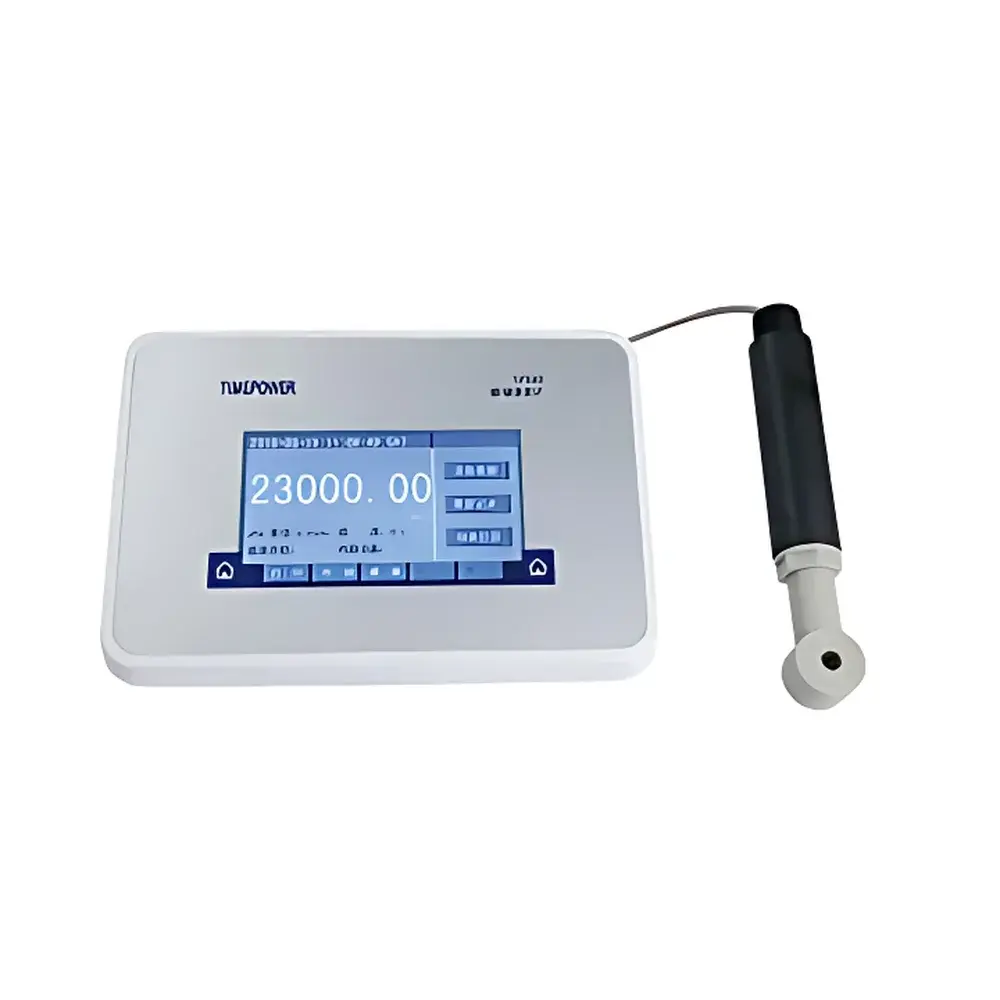
TimePower TP340 Acid-Base Concentration Meter
| Brand | TimePower |
|---|---|
| Model | TP340 |
| Origin | Beijing, China |
| Manufacturer | TimePower (Producer) |
| Type | Conductivity-Based Acid-Base Concentration Analyzer |
| Measurement Principle | Conductometric titration / Specific conductivity correlation with concentration |
| Measuring Range | HCl (0–10.00%), NaOH (0–10.00%), H₂SO₄ (0–20.00%), NaCl (0–20.00%), HNO₃ (0–15.00%), Na₂CO₃ (0–10.00%) |
| Accuracy | ±2% F.S. |
| Resolution | 0.01% |
| Repeatability | ≤1% |
| Stability | ±1% F.S./4 h |
| Temperature Compensation | PT1000 sensor, 0–60 °C |
| Sample Temp. | 5–50 °C |
| Ambient Temp. | 5–45 °C |
| Humidity | ≤90% RH (non-condensing) |
| Storage Temp. | −25–55 °C |
| Power Supply | AC 85–265 V, 45–65 Hz |
| Power Consumption | ≤5 W |
| Dimensions | 200 mm × 200 mm × 85 mm |
| Weight | 2.1 kg |
| Display | 5.0″ color TFT touchscreen, Chinese UI |
| A/D Converter | 24-bit |
| Electrode | Corrosion-resistant conductometric cell |
Overview
The TimePower TP340 Acid-Base Concentration Meter is a dedicated conductometric analyzer engineered for precise, real-time quantification of strong acid and base concentrations in industrial process streams and laboratory samples. It operates on the fundamental principle that the electrical conductivity of aqueous electrolyte solutions exhibits a predictable, near-linear relationship with solute concentration—within defined ranges—for monovalent and divalent strong electrolytes such as HCl, NaOH, H₂SO₄, HNO₃, NaCl, and Na₂CO₃. By measuring solution conductivity at controlled temperature (with automatic compensation via integrated PT1000 sensor), and applying pre-calibrated, matrix-specific conductivity-concentration correlation curves, the instrument calculates mass percentage concentration directly. Unlike pH-based methods—which saturate or drift at high acid/base strengths—the TP340 maintains metrological integrity across its full operational range (e.g., up to 20.00% w/w H₂SO₄), making it indispensable for applications where robustness, repeatability, and non-destructive continuous monitoring are critical.
Key Features
- Corrosion-resistant conductometric electrode assembly, optimized for long-term stability in aggressive acidic and alkaline environments.
- High-resolution 24-bit analog-to-digital conversion ensures minimal quantization error and high signal fidelity across low- and high-conductivity regimes.
- Integrated PT1000 temperature sensor enables accurate automatic temperature compensation (0–60 °C), correcting for thermal effects on conductivity per ISO 7888 and ASTM D1125 standards.
- Embedded microcontroller architecture delivers low power consumption (≤5 W), high computational throughput, and deterministic real-time response.
- 5.0-inch capacitive touchscreen display with intuitive Chinese-language menu navigation—designed for rapid operator training and minimal procedural error.
- Circular data logging buffer stores up to 1,000 measurement records; overflow management ensures uninterrupted operation without manual intervention.
- Compact benchtop form factor (200 × 200 × 85 mm) and lightweight design (2.1 kg) facilitate deployment in QC labs, control rooms, or mobile field stations.
Sample Compatibility & Compliance
The TP340 is validated for use with clear, non-viscous, non-particulate aqueous solutions containing strong electrolytes. It is not intended for weak acids/bases (e.g., acetic acid, ammonia), organic solvents, or suspensions. Its measurement protocol aligns with the electrochemical principles outlined in IEC 60746-3 (Electrochemical analyzers – Part 3: Conductivity meters) and supports traceability under GLP-compliant workflows when paired with documented calibration procedures. While the device itself does not include FDA 21 CFR Part 11-compliant audit trails, its stable analog front-end and deterministic firmware architecture provide a foundation for integration into validated systems where electronic records are managed externally. Calibration verification is performed using NIST-traceable KCl standard solutions at multiple points across each supported concentration range.
Software & Data Management
The TP340 operates autonomously without external software dependency. All configuration, calibration, and data review occur locally via the embedded touchscreen interface. Calibration routines support multi-point linear or segmented curve fitting for each analyte (HCl, NaOH, etc.), allowing users to tailor response models to site-specific fluid matrices. Logged data—including timestamp, concentration value, temperature, and operator ID (if entered)—can be reviewed on-screen or exported via optional USB interface (not included standard). For enterprise integration, the instrument’s RS-485 port (optional module) supports Modbus RTU protocol, enabling seamless connection to SCADA, DCS, or LIMS platforms for centralized data aggregation and trend analysis—critical for batch release documentation in pharmaceutical or food manufacturing per USP and ISO 22000 requirements.
Applications
- Power generation: Monitoring regenerant strength during ion exchange resin regeneration in demineralized water treatment plants.
- Chemical & metallurgical processing: In-line verification of pickling bath concentration (HCl/H₂SO₄) in steel surface treatment lines; caustic scrubber solution monitoring in flue gas desulfurization.
- Pharmaceutical manufacturing: Quantitative control of cleaning-in-place (CIP) alkaline and acidic solutions per FDA guidance on equipment cleaning validation.
- Food & beverage production: Verification of sanitizing solution concentrations (e.g., NaOH, HNO₃) in dairy and brewing facilities compliant with SQF and BRCGS standards.
- Environmental laboratories: Rapid, interference-free analysis of strong acid/base content in industrial effluents prior to neutralization and discharge.
FAQ
What measurement principle does the TP340 employ?
It uses solution conductivity correlated to concentration via empirically calibrated, analyte-specific curves—not potentiometric pH measurement.
Can the TP340 measure weak acids like acetic acid?
No. It is validated only for strong, fully dissociated electrolytes (HCl, H₂SO₄, NaOH, etc.) where conductivity–concentration linearity holds reliably.
Is temperature compensation mandatory?
Yes. Conductivity varies significantly with temperature; the built-in PT1000 sensor and algorithm ensure compliance with ISO 7888 reference conditions (25 °C).
How often must the electrode be calibrated?
Initial calibration is required before first use; subsequent verification is recommended before each analytical shift or after exposure to highly contaminated samples.
Does the instrument meet IP rating requirements for wet environments?
The TP340 has no formal IP rating; it is designed for indoor laboratory or controlled industrial environments—electrode cables and connectors must remain dry per operational safety guidelines.
Related Products





