
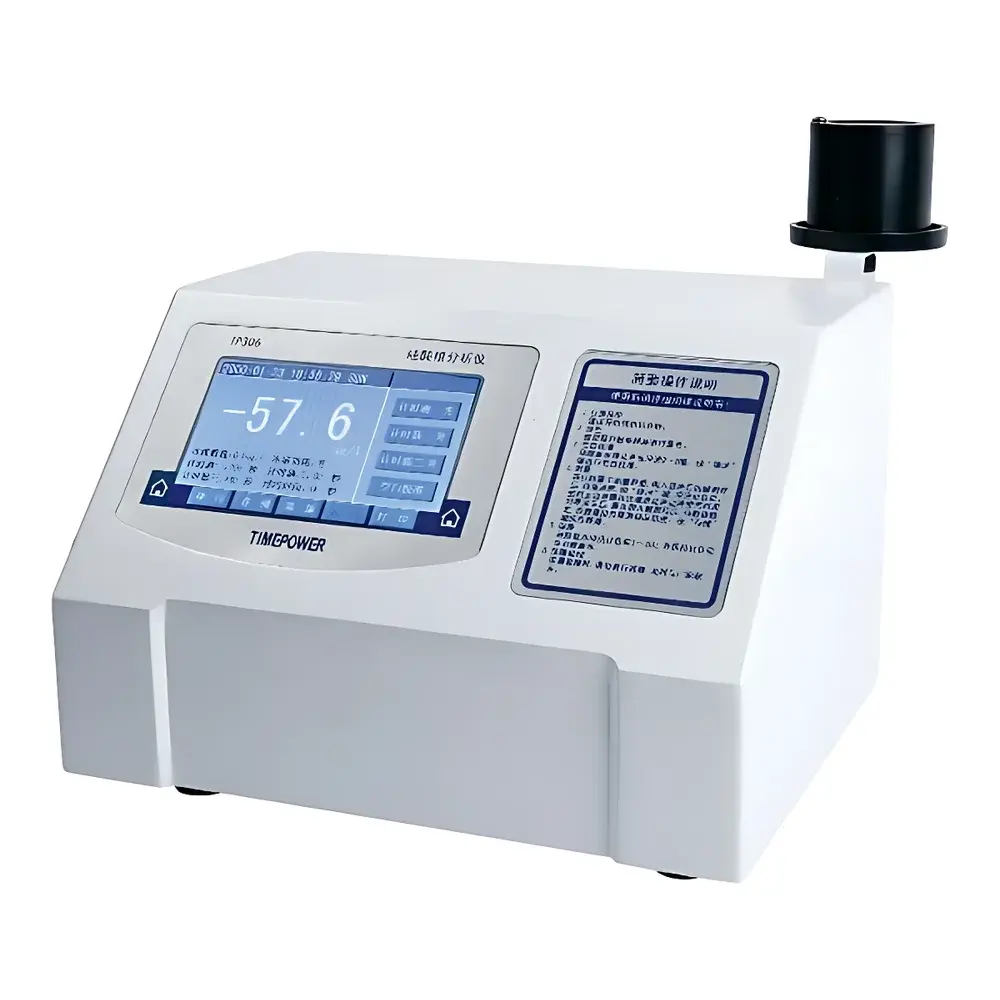
Timepower TP-307 Laboratory Phosphate Analyzer
| Brand | Timepower |
|---|---|
| Origin | Beijing, China |
| Manufacturer Type | OEM Manufacturer |
| Product Category | Domestic |
| Model | TP-307 |
| Instrument Type | Benchtop Laboratory Analyzer |
| Measurement Method | Phosphovanadomolybdate Colorimetric Method (Yellow Complex Formation) |
| Display | 5.0-inch TFT Touchscreen with Chinese UI |
| Optical Source | Imported Monochromatic Cold Light LED |
| Data Storage | Cyclic Memory for ≤256 Entries |
| Calibration | Automatic Zero Calibration (Blank Compensation) |
| Power Consumption | Low-Power Microcontroller Architecture |
| Design | Integrated PCB Layout with Surface-Mount Technology (SMT) |
Overview
The Timepower TP-307 Laboratory Phosphate Analyzer is a benchtop spectrophotometric instrument engineered for precise quantification of orthophosphate (PO₄³⁻) concentration in ultra-pure and process water streams. It operates on the internationally standardized phosphovanadomolybdate colorimetric principle—where orthophosphate reacts with ammonium metavanadate and ammonium molybdate under acidic conditions to form a stable yellow heteropoly acid complex (phosphovanadomolybdic acid), whose absorbance is measured at 420 nm. This method complies with ASTM D859–22 and ISO 6878:2004 for phosphate determination in water. Designed specifically for power generation facilities—including boiler feedwater, condensate, and demineralized water circuits—the TP-307 delivers high reproducibility in low-range measurement (0–5.0 mg/L PO₄ as P), meeting stringent requirements for steam cycle chemistry control per EPRI guidelines and IAPWS-RP-1994.
Key Features
- 5.0-inch high-resolution capacitive touchscreen with intuitive Chinese-language interface, enabling rapid parameter navigation and real-time status feedback.
- Monochromatic cold-light LED source with narrow spectral bandwidth (<10 nm FWHM) and thermal stability, ensuring long-term photometric consistency and eliminating lamp replacement cycles typical of tungsten-halogen systems.
- Embedded microcontroller architecture with optimized firmware for low-power operation, supporting continuous monitoring mode and battery-backup-ready configurations.
- Automatic zero-point calibration using reagent blank compensation, mitigating baseline drift caused by electronic offset or cuvette imperfections—critical for sub-0.1 mg/L detection reliability.
- Integrated SMT-based printed circuit board assembly with conformal coating, enhancing resistance to humidity and chemical vapor exposure common in laboratory and utility control room environments.
- Onboard cyclic data logger storing up to 256 measurement records with timestamp, sample ID, and calibration status; overflow management ensures uninterrupted logging without manual intervention.
Sample Compatibility & Compliance
The TP-307 accepts standard 10-mm pathlength quartz or optical-grade plastic cuvettes and is validated for aqueous matrices with total dissolved solids (TDS) < 50 ppm and turbidity < 1 NTU. It supports direct analysis of pretreated samples from thermal power plants, pharmaceutical purified water (PW) loops, semiconductor rinse water, and chemical process streams. Method validation adheres to USP for phosphate in water for injection (WFI) and meets GLP documentation requirements for audit-ready calibration logs and user-accessible audit trails. While not certified for unattended 24/7 operation, its design aligns with IEC 61000-6-3 (EMC immunity) and IEC 61010-1 safety standards for laboratory electrical equipment.
Software & Data Management
Data export is supported via USB 2.0 interface to FAT32-formatted flash drives in CSV format, preserving measurement time, operator ID (if enabled), calibration coefficients, and raw absorbance values. The internal firmware implements role-based access control (administrator/operator modes) and maintains immutable calibration history with date/time stamps—facilitating compliance with FDA 21 CFR Part 11 Annex 11 expectations for electronic records integrity. No cloud connectivity or proprietary software installation is required; all configuration and reporting occur locally through the embedded UI.
Applications
- Monitoring phosphate residuals in drum boiler feedwater to prevent scale formation and maintain optimal alkalinity-phosphate ratios (e.g., coordinated phosphate treatment).
- Verification of phosphate removal efficiency in ion exchange demineralizers and mixed-bed polishing units.
- Quality control of purified water in pharmaceutical manufacturing (USP/EP compliant environments).
- Process water analysis in synthetic fiber production where phosphate acts as a catalyst residue indicator.
- Educational and R&D laboratories conducting method development for low-concentration anion analysis in ultrapure water systems.
FAQ
What is the detection range and typical LOD for the TP-307?
The instrument is calibrated for 0–5.0 mg/L as phosphorus (equivalent to 0–22.9 mg/L as PO₄³⁻), with a limit of detection estimated at ≤0.02 mg/L P based on 3× baseline noise under controlled lab conditions.
Does the TP-307 support automatic dilution or multi-range measurement?
No—sample dilution must be performed manually prior to analysis. The device operates exclusively in single-range mode optimized for low-concentration applications.
Is reagent kit availability documented and traceable?
Yes—Timepower provides lot-numbered reagent kits (phosphomolybdate/vanadate acid mixture, reducing agent, buffer) with CoA documentation including shelf-life, purity assay, and batch-specific calibration verification data.
Can the TP-307 be integrated into a SCADA or LIMS environment?
Not natively—data transfer is file-based only (USB export). Modbus RTU or Ethernet/IP integration is not supported in current firmware revision.
What maintenance intervals are recommended for optical and fluidic components?
LED source lifetime exceeds 50,000 hours; no scheduled optical alignment is required. Cuvette holder cleaning is advised after every 20 analyses using deionized water and lint-free wipes; no pump or valve maintenance is needed due to gravity-fed sample handling.







