
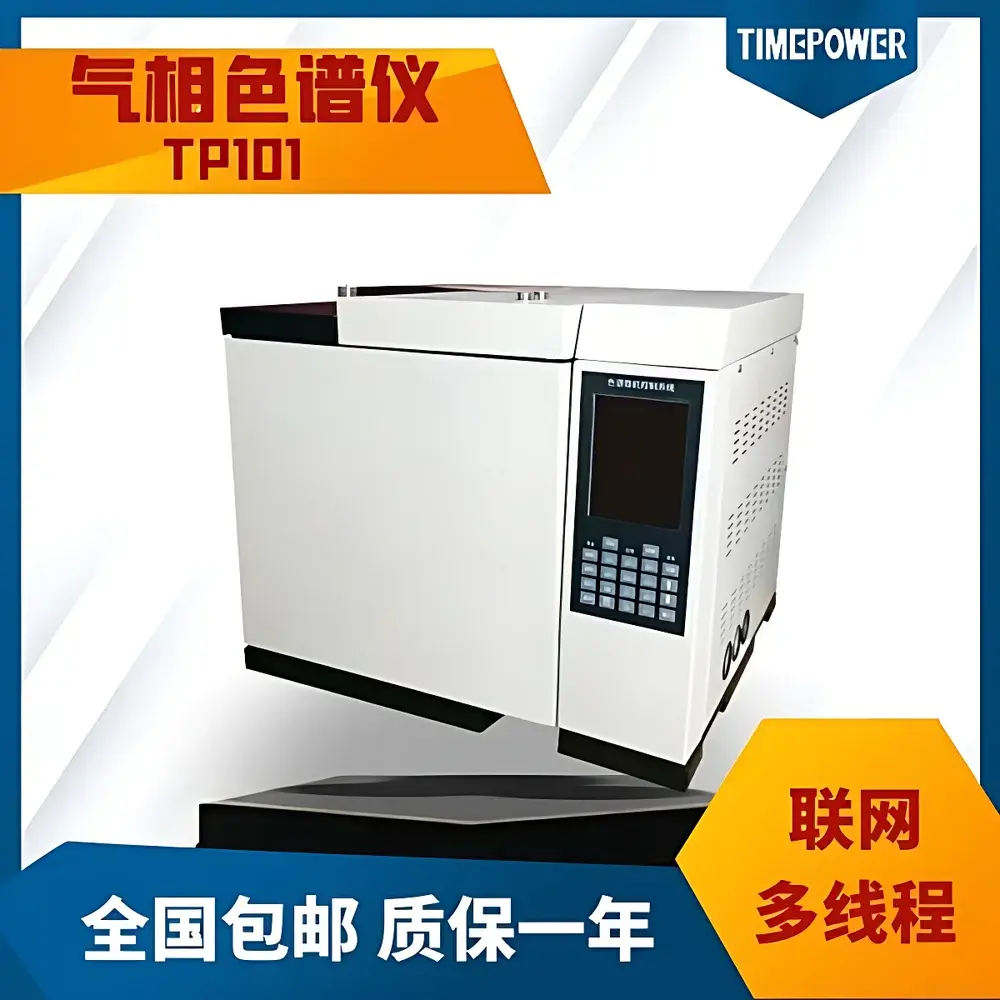
TimePower TP/101 Laboratory Gas Chromatograph
| Brand | TimePower |
|---|---|
| Origin | Beijing, China |
| Manufacturer Type | Direct Manufacturer |
| Regional Classification | Domestic (China) |
| Model | TP/101 |
| Instrument Type | Laboratory Gas Chromatograph |
| Application Scope | General-Purpose |
| Oven Temperature Range | 8 °C above ambient to 450 °C |
| Oven Ramp Rate | 16-step programmable, 0.1–39 °C/min (standard configuration) |
| Oven Cooling Rate | ~18 min from 39 °C to 0.1 °C (ultra-fast cooling mode) |
| Carrier Gas Flow Range & Control | 0–1200 mL/min (7 program segments) |
| Carrier Gas Pressure Range & Control | 0–970 kPa (7 program segments) |
| Injector Maximum Operating Temperature | 450 °C |
| Injector Pressure Setpoint Range | 0–970 kPa |
| Injector Total Flow Setpoint Range | 0–1200 mL/min |
Overview
The TimePower TP/101 Laboratory Gas Chromatograph is a high-performance, modular GC system engineered for precision analysis of dissolved gases in insulating oils—primarily serving the power transmission and distribution sector. It operates on the fundamental principle of gas-liquid partition chromatography, where volatile analytes are separated based on differential partitioning between a mobile phase (inert carrier gas) and a stationary phase (capillary or packed column). Designed in strict compliance with GB/T 17623–1998 and GB/T 7252–2001, the TP/101 implements a validated three-detector, dual-column parallel flow architecture with single-injection, split-flow configuration. This configuration ensures simultaneous detection of H₂, O₂, N₂, CH₄, C₂H₂, C₂H₄, C₂H₆, CO, and CO₂ at sub-ppm levels—meeting and exceeding sensitivity, resolution, and quantitative accuracy requirements specified in national and industry standards for transformer oil diagnostics.
Key Features
- Modular hardware architecture supporting flexible detector configurations—including dual FID (flame ionization detector), TCD (thermal conductivity detector), and optional ECD or PID—enabling concurrent analysis across multiple compound classes.
- Six independent temperature-controlled zones: oven, up to three injectors, and up to two detectors—each with real-time PID control and 16-stage programmable ramping (0.1–39 °C/min).
- Ultra-fast oven cooling system achieving ~18-minute cooldown from 39 °C to 0.1 °C, significantly improving throughput for high-volume routine testing.
- Integrated 5.7-inch color TFT-LCD touchscreen interface with intuitive menu navigation and embedded keyboard operation—designed for minimal training overhead in plant laboratories.
- Triple-process network stack supporting simultaneous connections to local operator station, departmental supervisor, and enterprise-level QA/QC server via 10/100M auto-sensing Ethernet.
- 24-bit high-resolution ADC with baseline storage and dynamic baseline subtraction algorithms—enhancing signal-to-noise ratio and peak integration reproducibility.
- Automatic detector recognition, power-on self-diagnostic routines, and non-volatile memory for parameter retention after power loss—ensuring operational continuity and audit readiness.
Sample Compatibility & Compliance
The TP/101 is optimized for gaseous and semi-volatile organic compounds in mineral oil matrices, particularly dissolved fault gases in transformer, reactor, and bushing insulating oils. It supports standard 1–10 mL headspace vials and accommodates both manual and automated liquid/gas injection (with optional autosampler integration). All thermal and pneumatic control modules conform to IEC 61000-4 electromagnetic compatibility requirements. The instrument’s firmware and data handling protocols support GLP-compliant operation—including electronic signatures, user access levels, and audit-trail-enabled event logging—aligning with ISO/IEC 17025 laboratory accreditation criteria and facilitating FDA 21 CFR Part 11 readiness when paired with validated network workstation software.
Software & Data Management
The TP/101 ships with TimePower’s Transformer Oil Gas Analysis (TOGA) Workstation—a Windows-based, network-deployable application supporting up to 253 concurrent GC units. The software provides full remote instrument control (including temperature, flow, pressure, and detector bias), real-time chromatogram visualization, automated peak identification using retention time indexing, and customizable calibration curve generation (linear, quadratic, or multi-point weighted). Raw data files adhere to ASTM E1947-compliant formats and include embedded metadata (operator ID, method timestamp, hardware configuration hash). Data export options include CSV, PDF reports, and LIMS-compatible XML—enabling seamless integration into enterprise quality management systems. Remote firmware updates and diagnostic telemetry are available via secure HTTPS tunneling—subject to explicit user authorization.
Applications
- Dissolved gas analysis (DGA) in power transformer and reactor insulating oils per IEEE C57.104 and IEC 60599 guidelines.
- Quantitative profiling of hydrocarbon gases (C₁–C₃), hydrogen, carbon oxides, and oxygen/nitrogen in high-voltage equipment maintenance programs.
- Method development and validation for alternative insulating fluids (e.g., natural esters, synthetic hydrocarbons) under evolving grid sustainability initiatives.
- Quality control of new oil batches prior to commissioning, including screening for oxidation byproducts and contamination markers.
- Research applications in electrical insulation degradation modeling, accelerated aging studies, and partial discharge signature correlation.
FAQ
Does the TP/101 comply with international DGA reporting standards?
Yes—the system implements retention time alignment, internal standard normalization, and response factor correction methods aligned with IEC 60599 Annex B and IEEE Std C57.104–2019 Annex C.
Can the instrument be integrated into an existing LIMS environment?
Yes—via configurable ODBC/JDBC drivers and HL7-compatible data export modules included in the TOGA Workstation.
Is the 16-stage temperature programming applicable to all six heated zones?
No—programmable ramping applies exclusively to the column oven; injector and detector zones support independent isothermal or simple ramp profiles.
What cybersecurity safeguards are implemented for remote access?
All remote sessions require TLS 1.2+ encrypted authentication; device-side firewall rules restrict inbound traffic to designated IP ranges and ports.
Is hardware calibration traceable to NIST or CNAS-certified references?
Yes—factory calibration certificates include traceability to CNAS-accredited reference standards; users may perform field verification using certified gas mixtures (e.g., Air Liquide CertiGas™).





