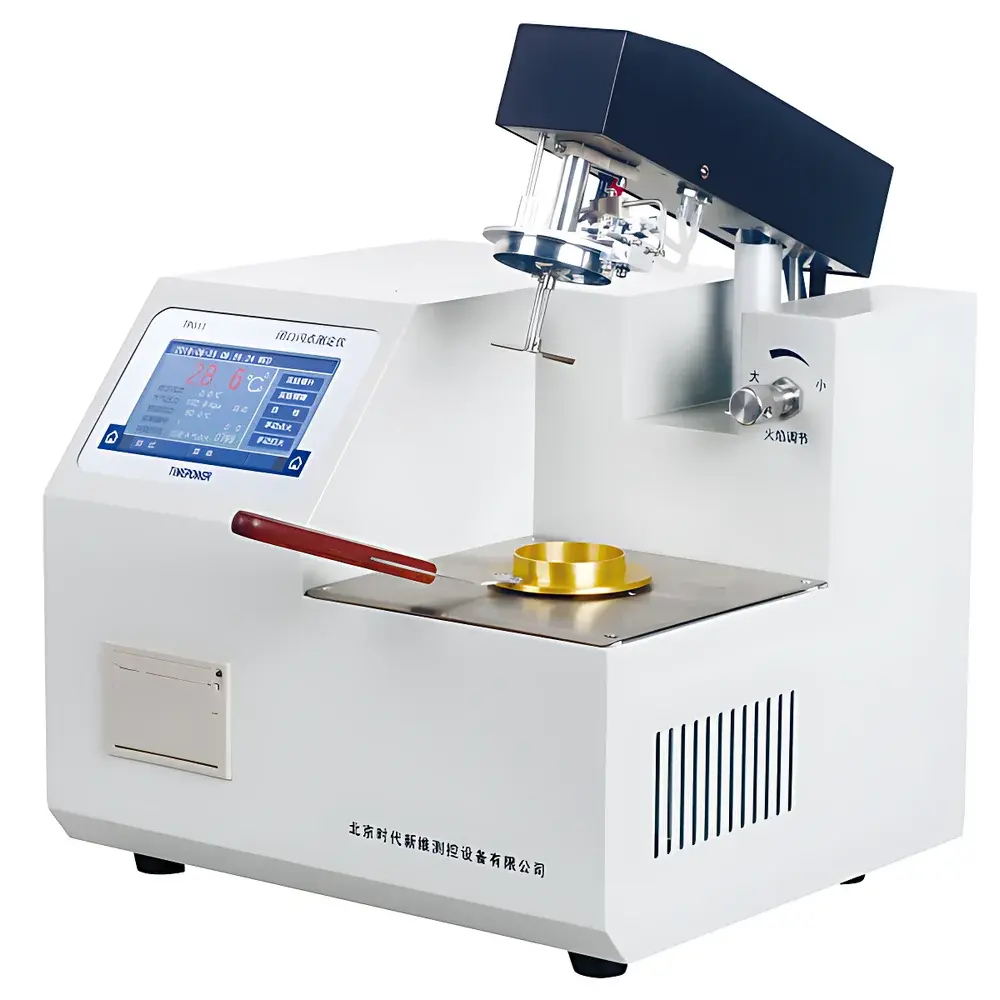
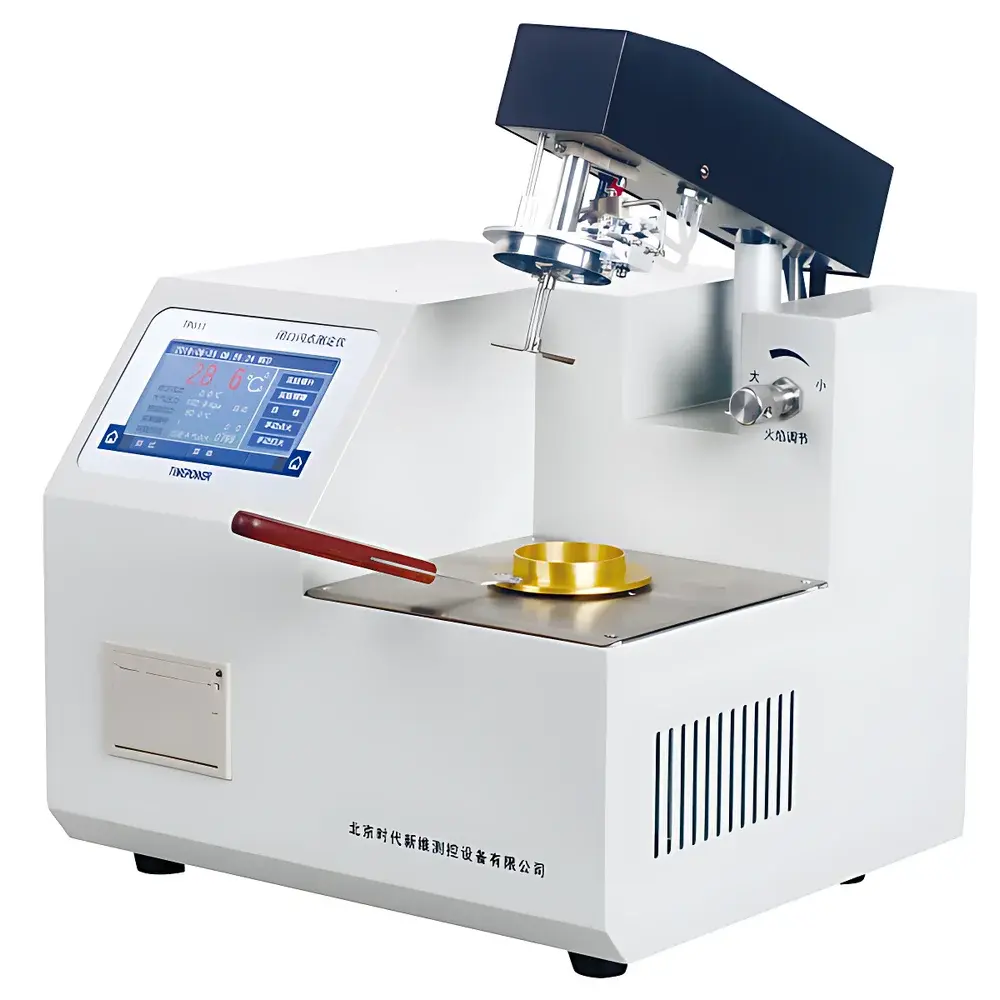
Timepower TP611 Automated Closed-Cup Flash Point Tester
| Brand | Timepower |
|---|---|
| Origin | Beijing, China |
| Manufacturer | Timepower |
| Country of Origin | China |
| Model | TP611 |
| Detection Method | Closed-Cup (ASTM D93 / GB/T 261) |
| Measurement Range | 40–370 °C |
| Accuracy | ±1 °C for flash point <110 °C |
| Repeatability | ≤2 °C |
| Resolution | 0.1 °C |
| Display | 260k-color TFT LCD (480×272) |
| Cooling | Integrated forced-air cooling |
| Printer | Thermal printer (36-character Chinese/English support) |
| Power Supply | AC 220 V ±10%, 50 Hz ±10% |
| Power Consumption | ≤500 W |
| Dimensions | 350 × 310 × 300 mm |
| Weight | 13.5 kg |
| Environmental Operating Range | 5–40 °C, RH ≤85% |
| Atmospheric Pressure Compensation | Yes |
| Ignition Options | Switchable gas flame scanning or electronic spark ignition |
| Safety Features | Over-temperature cutoff, self-diagnostic system, automated test arm retraction |
Overview
The Timepower TP611 Automated Closed-Cup Flash Point Tester is an engineered solution for precise, repeatable determination of the closed-cup flash point of petroleum products, lubricants, biodiesel blends, and related hydrocarbon-based liquids. It operates on the principle of controlled heating under standardized closed-vessel conditions—specifically adhering to ASTM D93 (Standard Test Method for Flash Point by Pensky-Martens Closed Cup Tester) and GB/T 261 (Chinese national standard equivalent). In this method, a sample is heated at a defined rate inside a sealed test cup while being continuously stirred. A calibrated ignition source—either a regulated gas flame or electronically generated spark—is periodically introduced across the vapor space above the liquid surface. The flash point is recorded as the lowest temperature at which the vapor-air mixture ignites momentarily upon exposure to the ignition source, without sustained combustion. This thermodynamic endpoint serves as a critical safety parameter for storage, transportation, handling, and regulatory classification of flammable liquids per UN GHS, OSHA HCS, and CLP regulations.
Key Features
- Fully automated operation sequence: cup positioning, temperature ramping, stirring, ignition triggering, flash detection, data logging, thermal shutdown, and test arm retraction—requiring no manual intervention after sample loading.
- Dual ignition mode selection: user-configurable switching between propane-butane gas flame scanning (with integrated pressure-regulated gas delivery interface) and solid-state electronic spark ignition—enabling compliance with both legacy and modern laboratory safety protocols.
- Intelligent temperature control architecture: PID-driven heating algorithm ensures linear, reproducible ramp rates compliant with ASTM D93 Annex A1 (2–3 °C/min) and GB/T 261 requirements, minimizing thermal lag and overshoot.
- Real-time atmospheric pressure compensation: integrated barometric sensor adjusts flash point calculation in accordance with ASTM D93 Section 8.2.3, ensuring traceable results across varying elevation and weather conditions.
- Self-diagnostic firmware: continuous monitoring of heater integrity, stirrer motor function, ignition circuit continuity, and cup seal status—flagging anomalies prior to test initiation or during runtime.
- High-fidelity human-machine interface: 260,000-color TFT display (480 × 272 resolution) provides intuitive graphical feedback of real-time temperature curves, step-by-step protocol guidance, and pass/fail status indicators aligned with ISO/IEC 17025 documentation expectations.
Sample Compatibility & Compliance
The TP611 is validated for use with refined mineral oils, transformer oils, turbine oils, hydraulic fluids, diesel fuels, kerosene, base stocks, and synthetic ester-based lubricants. It excludes highly volatile solvents (e.g., gasoline, acetone, ethanol) due to inherent safety limitations of closed-cup methodology. All operational parameters—including heating rate, stir speed, ignition frequency, and dwell time—are programmable to satisfy multiple international standards beyond ASTM D93 and GB/T 261, including ISO 2719 and IP 34. The instrument’s mechanical design conforms to IEC 61010-1:2010 safety requirements for electrical equipment used in measurement, control, and laboratory applications. Data output meets GLP audit-trail prerequisites: each test record includes timestamp, operator ID (via optional USB keyboard input), ambient pressure, final flash point, repeatability delta, and instrument serial number—exportable via USB port in CSV format for LIMS integration.
Software & Data Management
No external PC software is required for basic operation; all test logic, calibration routines, and report generation are embedded within the device’s industrial-grade ARM Cortex-M7 microcontroller. However, optional USB host functionality supports direct export of test logs (including raw temperature vs. time arrays) to FAT32-formatted flash drives. Each thermal record contains metadata fields compatible with 21 CFR Part 11-compliant systems when paired with validated third-party laboratory informatics platforms. The built-in thermal printer produces permanent, tamper-evident hardcopy reports featuring bilingual (English/Chinese) labeling, instrument identification, standard reference numbers, and signature-ready fields for QA sign-off—fully satisfying internal quality audits and CNAS accreditation requirements.
Applications
- Quality control laboratories in refineries and petrochemical plants verifying batch conformity against specification limits (e.g., ASTM D130, D924).
- Power generation facilities assessing oxidation stability and contamination levels in insulating oils per IEEE C57.106 and IEC 60296.
- Independent testing labs performing contract analysis for customs clearance, insurance risk assessment, and SDS authoring under REACH and TSCA frameworks.
- R&D departments evaluating flash point depression effects from additive packages, moisture ingress, or thermal degradation in next-generation bio-lubricants.
- Regulatory inspection agencies conducting field verification of fuel specifications per GB 17930 (Chinese gasoline standard) or EN 590 (European diesel standard).
FAQ
What standards does the TP611 comply with?
The instrument is designed and verified to meet ASTM D93, GB/T 261, ISO 2719, and IP 34 for closed-cup flash point determination.
Can the TP611 be used for open-cup testing?
No—it is strictly configured for closed-cup methodology per its mechanical design, cup geometry, and ignition path constraints.
Is external gas supply mandatory?
No. The dual-ignition architecture allows full operation using only the electronic spark mode; gas mode is optional and requires a certified propane/butane cylinder with CGA 600 regulator.
How often does the instrument require calibration verification?
Users should perform daily verification using certified reference materials (e.g., n-decane, cyclohexane) traceable to NIST or NMi; full calibration is recommended every six months or after major component replacement.
Does the TP611 support network connectivity or remote monitoring?
Not natively—but test data exported via USB can be ingested into centralized SCADA or LIMS environments using configurable parsing scripts.