
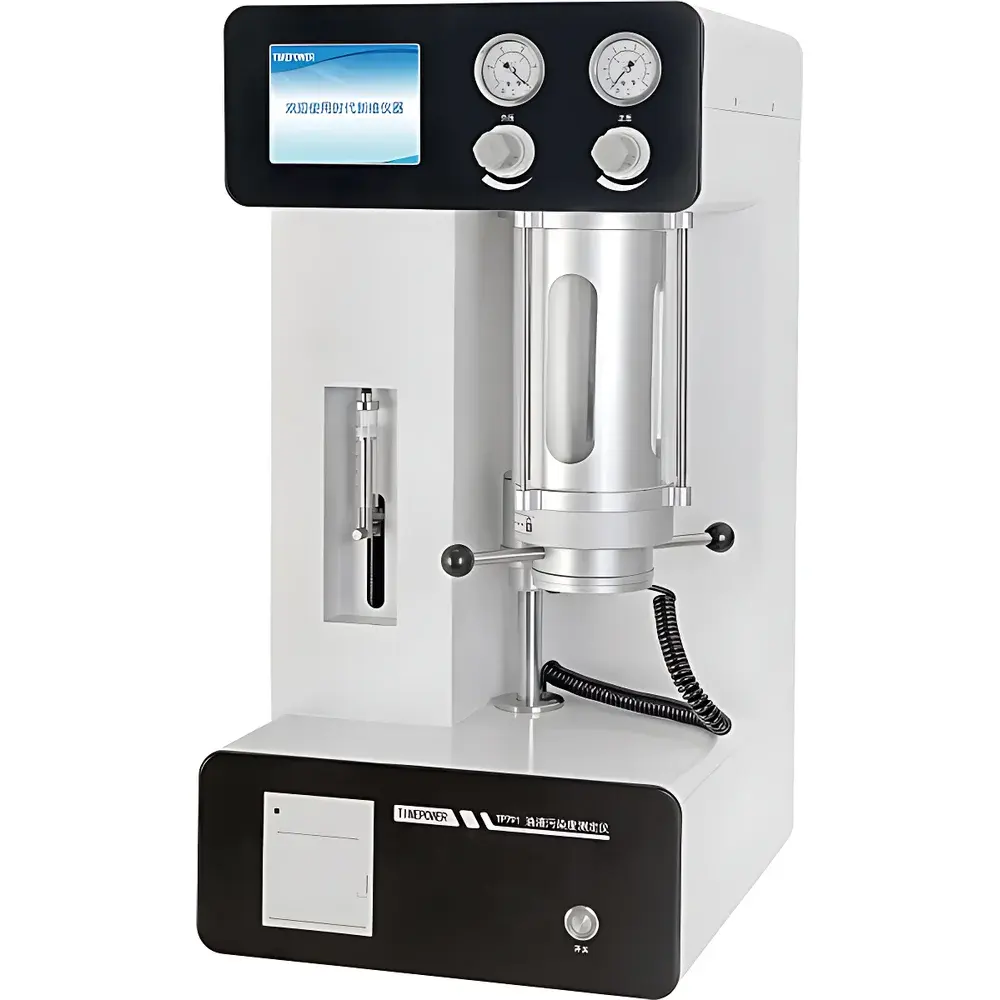
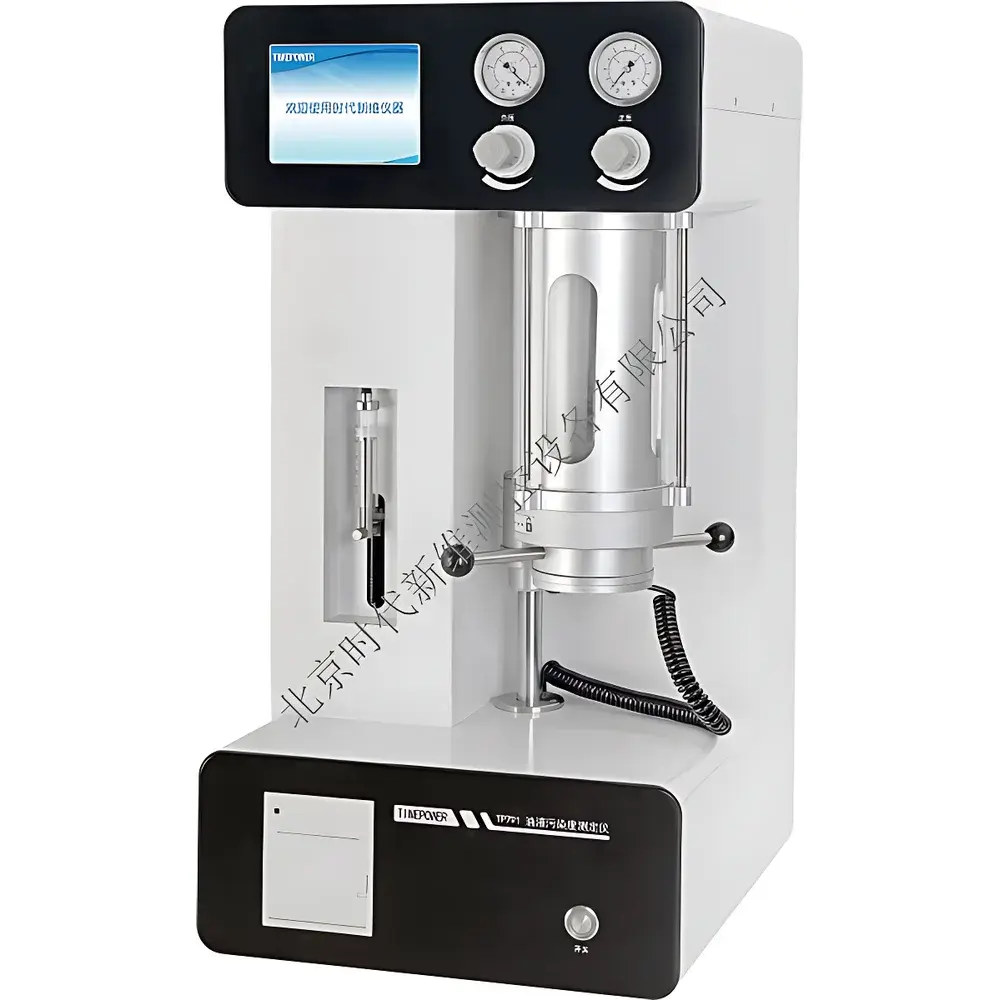
TimePower TP791 Oil Particle Contaminant Analyzer (Light Obscuration Method)
| Brand | TimePower |
|---|---|
| Origin | Beijing, China |
| Manufacturer Type | OEM Manufacturer |
| Product Origin | Domestic (China) |
| Model | TP791 |
| Pricing | Upon Request |
| Light Source | Semiconductor Laser |
| Measurement Principle | Light Obscuration (ISO 11171, ISO 4402 compliant) |
| Particle Size Range | 0.8 µm to 500 µm (sensor-dependent) |
| Detection Channels | 8 programmable channels |
| Adjustable Channel Thresholds | Within calibrated size range per selected standard |
| Sample Volume Range | 0.2–1000 mL |
| Sampling Flow Rate | 5–80 mL/min |
| Resolution | <10% (per ISO 21501-4) |
| Coincidence Limit | 10,000 particles/mL |
| Maximum Positive Pressure (Chamber) | 0.8 MPa |
| Maximum Negative Pressure (Chamber) | 0.08 MPa |
| Ambient Operating Temperature | 10–40 °C |
| Power Supply | AC 220 V ±10%, 50 Hz ±10% |
| Power Consumption | ≤200 W |
| Dimensions (W×D×H) | 390 × 340 × 660 mm |
| Weight | 23.5 kg |
| Data Output | Built-in thermal printer + RS232 serial interface |
| Calibration Standards Supported | GJB-420B, NAS 1638, ISO 4406, GOCT 17216 |
| Custom Standard Programming | Yes |
| Sample Introduction | Precision syringe pump + dual-pressure (positive/negative) chamber for degassing and viscous fluid handling |
| Integrated Air Filtration System | HEPA-class internal purification |
| Display & Interface | Color touchscreen with Chinese-language UI, on-device data storage, automated grade classification per selected standard |
Overview
The TimePower TP791 Oil Particle Contaminant Analyzer is a laboratory-grade particle counter engineered for quantitative assessment of solid particulate contamination in liquid media—primarily lubricants, hydraulic fluids, insulating oils, and other industrial process liquids. It operates on the internationally standardized light obscuration (LO) principle defined in ISO 11171 and ISO 4402, wherein particles suspended in a flowing liquid stream pass through a precisely collimated laser beam; each particle causes a transient reduction in transmitted light intensity proportional to its projected area. This analog signal is digitized, classified across eight user-configurable size thresholds, and converted into particle counts per unit volume. The system is designed to meet the metrological rigor required for condition monitoring in critical infrastructure—including aviation hydraulics, power generation turbine systems, and military-grade fluid maintenance—where adherence to contamination control protocols directly impacts equipment reliability and service life.
Key Features
- High-stability semiconductor laser source ensuring consistent beam profile and low noise floor over extended operation cycles.
- Dual-mode sample introduction: precision micro-syringe pump (0.2–1000 mL programmable volume) combined with a pressurized/depressurized test chamber (0.8 MPa max positive, 0.08 MPa max negative) enabling controlled degassing and accurate aspiration of high-viscosity oils (e.g., ISO VG 220 gear oils).
- Integrated HEPA-filtered air purification system minimizes ambient airborne contamination during analysis, supporting cleanroom-adjacent operation without external laminar flow hoods.
- Eight independent detection channels with fully adjustable threshold settings—allowing granular binning from 0.8 µm up to 500 µm based on sensor configuration and calibration curve selection.
- Automated contamination grading engine compliant with four major international standards: GJB-420B (Chinese military), NAS 1638 (aerospace), ISO 4406:2017 (industrial hydraulics), and GOCT 17216 (Russian Federation). User-defined standards can be imported via RS232 or configured locally.
- Touchscreen HMI with embedded Chinese language support, real-time histogram visualization, automatic report generation, and non-volatile internal memory for traceable data archiving.
Sample Compatibility & Compliance
The TP791 accommodates a broad spectrum of petroleum-based and synthetic fluids—including but not limited to aviation turbine fuel (Jet A-1), phosphate ester fire-resistant hydraulic fluids, silicone dielectric oils, polyalphaolefin (PAO) lubricants, and water-glycol emulsions. Its pressure-assisted sampling architecture ensures reproducible results across viscosity ranges spanning ISO VG 10 to VG 680. All optical and fluidic components are chemically resistant to common solvents and cleaning agents (e.g., petroleum ether, isopropanol). The instrument supports GLP-compliant workflows via timestamped audit logs, operator ID tagging, and electronic signature-ready output. While not FDA 21 CFR Part 11 certified out-of-the-box, raw data export (CSV/ASCII) enables integration into validated LIMS environments meeting ISO/IEC 17025 and ASTM D7619 requirements.
Software & Data Management
Data acquisition and reporting are managed entirely onboard via embedded firmware. Each test record includes full metadata: date/time stamp, operator ID, sample ID, volume aspirated, flow rate, environmental temperature, and applied contamination standard. Reports are printable in situ or exported via RS232 to external PCs running third-party statistical process control (SPC) or CMMS platforms. Firmware supports firmware updates via USB, and calibration parameters—including sensor gain, background offset, and channel sensitivity—are stored in protected EEPROM with write-protection logic. No cloud connectivity or proprietary software installation is required for basic operation; however, optional PC-based analysis suites (available under separate license) provide advanced trend analysis, multi-instrument fleet benchmarking, and PDF/A-1a archival report generation.
Applications
The TP791 serves as a primary tool for predictive maintenance programs across regulated sectors. In aerospace MRO facilities, it verifies compliance with NAS 1638 Class 5–7 limits prior to component reinstallation. Power utilities apply it to transformer oil per IEC 60429 and ASTM D6786 to assess insulation integrity. Naval engineering departments use GJB-420B mode for shipboard hydraulic system certification. Wind turbine operators deploy it for gearbox oil trending against ISO 4406 codes to schedule oil changes before catastrophic wear onset. Additionally, polymer solution manufacturers utilize its sub-micron capability (down to 0.8 µm) for QC screening of filter integrity in solvent-cast film production lines.
FAQ
What calibration standards does the TP791 natively support?
The instrument ships with preloaded calibration curves for GJB-420B, NAS 1638, ISO 4406:2017, and GOCT 17216. Users may define custom thresholds and assign them to new standard names within the firmware interface.
Is the system suitable for testing highly viscous oils such as gear oils or greases?
Yes—the dual-pressure chamber and programmable syringe pump allow controlled aspiration and degassing of oils up to ISO VG 680. Pre-dilution is not required for most routine tests.
Does the TP791 require annual recalibration by an accredited lab?
While not mandatory for all applications, TimePower recommends traceable recalibration every 12 months using NIST-traceable PSL reference particles (ISO 11171 compliant). Optional factory-certified calibration reports are available upon request.
Can raw particle count data be exported for statistical analysis?
Yes—via RS232 serial output in ASCII format, including channel-specific counts, sample volume, and timestamp. No proprietary drivers or software are needed for data ingestion.
What safety precautions apply when operating the pressurized chamber?
Always verify zero pressure reading on the display before opening the chamber lid. Never attempt manual disassembly of the syringe assembly under pressure. Post-test cleaning with petroleum ether is required to prevent residue buildup affecting subsequent measurements.






