
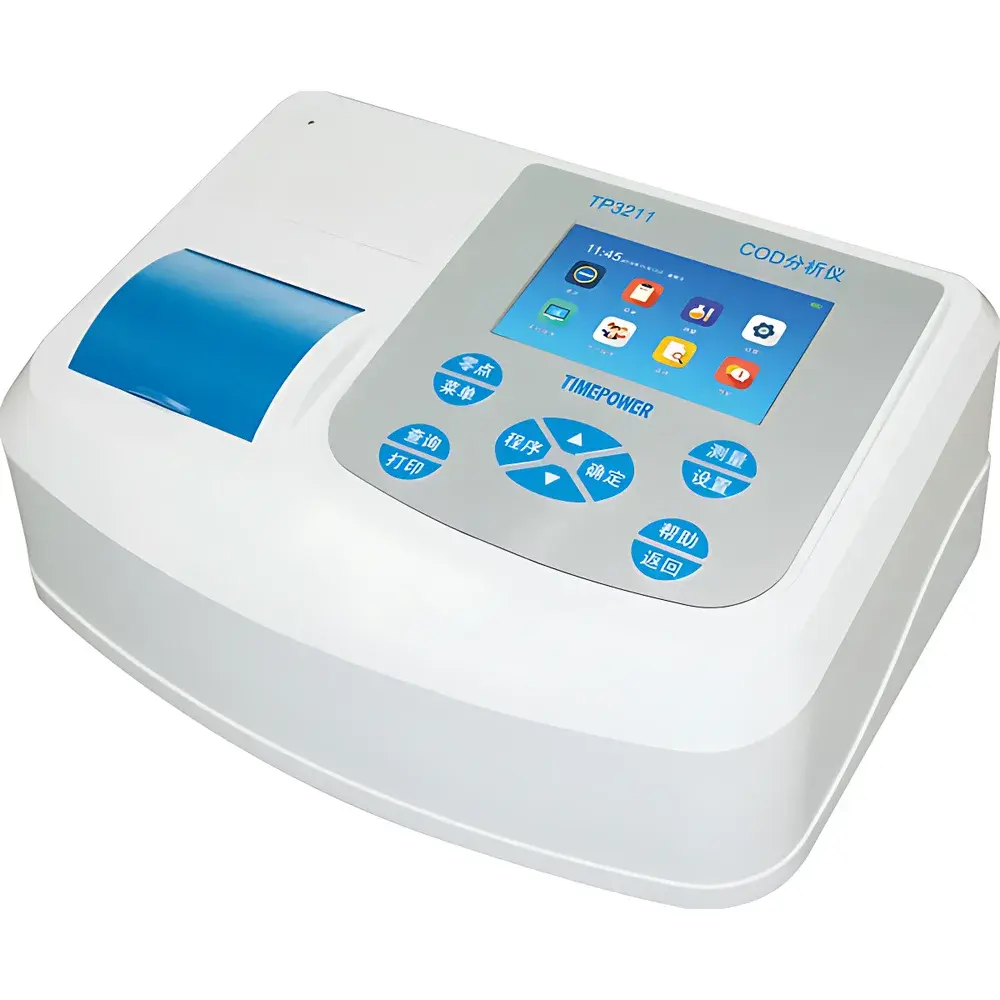
Timepower TP3211 COD Analyzer (Dichromate Method)
| Brand | Timepower |
|---|---|
| Origin | Beijing, China |
| Manufacturer Type | Direct Manufacturer |
| Country of Origin | China |
| Model | TP3211 |
| Measurement Principle | Photometric Colorimetry (K₂Cr₂O₇ Oxidation) |
| Range | 5–2000 mg/L COD |
| Repeatability | ±3% RSD |
| Accuracy | ≤ ±3% of reading (at mid-range), ≤ ±5% F.S. |
| LOD | 0.20 mg/L |
| Resolution | 0.01 mg/L |
| Single-Test Duration | 30 min |
| Chloride Interference Tolerance | ≤ 2000 mg/L Cl⁻ |
| Dimensions | 340 × 250 × 130 mm |
| Weight | 4 kg |
| Power Consumption | <10 W |
| Operating Environment | 5–40 °C, RH ≤85% |
| Power Supply | AC 220 ±22 V, 50 ±0.5 Hz |
Overview
The Timepower TP3211 COD Analyzer is a dedicated photometric instrument engineered for the quantitative determination of Chemical Oxygen Demand (COD) in aqueous samples using the standardized potassium dichromate (Cr⁶⁺) oxidation method—fully compliant with ISO 6060 and HJ 828–2017 (China’s national standard for COD determination). It operates on the fundamental principle of Lambert–Beer law: under controlled optical path length and monochromatic illumination (using stable cold-light LED sources), absorbance at 610 nm correlates linearly with the concentration of Cr³⁺ generated during the acidic dichromate digestion of organic matter. Unlike integrated benchtop systems, the TP3211 adopts a modular architecture—separating the high-temperature digestion unit from the photometric detection module—to eliminate thermal drift in optical alignment and ensure long-term baseline stability. This design significantly enhances measurement reproducibility across extended operational cycles and varying ambient conditions.
Key Features
- Modular dual-unit configuration: Independent high-temperature digestion block (pre-set at 165 °C, 30 min cycle) physically isolated from the optical measurement chamber to prevent thermal lensing and detector thermal noise.
- Cold-light LED photometer with narrow-band interference filter (center wavelength 610 nm ±2 nm) and silicon photodiode detector—engineered for superior photometric stability (<0.5% drift over 8 h).
- Large backlit LCD display (128 × 64 pixels) with intuitive icon-based navigation; supports real-time status feedback, calibration prompts, and error diagnostics.
- Integrated thermal printer for immediate hard-copy output of sample ID, measured value, date/time stamp, and operator code—traceable per GLP requirements.
- USB 2.0 interface compliant with CDC (Communication Device Class) protocol, enabling seamless data export to Windows-based LIMS or Excel without proprietary drivers.
- Pre-programmed calibration curves for low-range (5–150 mg/L) and high-range (150–2000 mg/L) modes, with optional user-defined curve import via USB.
Sample Compatibility & Compliance
The TP3211 accommodates a broad spectrum of environmental and industrial water matrices—including raw surface water, treated effluent, municipal wastewater, and process streams from chemical, pharmaceutical, and food manufacturing facilities. Its chloride tolerance up to 2000 mg/L Cl⁻ enables direct analysis of moderately saline samples without prior masking (e.g., HgSO₄ addition), reducing reagent consumption and procedural complexity. All analytical procedures align with ISO 6060:1989 (Water quality — Determination of chemical oxygen demand), EPA Method 410.4 (COD by Dichromate), and Chinese standard HJ 828–2017. The instrument’s hardware and firmware support audit-trail generation (time-stamped calibration logs, test records, user logins), facilitating compliance with ISO/IEC 17025:2017 laboratory accreditation and internal QA/QC protocols.
Software & Data Management
Data acquisition and reporting are managed via embedded firmware supporting three-tier data integrity: (1) On-device storage retains ≥500 test records with full metadata (sample ID, operator, date/time, range mode, raw absorbance); (2) USB mass-storage mode allows drag-and-drop export of CSV-formatted reports compatible with statistical software (e.g., Minitab, JMP); (3) Optional PC software (supplied on USB drive) provides trend charting, batch report generation, and calibration certificate printing. All stored records include immutable timestamps and are write-protected post-acquisition—meeting foundational requirements for FDA 21 CFR Part 11 electronic record integrity where local regulatory interpretation permits.
Applications
- Regulatory monitoring of discharge compliance under national wastewater permits (e.g., China’s “Discharge Standard of Pollutants for Municipal Wastewater Treatment Plants” GB 18918–2002).
- In-process control of biological treatment efficiency in activated sludge and MBR systems.
- Validation of pretreatment effectiveness for industrial effluents prior to central sewer entry.
- Research-grade COD profiling in limnological and hydrological field studies where portability and ruggedness are essential.
- Quality assurance testing of drinking water source vulnerability assessments (e.g., upstream influent screening).
FAQ
What digestion temperature and time does the TP3211 require for full oxidation?
The integrated digestion module operates at a fixed 165 °C for precisely 30 minutes—validated to achieve ≥95% oxidation efficiency for refractory organics per ISO 6060 Annex B.
Can the instrument automatically correct for chloride interference?
No automatic correction algorithm is implemented; however, the system tolerates chloride concentrations ≤2000 mg/L without significant bias—eliminating the need for mercury sulfate in most municipal and light-industrial applications.
Is the calibration traceable to NIST or equivalent reference materials?
Yes—calibration verification is performed using certified potassium hydrogen phthalate (KHP) standards traceable to NIM (National Institute of Metrology, China) or equivalent national metrology institutes.
Does the device support multi-point calibration with user-defined standards?
Yes—up to five user-entered standard concentrations can be stored and applied for custom curve fitting, with residual error reporting per point.
What maintenance is required for long-term optical stability?
Annual verification of LED intensity and filter transmittance is recommended; no optical alignment or lamp replacement is needed—the cold-light source has a rated lifetime exceeding 10,000 hours.







