
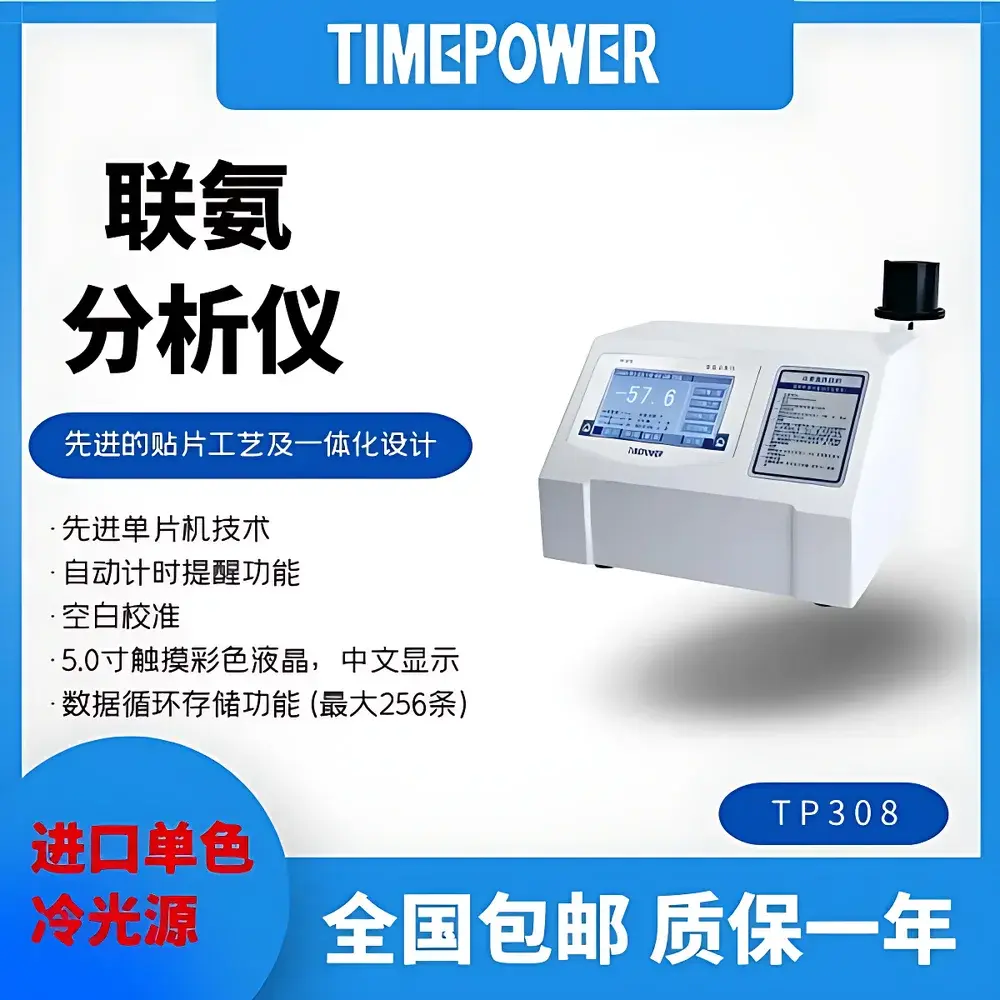
Timepower TP308 Hydrazine Analyzer for Laboratory Water Quality Analysis
| Brand | Timepower |
|---|---|
| Origin | Beijing, China |
| Manufacturer Type | Direct Manufacturer |
| Product Origin | Domestic (China) |
| Model | TP308 |
| Pricing | Available Upon Request |
Overview
The Timepower TP308 Hydrazine Analyzer is a dedicated benchtop photometric instrument engineered for trace-level quantification of hydrazine (N₂H₄) in ultrapure water matrices. It operates on the principle of acid-catalyzed diazo coupling between hydrazine and p-dimethylaminobenzaldehyde (PDAB), forming a stable yellow azo chromophore with maximal absorbance at 455 nm. Quantification follows the Lambert–Beer law, where absorbance (A) is linearly proportional to hydrazine concentration under fixed optical path length and reagent stoichiometry. Designed specifically for power generation and high-purity process industries, the TP308 delivers reliable, operator-independent measurements in boiler feedwater, condensate, steam-cycle makeup water, and critical process streams in pharmaceutical, semiconductor, and fine chemical manufacturing—where hydrazine residual control is mandated per ASTM D129-20 (Standard Test Method for Sulfur in Petroleum Products) and ISO 8573-1 (compressed air purity classes requiring trace contaminant monitoring).
Key Features
- Integrated optoelectronic architecture featuring imported monochromatic cold-light source (LED-based, 455 nm peak emission), ensuring low thermal drift, high signal stability, and extended operational lifetime (>10,000 hours).
- High-density surface-mount PCB design with embedded 32-bit microcontroller unit (MCU), optimized for low-power operation (<30 W) and electromagnetic compatibility (EMC) compliance in industrial laboratory environments.
- 5.0-inch capacitive touchscreen LCD with native Chinese UI; supports real-time graphical display of calibration curves, measurement history, and system diagnostics.
- Automated timing sequence with audible/visual alerts for reaction incubation (standard 10-min acid-PDAB coupling period), eliminating manual stopwatch dependency and reducing inter-operator variability.
- Dual-stage calibration protocol: zero-point compensation via blank calibration (deionized water + reagents) and full-range curve verification using certified hydrazine standards (0–100 µg/L), supporting GLP-aligned documentation practices.
- Circular data buffer storing up to 256 measurement records with timestamp, sample ID, and operator tag; auto-rollover overwrite logic prevents data loss during unattended operation.
Sample Compatibility & Compliance
The TP308 is validated for aqueous samples with conductivity <0.1 µS/cm and total organic carbon (TOC) <50 ppb—conditions typical of Type I ultrapure water per ASTM D1193-20 and ISO 3696:1987. It complies with electrical safety requirements per GB 4793.1–2019 (equivalent to IEC 61010-1) and electromagnetic immunity per GB/T 18268.1–2010 (IEC 61326-1). While not FDA 21 CFR Part 11–certified out-of-the-box, its audit-trail-capable data storage and user-access-controlled calibration functions support alignment with GMP Annex 11 and USP analytical instrument qualification frameworks when deployed within validated laboratory systems.
Software & Data Management
Data export is supported via USB 2.0 interface to standard FAT32-formatted flash drives in CSV format, enabling direct import into LIMS platforms or statistical analysis tools (e.g., JMP, Minitab). The onboard firmware implements secure user role management (administrator/operator modes), password-protected method editing, and immutable event logging—including calibration events, error codes, and power-on self-test results. All stored records retain ISO 8601-compliant timestamps and are non-editable post-acquisition, satisfying basic ALCOA+ (Attributable, Legible, Contemporaneous, Original, Accurate, Complete, Consistent, Enduring, Available) data integrity expectations for regulated environments.
Applications
- Monitoring hydrazine residuals in fossil-fuel and nuclear power plant secondary coolant loops to verify oxygen scavenger dosage efficacy and prevent copper alloy corrosion per EPRI TR-102153 guidelines.
- Verification of hydrazine removal efficiency in mixed-bed ion exchange polishing units serving semiconductor fab UPW distribution systems (SEMI F63-0318).
- Release testing of purified water (PW) and water for injection (WFI) in pharmaceutical facilities where hydrazine may originate from nitro-compound synthesis intermediates or packaging leachables.
- Quality control of high-purity reagent water used in atomic absorption spectroscopy (AAS) and inductively coupled plasma mass spectrometry (ICP-MS) sample preparation, where hydrazine interference can suppress metal ion signals.
FAQ
What is the recommended frequency for blank calibration?
Daily blank calibration is required to compensate for zero drift arising from ambient temperature fluctuations, LED intensity decay, and photodetector baseline shift.
Can the TP308 measure hydrazine in seawater or wastewater matrices?
No—the instrument is validated exclusively for ultrapure water applications; high ionic strength, turbidity, or interfering amines (e.g., methylhydrazine, ethylhydrazine) will compromise specificity and accuracy.
Is PDAB reagent supplied with the analyzer?
No—PDAB reagent, hydrazine standard solutions, and high-purity deionized water must be procured separately per the included reagent specification sheet (ASTM E200-20 compliant grade).
Related Products





