
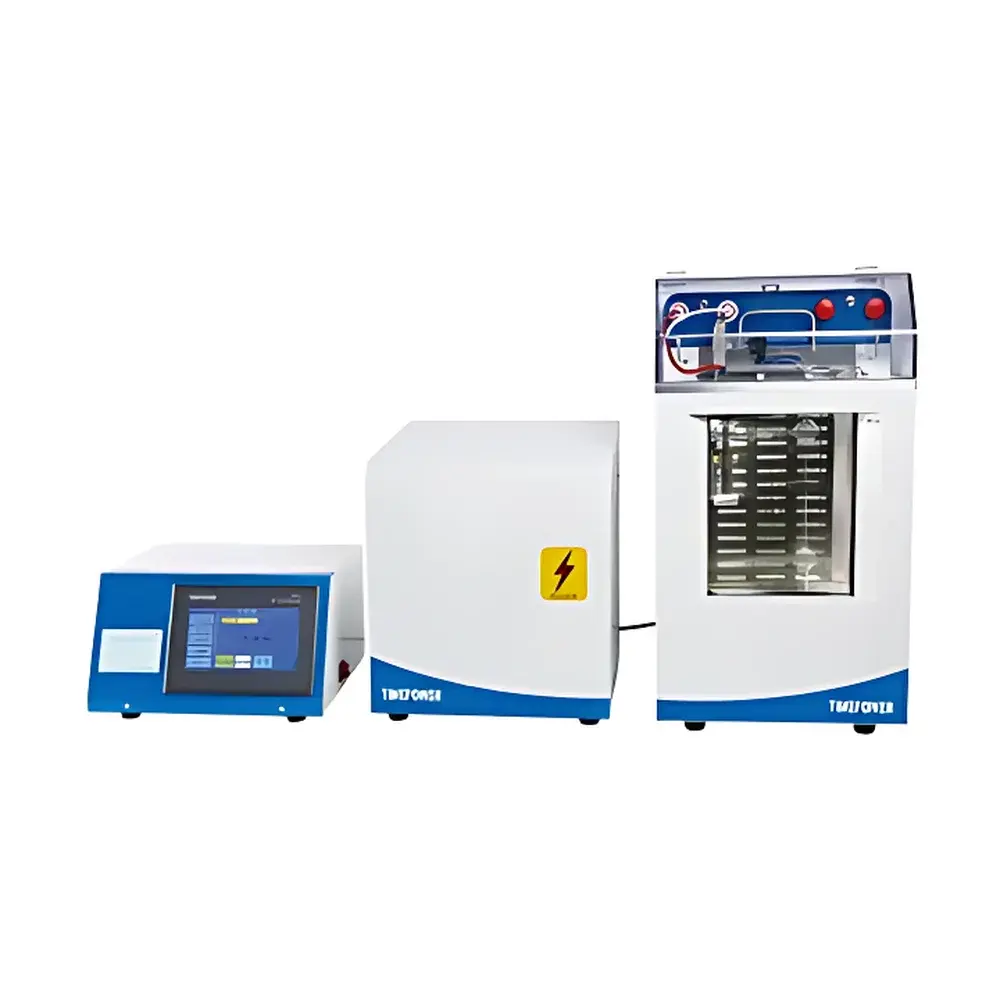
TimePower TP575 Insulating Oil Gassing Tendency Tester
| Brand | TimePower |
|---|---|
| Origin | Beijing, China |
| Manufacturer Type | Direct Manufacturer |
| Country of Origin | China |
| Model | TP575 |
| Pricing | Available Upon Request |
| Display | 7-inch capacitive touchscreen LCD |
| Temperature Control Range | Ambient to 100 °C (standard test at 80 °C ± 0.05 °C) |
| Temperature Resolution | 0.01 °C |
| Test Voltage | 10 kV ± 0.2 kV (resolution: 0.01 kV) |
| Frequency | 50 Hz ± 10% |
| Test Duration Options | 5 min, 10 min, 50 min, 120 min (auto-configured per standard) |
| Timing Accuracy | < ±0.1 s |
| Hydrogen Inlet Pressure | 0.05–0.1 MPa |
| Stirring Speed | 1200 rpm |
| Ambient Operating Conditions | 10–40 °C, RH < 85% |
| Heating Power | ≤1500 W |
| Total Power Consumption | ≤1700 W |
| Dimensions (Controller / HV Generator / Test Unit) | 320×305×195 mm / 320×305×380 mm / 320×305×590 mm |
| Data Storage | 1000 test records |
| Safety Features | Grounding terminal, interlocked safety switch, dry-bath protection |
| Output | Thermal printer (integrated) |
| Compliance | GB/T 11142–1989, NB/SH/T 0810–2010 |
Overview
The TimePower TP575 Insulating Oil Gassing Tendency Tester is an electrometric analytical instrument engineered for the quantitative assessment of gassing behavior in electrical insulating oils under controlled high-voltage, high-temperature, and hydrogen-saturated conditions. It operates on the principle of dielectric discharge-induced gas evolution or absorption at the oil–hydrogen interface, as defined by standardized electrochemical stress protocols. During testing, a pre-dried and hydrogen-saturated oil sample is subjected to a radial electric field generated by a 10 kV, 50 Hz alternating voltage across a precisely dimensioned electrode assembly immersed in the oil bath. The resulting net volume change of hydrogen gas—measured volumetrically via calibrated gas burette—is indicative of the oil’s inherent tendency to either absorb or evolve gas under electrical stress. This parameter is critical for evaluating long-term stability, oxidation resistance, and suitability for use in high-voltage transformers, reactors, and switchgear where gas accumulation may compromise dielectric integrity or trigger protective relay actions.
Key Features
- Integrated 7-inch capacitive touchscreen interface with intuitive navigation, real-time graphical feedback, and embedded procedural flowcharts aligned with GB/T 11142 and NB/SH/T 0810 test sequences
- High-stability temperature control system utilizing imported platinum RTD sensors and PID-driven solid-state thermal modules, achieving ±0.05 °C accuracy at 80 °C with resolution to 0.01 °C
- Dual-stage high-voltage generation architecture delivering stable 10 kV AC output (±0.2 kV tolerance) with ripple suppression and continuous arc detection
- Automated timing logic supporting multiple standard durations (5, 10, 50, and 120 minutes), with microsecond-level quartz-based chronometry (< ±0.1 s deviation)
- Dedicated hydrogen pressure regulation circuit maintaining inlet pressure between 0.05–0.1 MPa, compatible with certified laboratory-grade H2 supply systems
- Mechanically robust stirring mechanism operating at fixed 1200 rpm to ensure uniform thermal and electric field distribution without cavitation or vibration coupling
- Thermal line printer with non-volatile memory buffer, producing permanent, timestamped reports compliant with internal QA documentation requirements
- Comprehensive hardware safety suite including earth-ground verification circuit, bath-empty sensor interlock, emergency power cutoff switch, and insulated HV enclosure with IEC 61010-1 Class II rating
Sample Compatibility & Compliance
The TP575 is validated for use with mineral-based, naphthenic, paraffinic, and synthetic ester insulating oils meeting ASTM D877, D1816, IEC 60296, and GB 2536 specifications. Sample preparation follows strict preconditioning steps: vacuum dehydration to <10 ppm water content, followed by hydrogen saturation under controlled pressure and dwell time. The instrument’s test cell design—comprising borosilicate glass gassing chamber, calibrated 100-mL graduated gas burette, and stainless-steel electrode assembly—ensures reproducible interfacial geometry and minimizes adsorption artifacts. All operational parameters and measurement outputs are traceable to national metrological standards (CNAS-accredited calibration certificates available). The device conforms to GB/T 11142–1989 and NB/SH/T 0810–2010, and its data acquisition architecture supports audit-ready record retention for GLP-compliant laboratories.
Software & Data Management
No external PC dependency is required; all test execution, parameter logging, and result calculation occur onboard. The embedded firmware stores up to 1000 complete test records—including date/time stamp, temperature/voltage profiles, elapsed time, final gas volume, and operator ID—with search-by-date, batch, or keyword functionality. Export options include USB flash drive transfer of CSV-formatted datasets compatible with LIMS integration (e.g., LabWare, STARLIMS). Audit trail functionality logs all user-initiated configuration changes, calibration events, and error flags with immutable timestamps. While not FDA 21 CFR Part 11-certified out-of-the-box, the system architecture supports optional digital signature modules and role-based access control upgrades for regulated environments requiring electronic record validation.
Applications
- Quality assurance of new insulating oils prior to transformer filling
- Condition monitoring of in-service oils during routine maintenance intervals
- Research into antioxidant additive efficacy and degradation kinetics under electrical stress
- Comparative evaluation of alternative base oils (e.g., bio-based esters vs. conventional mineral oils)
- Root-cause analysis of abnormal dissolved gas analysis (DGA) trends indicating incipient fault modes
- Validation of reclamation and regeneration processes for reclaimed transformer oil
FAQ
What safety certifications does the TP575 hold?
The instrument complies with IEC 61010-1:2010 for electrical safety in laboratory equipment and incorporates dual-redundant grounding verification, overtemperature cutoff, and HV interlock mechanisms.
Is hydrogen gas handling training required to operate this instrument?
Yes—users must be trained in compressed gas safety per OSHA 1910.101 and local jurisdictional regulations; hydrogen-specific risk mitigation (leak detection, ventilation, ignition source control) is mandatory.
Can the TP575 be used for oils other than transformer-grade mineral oil?
It is validated for naphthenic, paraffinic, silicone, and synthetic ester insulating fluids per NB/SH/T 0810 scope; performance with non-standard formulations requires method verification per ISO/IEC 17025.
How often does the temperature sensor require recalibration?
Annual calibration against NIST-traceable reference standards is recommended; factory calibration certificate includes uncertainty budget and drift characterization over 0–100 °C.
Does the instrument support remote diagnostics or firmware updates?
Firmware updates are performed via USB; remote diagnostic access is not enabled by default but can be provisioned under signed service agreement with TimePower technical support.






