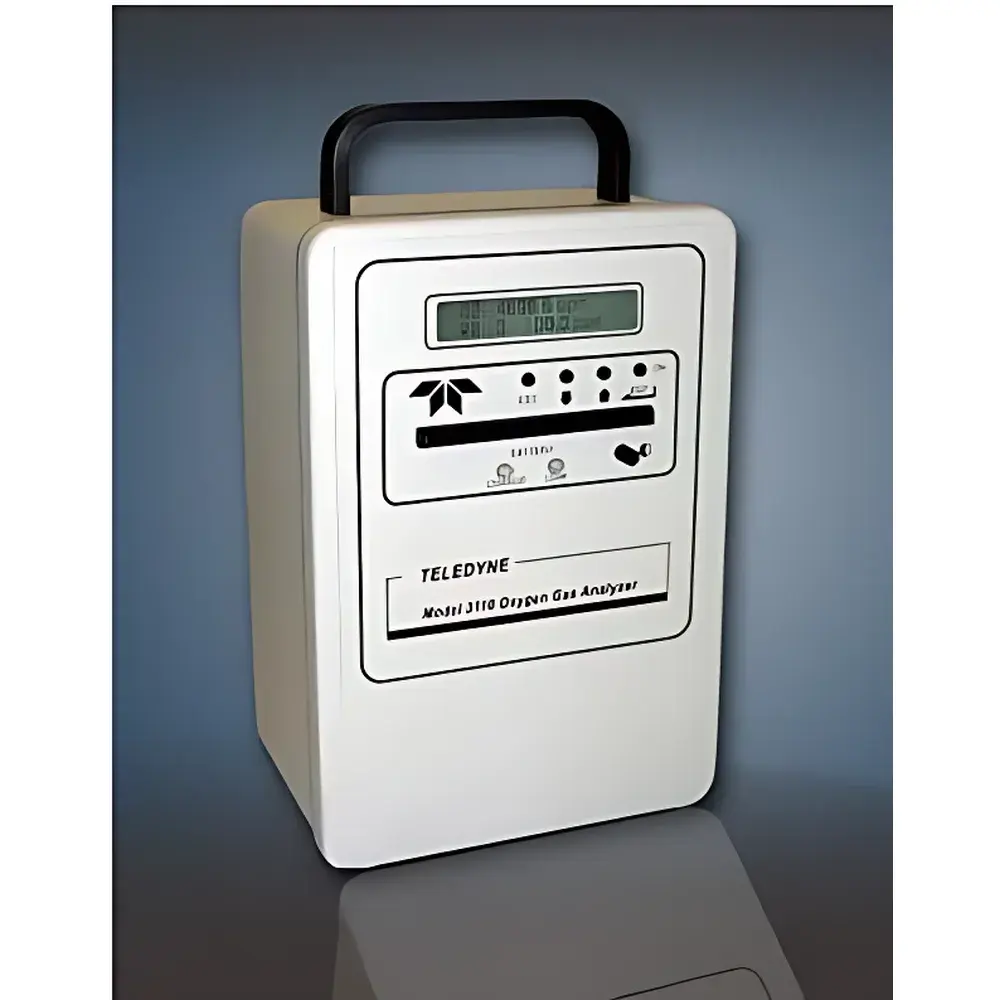
Teledyne 3110 Portable Digital Trace & Percent Oxygen Analyzer
| Brand | Teledyne Cetac |
|---|---|
| Origin | USA |
| Model | 3110 |
| Measurement Range | 0–10 ppm to 0–25% O₂ |
| Output | 0–1 VDC analog |
| Sensor Type | Electrochemical fuel cell (B-2C for trace, B-1 for percent) |
| Response Time | <60 s (trace), <7 s (percent) |
| Operating Temperature | 0–40°C |
| Repeatability | ±1% of reading |
| Power | Rechargeable NiCd battery (>100 h per charge, 5-year service life) + AC adapter (110/220 VAC, 50/60 Hz) |
| Weight | 2.71 kg (6 lbs) |
| Certifications | FM/FMc Class I Div 1 Groups A–D T6, ATEX Ex ia IIC T3, CE marked |
| Ingress Protection | Not specified |
| Data Logging | Integrated |
| Safety Rating | Intrinsically safe |
Overview
The Teledyne 3110 Portable Digital Trace & Percent Oxygen Analyzer is a field-deployable electrochemical analyzer engineered for high-fidelity oxygen quantification across dual concentration domains—from sub-part-per-million (ppm) trace levels up to 25% volume/volume (v/v) in gas-phase process streams. It employs a temperature-stabilized, solid-polymer electrolyte fuel cell sensor architecture—specifically the B-2C sensor for trace-range detection (0–10 ppm) and the B-1 sensor for percent-range applications (0–25% O₂)—delivering stable, drift-free measurements without requiring external calibration gases under routine operation. Designed for compliance-critical environments including semiconductor fabrication, inert gas purging validation, catalyst protection monitoring, and nuclear fuel handling, the instrument operates on the principle of galvanic oxygen reduction, where O₂ diffusion through a selective membrane drives a current proportional to partial pressure. Its intrinsically safe construction enables deployment in hazardous locations classified under FM/FMc Class I Division 1 Groups A–D T6 and ATEX Ex ia IIC T3, making it suitable for use in hydrocarbon processing, ethylene monomer handling, and glovebox integrity verification.
Key Features
- Intrinsically safe design certified to FM/FMc Class I Div 1 Groups A–D T6 and ATEX Ex ia IIC T3 for deployment in flammable atmospheres.
- Dual-range capability: interchangeable or factory-configured sensors support seamless transition between trace (0–10 ppm) and percent-level (0–25% O₂) measurement without hardware modification.
- Electrochemical fuel cell sensor with solid polymer electrolyte ensures zero-zero drift, no warm-up time, and immunity to CO₂, H₂S, or hydrocarbon interference typical of paramagnetic or zirconia-based analyzers.
- Integrated data logging with timestamped records stored onboard; exportable via USB or analog 0–1 VDC output compatible with PLCs, DCS systems, and SCADA interfaces.
- Rechargeable NiCd battery delivering >100 hours of continuous operation per full charge, with an expected service life of five years under normal field conditions.
- Compact, ergonomic housing (2.71 kg) with backlit LCD display, intuitive menu navigation, and real-time unit switching (ppm, %, µmol/mol) for multi-user operational flexibility.
Sample Compatibility & Compliance
The Teledyne 3110 is validated for direct sampling of dry, non-corrosive gas matrices including nitrogen, argon, helium, hydrogen, natural gas, ethylene, propylene, vinyl chloride, and butadiene. It is not recommended for use in condensing, acidic, or solvent-saturated streams without appropriate sample conditioning (e.g., particulate filtration, moisture removal). The analyzer meets CE marking requirements and supports quality assurance protocols aligned with ISO 9001, ASTM D6866 (for biogenic content verification), and USP for residual oxygen testing in pharmaceutical inerting. Its intrinsic safety certification satisfies OSHA 1910.307 and IEC 60079-11 standards for hazardous area instrumentation. While not FDA 21 CFR Part 11–compliant out-of-the-box, audit-trail-capable data export enables integration into validated GMP/GLP workflows when paired with compliant LIMS or electronic lab notebook platforms.
Software & Data Management
The 3110 operates independently without host software but supports configuration and data retrieval via Teledyne’s proprietary PC utility (Windows-compatible, USB interface). Logged data includes date/time stamp, measured O₂ concentration, sensor status flag (e.g., low battery, sensor saturation), and ambient temperature. All records are stored in CSV format for import into statistical process control (SPC) tools such as Minitab or JMP. The 0–1 VDC analog output is scalable and linear across user-defined ranges, enabling direct connection to distributed control systems without signal conditioning. Firmware updates are performed via USB; version history and calibration event logs are retained in non-volatile memory to support regulatory traceability.
Applications
- Residual oxygen monitoring in semiconductor process tool purge cycles and nitrogen blanketing of wafer fabrication chambers.
- Leak detection in inerted gloveboxes, piping networks, and reactor vessels using rapid-response trace O₂ rise detection.
- Catalyst protection in petrochemical reformers and hydrotreaters by verifying O₂ ingress below 1 ppm thresholds.
- Purity certification of industrial gases (e.g., high-purity N₂, Ar) per ISO 8573-1 Class 1 requirements.
- Thermal process atmosphere control during brazing, annealing, and sintering where O₂-induced oxidation must remain <10 ppm.
- Off-gas analysis in chemical synthesis reactors and headspace O₂ profiling in polymerization vessels for kinetic modeling.
FAQ
What sensor technologies are supported by the 3110 platform?
The 3110 accommodates two electrochemical fuel cell variants: the B-2C sensor for trace-range detection (0–10 ppm) and the B-1 sensor for percent-range applications (0–25% O₂). Both utilize solid-polymer electrolyte membranes and require no external power for sensing.
Is periodic calibration required?
While the fuel cell exhibits excellent long-term stability, Teledyne recommends a zero/span verification every 3–6 months using certified standard gases (e.g., 0 ppm N₂ balance and 1–5% O₂ in N₂) to maintain traceability under ISO/IEC 17025-accredited QA programs.
Can the 3110 be used in explosive atmospheres?
Yes—the instrument carries FM/FMc Class I Division 1 Groups A–D T6 and ATEX Ex ia IIC T3 certifications, permitting use in Zone 0/1 and Division 1 hazardous locations where flammable vapors or gases may be present.
Does the device support battery-powered operation in remote field locations?
Yes—its rechargeable NiCd battery provides over 100 hours of continuous measurement, with a rated service life of five years. An AC adapter (110/220 VAC, 50/60 Hz) is included for benchtop recharging.
How is data integrity ensured during extended logging sessions?
All logged entries include UTC timestamps, sensor health indicators, and checksum-verified storage in non-volatile flash memory—enabling forensic reconstruction of measurement history during regulatory audits or failure investigations.
Related Products